
Pulp Fiction, 1887 · page 329 of 399
The Argosy — page 329: what you’re looking at
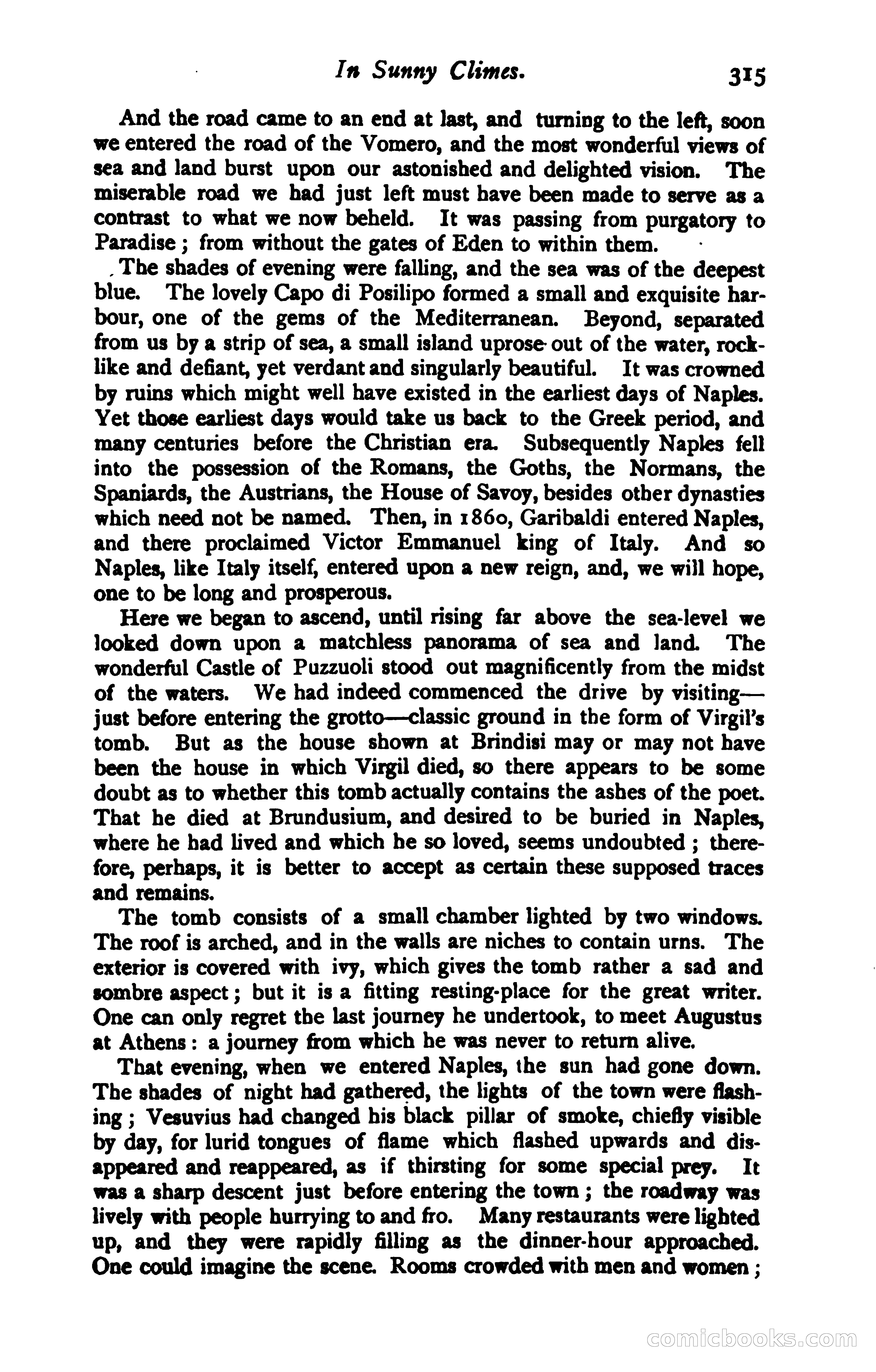
A restored page from Pulp Fiction, 1887. Page through the whole issue in the reader above.
📄 Transcribed text from this page (OCR, searchable)
Machine-transcribed from the original scan — historical spelling and the odd misread are preserved.
In Sunny Climes. 315 And the road came to an end at last, and turning to the left, soon we entered the road of the Vomero, and the most wonderful views of sea and land burst upon our astonished and delighted vision. The miserable road we had just left must have been made to serve as a contrast to what we now beheld. It was passing from purgatory to Paradise ; from without the gates of Eden to within them. __- _ The shades of evening were falling, and the sea was of the deepest blue. The lovely Capo di Posilipo formed a small and exquisite har- bour, one of the gems of the Mediterranean. Beyond, separated from us by a strip of sea, a small island uprose out of the water, rock- like and defiant, yet verdant and singularly beautiful. It was crowned by ruins which might well have existed in the earliest days of Naples. Yet those earliest days would take us back to the Greek period, and many centuries before the Christian era. Subsequently Naples fell into the possession of the Romans, the Goths, the Normans, the Spaniards, the Austrians, the House of Savoy, besides other dynasties which need not be named. Then, in 1860, Garibaldi entered Naples, and there proclaimed Victor Emmanuel king of Italy. And so Naples, like Italy itself, entered upon a new reign, and, we will hope, one to be long and prosperous. Here we began to ascend, until rising far above the sea-level we looked down upon a matchless panorama of sea and land. The wonderful Castle of Puzzuoli stood out magnificently from the midst of the waters. We had indeed commenced the drive by visiting— just before entering the grotto—classic ground in the form of Virgil’s tomb. But as the house shown at Brindisi may or may not have been the house in which Virgil died, so there appears to be some doubt as to whether this tomb actually contains the ashes of the poet. That he died at Brundusium, and desired to be buried in Naples, where he had lived and which he so loved, seems undoubted ; there- fore, perhaps, it is better to accept as certain these supposed traces and remains. The tomb consists of a small chamber lighted by two windows. The roof is arched, and in the walls are niches to contain urns. The exterior is covered with ivy, which gives the tomb rather a sad and sombre aspect ; but it is a fitting resting-place for the great writer. One can only regret the last journey he undertook, to meet Augustus at Athens: a journey from which he was never to return alive. That evening, when we entered Naples, the sun had gone down. The shades of night had gathered, the lights of the town were flash- ing ; Vesuvius had changed his black pillar of smoke, chiefly visible by day, for lurid tongues of flame which flashed upwards and dis- appeared and reappeared, as if thirsting for some special prey. It was a sharp descent just before entering the town; the roadway was lively with people hurrying to and fro. Many restaurants were lighted up, and they were rapidly filling as the dinner-hour approached. One could imagine the scene. Rooms crowded with men and women ; EOMRRIC OOO SS (GO) i