
Pulp Fiction, 1901 · page 60 of 400
The Argosy — page 60: what you’re looking at
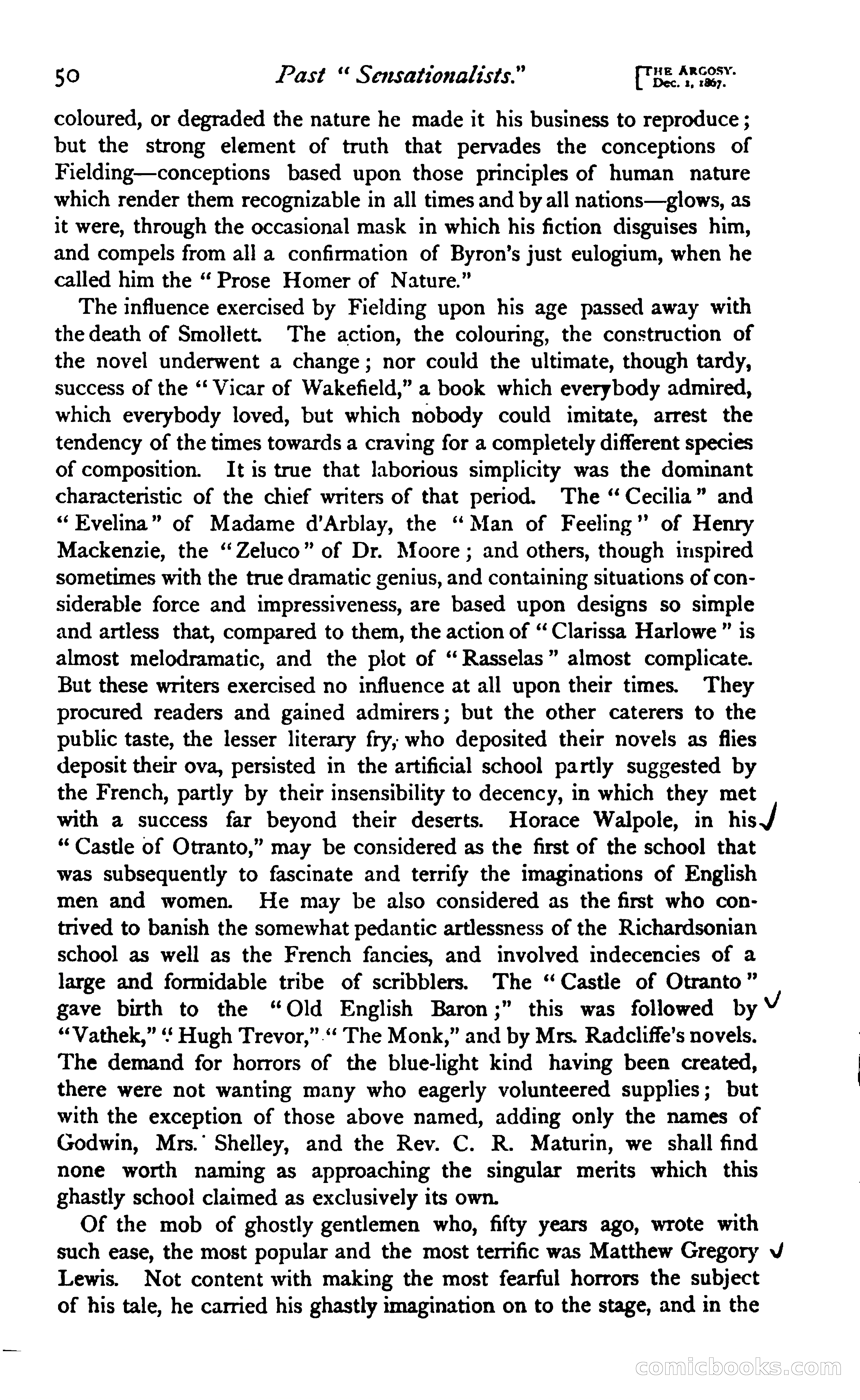
A restored page from Pulp Fiction, 1901. Page through the whole issue in the reader above.
📄 Transcribed text from this page (OCR, searchable)
Machine-transcribed from the original scan — historical spelling and the odd misread are preserved.
50 Past “ Sensationalists.” pipe sacar. coloured, or degraded the nature he made it his business to reproduce ; but the strong element of truth that pervades the conceptions of Fielding—conceptions based upon those principles of human nature which render them recognizable in all times and by all nations—glows, as it were, through the occasional mask in which his fiction disguises him, and compels from all a confirmation of Byron’s just eulogium, when he called him the “ Prose Homer of Nature.” The influence exercised by Fielding upon his age passed away with the death of Smollett. The action, the colouring, the construction of the novel underwent a change; nor could the ultimate, though tardy, success of the ‘‘ Vicar of Wakefield,” a book which everybody admired, which everybody loved, but which nobody could imitate, arrest the tendency of the times towards a craving for a completely different species of composition. It is true that laborious simplicity was the dominant characteristic of the chief writers of that period. The “ Cecilia” and “Evelina” of Madame d’Arblay, the “Man of Feeling” of Henry Mackenzie, the “ Zeluco” of Dr. Moore; and others, though imspired sometimes with the true dramatic genius, and containing situations of con- siderable force and impressiveness, are based upon designs so simple and artless that, compared to them, the action of “Clarissa Harlowe ” is almost melodramatic, and the plot of ‘‘ Rasselas” almost complicate. But these writers exercised no influence at all upon their times. They procured readers and gained admirers; but the other caterers to the public taste, the lesser literary fry, who deposited their novels as flies deposit their ova, persisted in the artificial school partly suggested by the French, partly by their insensibility to decency, in which they met with a success far beyond their deserts. Horace Walpole, in his “Castle of Otranto,” may be considered as the first of the school that was subsequently to fascinate and terrnfy the imaginations of English men and women. He may be also considered as the first who con- trived to banish the somewhat pedantic artlessness of the Richardsonian school as well as the French fancies, and involved indecencies of a large and formidable tribe of scnbblers. The “ Castle of Otranto ” gave birth to the “Old English Baron;” this was followed by v ‘““Vathek,” “ Hugh Trevor,”.“‘ The Monk,” and by Mrs. Radcliffe’s novels. The demand for horrors of the blue-light kind having been created, there were not wanting many who eagerly volunteered supplies; but with the exception of those above named, adding only the names of Godwin, Mrs.’ Shelley, and the Rev. C. R. Maturin, we shall find none worth naming as approaching the singular ments which this ghastly school claimed as exclusively its own. Of the mob of ghostly gentlemen who, fifty years ago, wrote with such ease, the most popular and the most ternfic was Matthew Gregory Vv Lewis. Not content with making the most fearful horrors the subject of his tale, he carried his ghastly imagination on to the stage, and in the comicaocks (GO)