
Pulp Fiction, 1901 · page 59 of 400
The Argosy — page 59: what you’re looking at
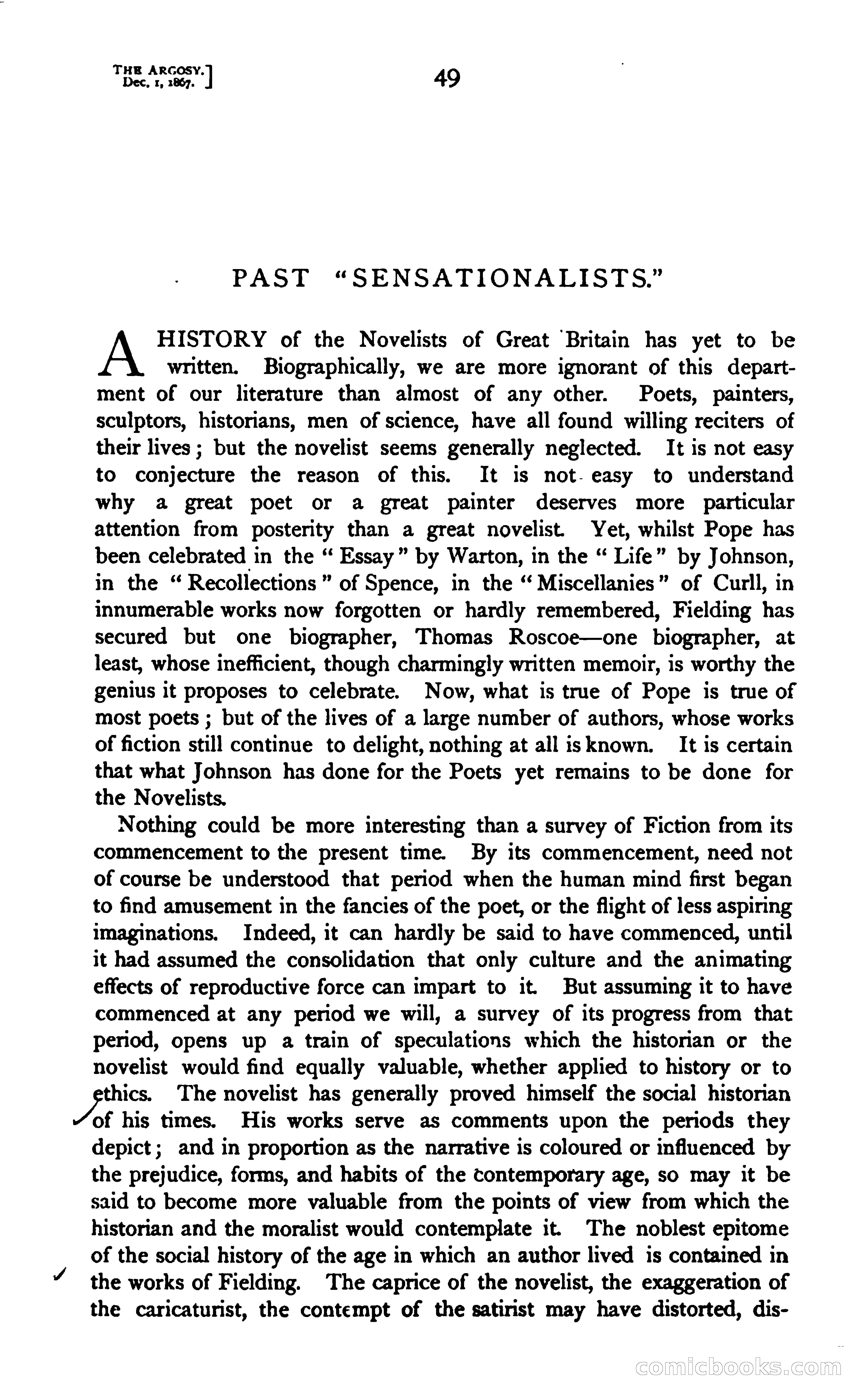
A restored page from Pulp Fiction, 1901. Page through the whole issue in the reader above.
📄 Transcribed text from this page (OCR, searchable)
Machine-transcribed from the original scan — historical spelling and the odd misread are preserved.
/ THE ARGOSY. PAST “SENSATIONALISTS.” HISTORY of the Novelists of Great Britain has yet to be written. Biographically, we are more ignorant of this depart- ment of our literature than almost of any other. Poets, painters, sculptors, historians, men of science, have all found willing reciters of their lives ; but the novelist seems generally neglected. It is not easy to conjecture the reason of this. It is not. easy to understand why a great poet or a great painter deserves more particular attention from posterity than a great novelist. Yet, whilst Pope has been celebrated in the “ Essay” by Warton, in the “ Life” by Johnson, in the “ Recollections ” of Spence, in the “ Miscellanies” of Curll, in innumerable works now forgotten or hardly remembered, Fielding has secured but one biographer, Thomas Roscoe—one biographer, at least, whose inefficient, though charmingly written memoir, is worthy the genius it proposes to celebrate. Now, what is true of Pope is true of most poets ; but of the lives of a large number of authors, whose works It 1s certain that what Johnson has done for the Poets yet remains to be done for of fiction still continue to delight, nothing at all is known. the Novelists. Nothing could be more interesting than a survey of Fiction from its commencement to the present time. By its commencement, need not of course be understood that period when the human mind first began to find amusement in the fancies of the poet, or the flight of less aspiring Imaginations. Indeed, it can hardly be said to have commenced, until it had assumed the consolidation that only culture and the animating effects of reproductive force can impart to it. But assuming it to have commenced at any period we will, a survey of its progress from that period, opens up a train of speculations which the histonan or the novelist would find equally valuable, whether applied to history or to thics. The novelist has generally proved himself the social historian of his times. His works serve as comments upon the periods they depict; and in proportion as the narrative is coloured or influenced by the prejudice, forms, and habits of the contemporary age, so may it be said to become more valuable from the points of view from which the historian and the moralist would contemplate it. The noblest epitome of the social history of the age in which an author lived is contained in the works of Fielding. The caprice of the novelist, the exaggeration of the caricaturist, the contempt of the satirist may have distorted, dis- GO) mn G OOO) <S (GO)