
Pulp Fiction, 1901 · page 56 of 400
The Argosy — page 56: what you’re looking at
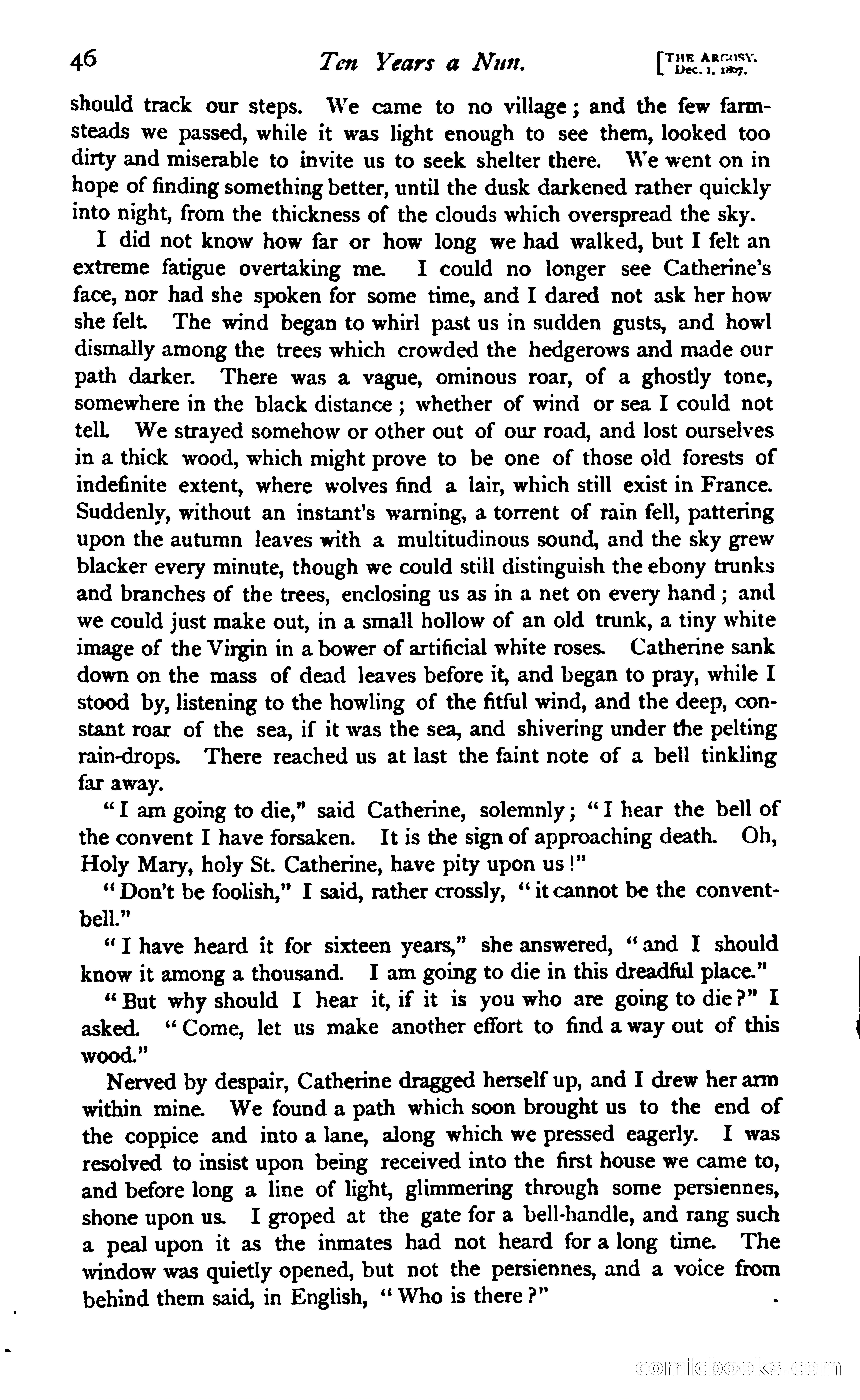
A restored page from Pulp Fiction, 1901. Page through the whole issue in the reader above.
📄 Transcribed text from this page (OCR, searchable)
Machine-transcribed from the original scan — historical spelling and the odd misread are preserved.
46 Ten Years a Nun. THE ARGOSY, Dec. 1, 1807, should track our steps. We came to no village; and the few farm- Steads we passed, while it was light enough to see them, looked too dirty and miserable to invite us to seek shelter there. We went on in hope of finding something better, until the dusk darkened rather quickly into night, from the thickness of the clouds which overspread the sky. I did not know how far or how long we had walked, but I felt an extreme fatigue overtaking me. I could no longer see Catherine's face, nor had she spoken for some time, and I dared not ask her how she felt. The wind began to whirl past us in sudden gusts, and howl dismally among the trees which crowded the hedgerows and made our path darker. There was a vague, ominous roar, of a ghostly tone, somewhere in the black distance ; whether of wind or sea I could not tell. We strayed somehow or other out of our road, and lost ourselves in a thick wood, which might prove to be one of those old forests of indefinite extent, where wolves find a lair, which still exist in France. Suddenly, without an instant’s warning, a torrent of rain fell, patterning upon the autumn leaves with a multitudinous sound, and the sky grew blacker every minute, though we could still distinguish the ebony trunks and branches of the trees, enclosing us as in a net on every hand ; and we could just make out, in a small hollow of an old trunk, a tiny white image of the Virgin in a bower of artificial white roses. Catherine sank down on the mass of dead leaves before it, and began to pray, while I stood by, listening to the howling of the fitful wind, and the deep, con- stant roar of the sea, if it was the sea, and shivering under the pelting rain-drops. There reached us at last the faint note of a bell tinkling far away. “T am going to die,” said Catherine, solemnly; “I hear the bell of the convent I have forsaken. It is the sign of approaching death. Oh, Holy Mary, holy St. Catherine, have pity upon us!” ‘Don’t be foolish,” I said, rather crossly, ‘‘it cannot be the convent- bell.” “T have heard it for sixteen years,” she answered, “and I should know it among a thousand. I am going to die in this dreadful place.” ‘But why should I hear it, if it is you who are going to die?” I asked. ‘‘Come, let us make another effort to find a way out of this wood.” Nerved by despair, Catherine dragged herself up, and I drew her arm within mine. We found a path which soon brought us to the end of the coppice and into a lane, along which we pressed eagerly. I was resolved to insist upon being received into the first house we came to, and before long a line of light, glimmering through some persiennes, shone upon us. I groped at the gate for a bell-handle, and rang such a peal upon it as the inmates had not heard fora long time. The window was quietly opened, but not the persiennes, and a voice from behind them said, in English, ‘‘ Who is there ?” ECOMniclooolkks @ (GO)