
Pulp Fiction, 1901 · page 55 of 400
The Argosy — page 55: what you’re looking at
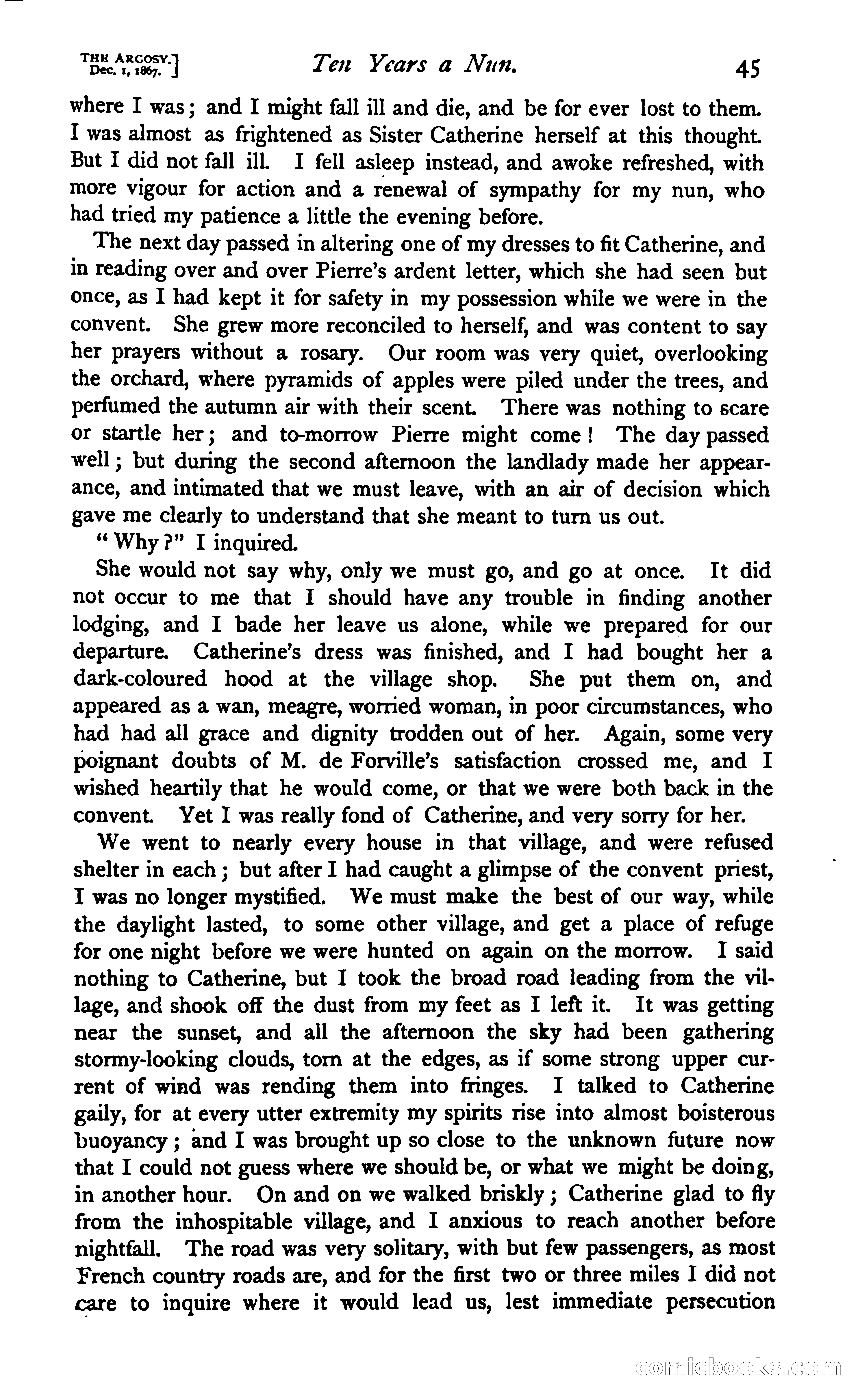
A restored page from Pulp Fiction, 1901. Page through the whole issue in the reader above.
📄 Transcribed text from this page (OCR, searchable)
Machine-transcribed from the original scan — historical spelling and the odd misread are preserved.
“Bec caer Ten Years a Nun. 45 where I was; and I might fall ill and die, and be for ever lost to them. I was almost as frightened as Sister Catherine herself at this thought. But I did not fall ill. I fell asleep instead, and awoke refreshed, with more vigour for action and a renewal of sympathy for my nun, who had tried my patience a little the evening before. The next day passed in altering one of my dresses to fit Catherine, and in reading over and over Pierre’s ardent letter, which she had seen but once, as I had kept it for safety in my possession while we were in the convent. She grew more reconciled to herself, and was content to say her prayers without a rosary. Our room was very quiet, overlooking the orchard, where pyramids of apples were piled under the trees, and perfumed the autumn air with their scent. There was nothing to scare or startle her; and to-morrow Pierre might come! The day passed well; but during the second afternoon the landlady made her appear- ance, and intimated that we must leave, with an air of decision which gave me clearly to understand that she meant to turn us out. ‘’ Why ?” T inquired. She would not say why, only we must go, and go at once. It did not occur to me that I should have any trouble in finding another lodging, and I bade her leave us alone, while we prepared for our departure. Catherine’s dress was finished, and I had bought her a dark-coloured hood at the village shop. She put them on, and appeared as a wan, meagre, worried woman, in poor circumstances, who had had all grace and dignity trodden out of her. Again, some very poignant doubts of M. de Forville’s satisfaction crossed me, and I wished heartily that he would come, or that we were both back in the convent. Yet I was really fond of Catherine, and very sorry for her. We went to nearly every house in that village, and were refused shelter in each ; but after I had caught a glimpse of the convent pnriest, I was no longer mystified. We must make the best of our way, while the daylight lasted, to some other village, and get a place of refuge for one night before we were hunted on again on the morrow. I said nothing to Catherine, but I took the broad road leading from the vil- lage, and shook off the dust from my feet as I left it. It was getting near the sunset, and all the afternoon the sky had been gathering stormy-looking clouds, torn at the edges, as if some strong upper cur- rent of wind was rending them into fmnges. I talked to Catherine gaily, for at every utter extremity my spirits mse into almost boisterous buoyancy ; and I was brought up so close to the unknown future now that I could not guess where we should be, or what we might be doing, in another hour. On and on we walked briskly ; Catherine glad to fly from the inhospitable village, and I anxious to reach another before nightfall. The road was very solitary, with but few passengers, as most French country roads are, and for the first two or three miles I did not care to inquire where it would lead us, lest immediate persecution ECOMniclooolkks G (GO)