
Pulp Fiction, 1901 · page 340 of 400
The Argosy — page 340: what you’re looking at
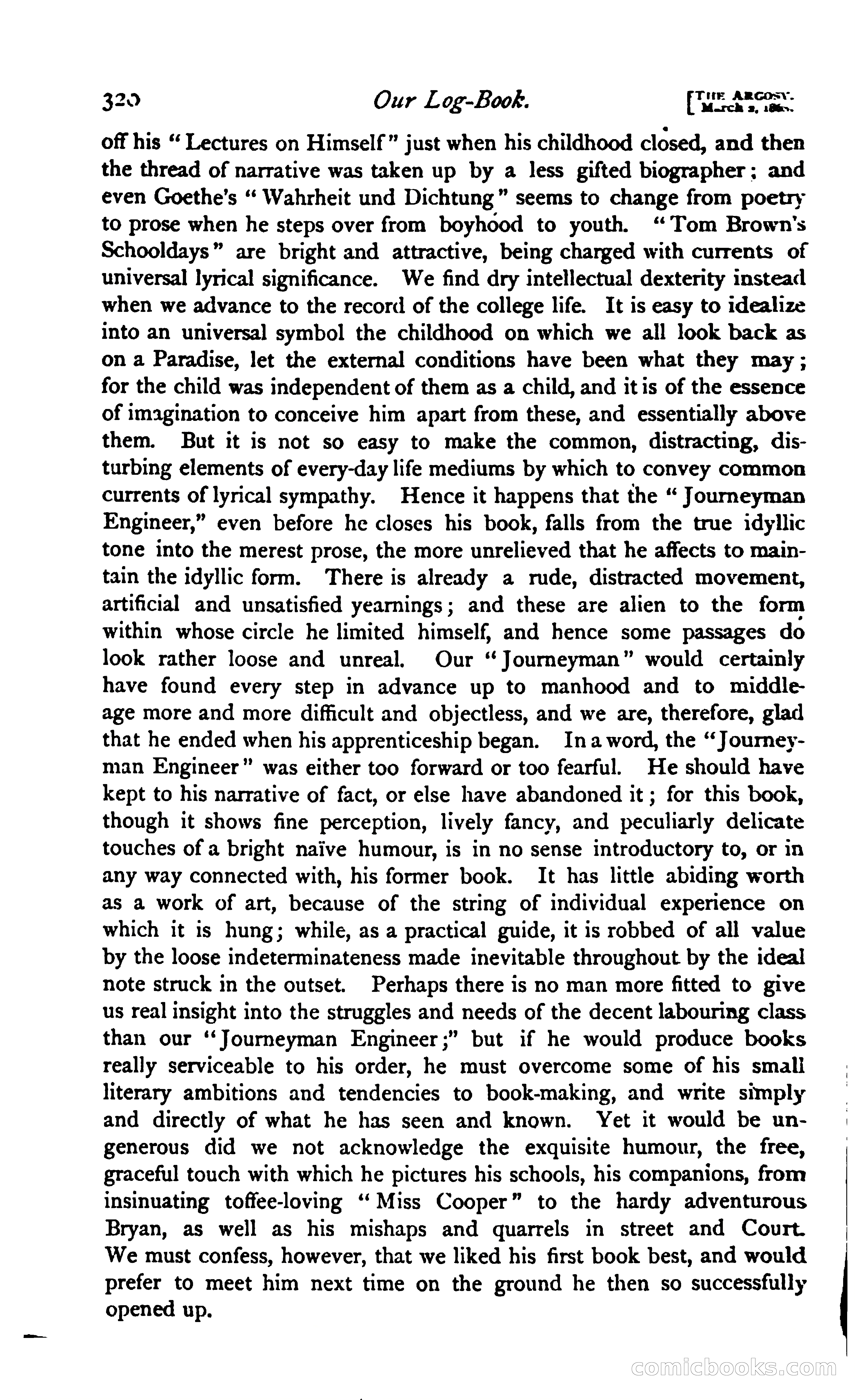
A restored page from Pulp Fiction, 1901. Page through the whole issue in the reader above.
📄 Transcribed text from this page (OCR, searchable)
Machine-transcribed from the original scan — historical spelling and the odd misread are preserved.
320 Our Log-Book. "March 3, 16m. off his “‘ Lectures on Himself” just when his childhood closed, and then the thread of narrative was taken up by a less gifted biographer; and even Goethe’s “ Wahrheit und Dichtung” seems to change from poetry to prose when he steps over from boyhood to youth. “Tom Brown's Schooldays” are bright and attractive, being charged with currents of universal lyrical significance. We find dry intellectual dexterity instead when we advance to the record of the college life. It 1s easy to idealize into an universal symbol the childhood on which we all look back as on a Paradise, let the external conditions have been what they may ; for the child was independent of them as a child, and itis of the essence of imagination to conceive him apart from these, and essentially above them. But it is not so easy to make the common, distracting, dis- turbing elements of every-day life mediums by which to convey common currents of lyrical sympathy. Hence it happens that the “ Journeyman Engineer,” even before he closes his book, falls from the true idyllic tone into the merest prose, the more unrelieved that he affects to main- tain the idyllic form. There is already a rude, distracted movement, artificial and unsatisfied yearnings; and these are alien to the form within whose circle he limited himself, and hence some passages do look rather loose and unreal. Our “Journeyman” would certainly have found every step in advance up to manhood and to middle- age more and more difficult and objectless, and we are, therefore, glad that he ended when his apprenticeship began. Ina word, the “Journey- man Engineer” was either too forward or too fearful. He should have kept to his narrative of fact, or else have abandoned it; for this book, though it shows fine perception, lively fancy, and peculiarly delicate touches of a bright naive humour, is in no sense introductory to, or in any way connected with, his former book. It has little abiding worth as a work of art, because of the string of individual experience on which it 1s hung; while, as a practical guide, it is robbed of all value by the loose indeterminateness made inevitable throughout by the ideal note struck in the outset. Perhaps there is no man more fitted to give us real insight into the struggles and needs of the decent labouring class than our ‘‘Journeyman Engineer ;” but if he would produce books really serviceable to his order, he must overcome some of his small literary ambitions and tendencies to book-making, and write simply and directly of what he has seen and known. Yet it would be un- generous did we not acknowledge the exquisite humour, the free, graceful touch with which he pictures his schools, his companions, from insinuating toffee-loving ‘‘ Miss Cooper” to the hardy adventurous Bryan, as well as his mishaps and quarrels in street and Court. We must confess, however, that we liked his first book best, and would prefer to meet him next time on the ground he then so successfully opened up. COMIC OOOKS. EO mn _