
Pulp Fiction, 1901 · page 339 of 400
The Argosy — page 339: what you’re looking at
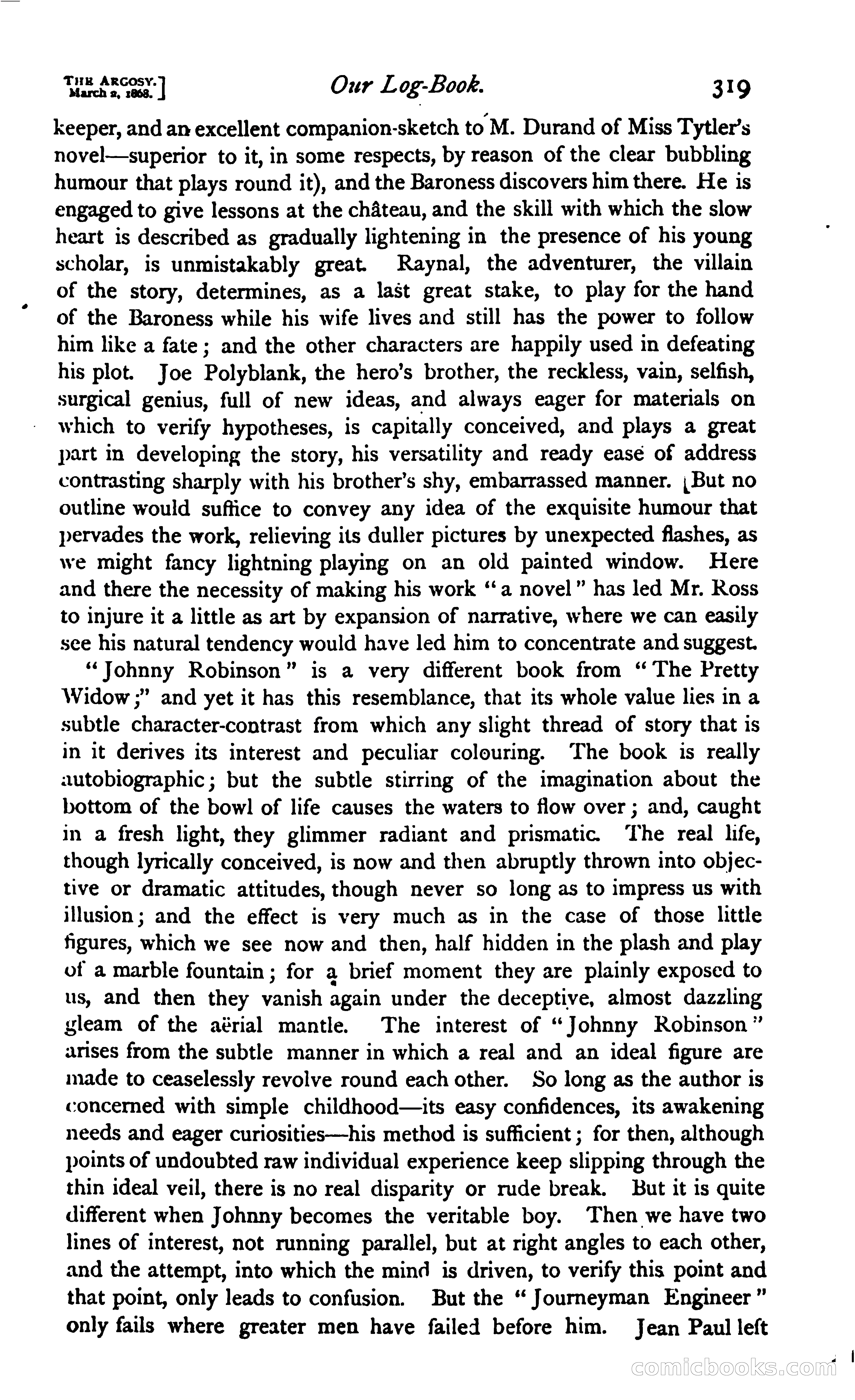
A restored page from Pulp Fiction, 1901. Page through the whole issue in the reader above.
📄 Transcribed text from this page (OCR, searchable)
Machine-transcribed from the original scan — historical spelling and the odd misread are preserved.
THR ARCOSY.} Our Log-Book. 319 keeper, and an excellent companion-sketch to M. Durand of Miss Tytler’s novel—superior to it, in some respects, by reason of the clear bubbling humour that plays round it), and the Baroness discovers him there. He is engaged to give lessons at the chateau, and the skill with which the slow heart is described as gradually lightening in the presence of his young scholar, is unmistakably great. Raynal, the adventurer, the villain of the story, determines, as a last great stake, to play for the hand of the Baroness while his wife lives and still has the power to follow him like a fate; and the other characters are happily used in defeating his plot. Joe Polyblank, the hero’s brother, the reckless, vain, selfish, surgical genius, full of new ideas, and always eager for materials on which to verify hypotheses, is capitally conceived, and plays a great part in developing the story, his versatility and ready easé of address contrasting sharply with his brother’s shy, embarrassed manner. , But no outline would suffice to convey any idea of the exquisite humour that pervades the work, relieving its duller pictures by unexpected flashes, as we might fancy lightning playing on an old painted window. Here and there the necessity of making his work “a novel” has led Mr. Ross to injure it a little as art by expansion of narrative, where we can easily see his natural tendency would have led him to concentrate and suggest. ‘“Johnny Robinson” is a very different book from ‘ The Pretty Widow ;” and yet it has this resemblance, that its whole value lies in a subtle character-contrast from which any slight thread of story that is in it derives its interest and peculiar colouring. ‘The book is really autobiographic; but the subtle stirring of the imagination about the bottom of the bowl of life causes the waters to flow over ; and, caught in a fresh light, they glimmer radiant and prismatic. The real life, though lyrically conceived, is now and then abruptly thrown into objec- tive or dramatic attitudes, though never so long as to impress us with illusion; and the effect is very much as in the case of those little figures, which we see now and then, half hidden in the plash and play of a marble fountain ; for a brief moment they are plainly exposed to us, and then they vanish again under the deceptive, almost dazzling yleam of the aérial mantle. The interest of “Johnny Robinson” arises from the subtle manner in which a real and an ideal figure are made to ceaselessly revolve round each other. So long as the author is concemed with simple childhood—its easy confidences, its awakening needs and eager curiosities—his method is sufficient ; for then, although points of undoubted raw individual experience keep slipping through the thin ideal veil, there is no real disparity or rude break. But it is quite different when Johnny becomes the veritable boy. Then we have two lines of interest, not running parallel, but at right angles to each other, and the attempt, into which the mind is driven, to verify this point and that point, only leads to confusion. But the “ Journeyman Engineer ” only fails where greater men have failed before him. Jean Paul left comicloooks (CO) _ ml