
Pulp Fiction, 1901 · page 145 of 400
The Argosy — page 145: what you’re looking at
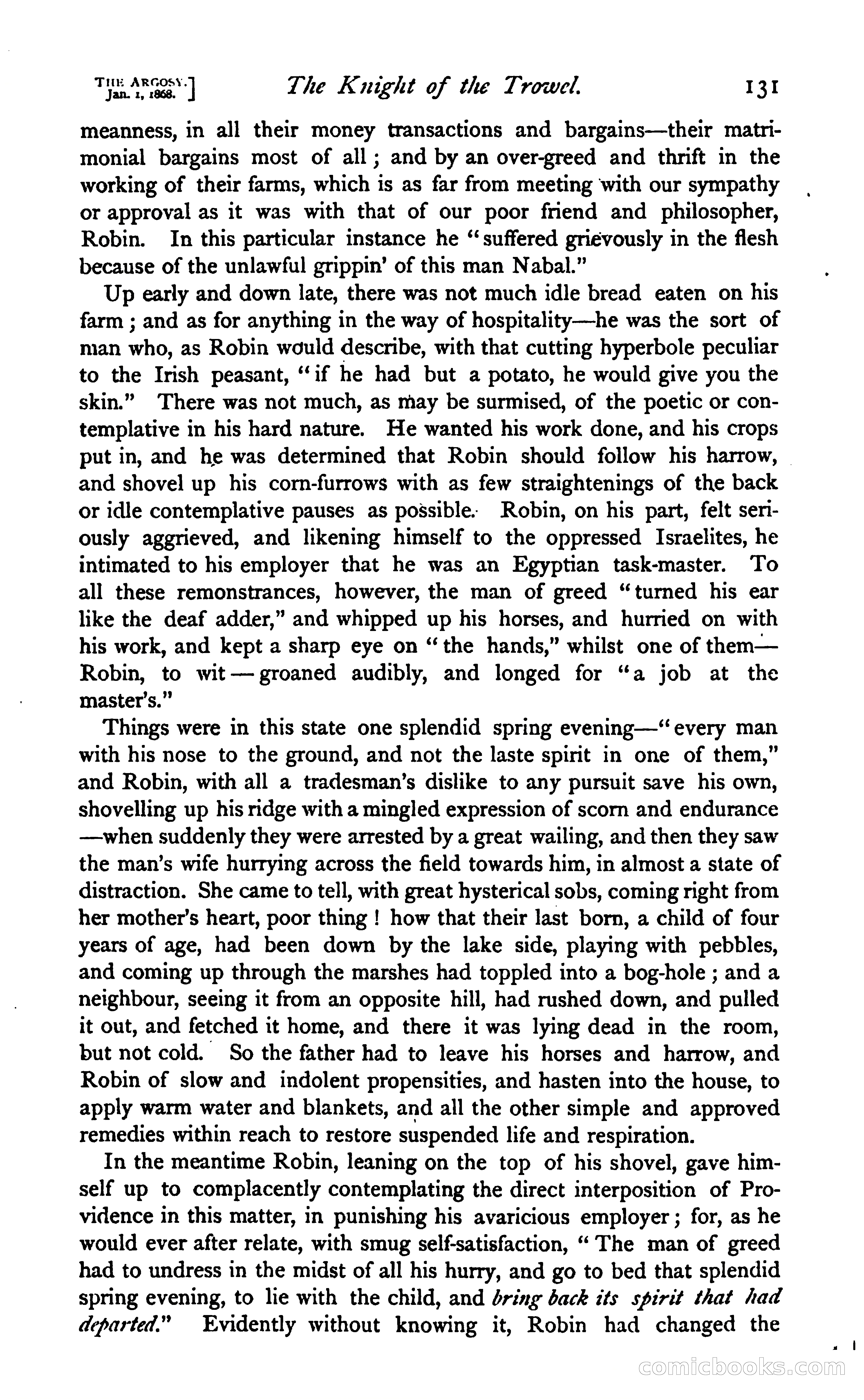
A restored page from Pulp Fiction, 1901. Page through the whole issue in the reader above.
📄 Transcribed text from this page (OCR, searchable)
Machine-transcribed from the original scan — historical spelling and the odd misread are preserved.
Tan 1008. The Kuight of the Trowel. 131 meanness, in all their money transactions and bargains—their matri- monial bargains most of all; and by an over-greed and thrift in the working of their farms, which is as far from meeting with our sympathy or approval as it was with that of our poor fmend and philosopher, Robin. In this particular instance he “suffered grievously in the flesh because of the unlawful grippin’ of this man Nabal.” Up early and down late, there was not much idle bread eaten on his farm ; and as for anything in the way of hospitality—he was the sort of man who, as Robin would describe, with that cutting hyperbole peculiar to the Irish peasant, ‘if he had but a potato, he would give you the skin.” There was not much, as may be surmised, of the poetic or con- templative in his hard nature. He wanted his work done, and his crops put in, and he was determined that Robin should follow his harrow, | and shovel up his corn-furrows with as few straightenings of the back or idle contemplative pauses as possible. Robin, on his part, felt ser- ously aggrieved, and likening himself to the oppressed Israelites, he intimated to his employer that he was an Egyptian task-master. To all these remonstrances, however, the man of greed “turned his ear like the deaf adder,” and whipped up his horses, and hurried on with his work, and kept a sharp eye on “the hands,” whilst one of them— Robin, to wit— groaned audibly, and longed for “a job at the master’s.” Things were in this state one splendid spring evening—‘“ every man with his nose to the ground, and not the laste spint in one of them,” and Robin, with all a tradesman’s dislike to any pursuit save his own, shovelling up his ridge with a mingled expression of scorn and endurance —when suddenly they were arrested by a great wailing, and then they saw the man’s wife hurrying across the field towards him, in almost a state of distraction. She came to tell, with great hysterical sobs, coming night from her mother’s heart, poor thing ! how that their last born, a child of four years of age, had been down by the lake side, playing with pebbles, and coming up through the marshes had toppled into a bog-hole ; and a neighbour, seeing it from an opposite hill, had rushed down, and pulled it out, and fetched it home, and there it was lying dead in the room, but not cold. So the father had to leave his horses and harrow, and Robin of slow and indolent propensities, and hasten into the house, to apply warm water and blankets, and all the other simple and approved remedies within reach to restore suspended life and respiration. In the meantime Robin, leaning on the top of his shovel, gave him- self up to complacently contemplating the direct interposition of Pro- vidence in this matter, in punishing his avaricious employer ; for, as he would ever after relate, with smug self-satisfaction, “The man of greed had to undress in the midst of all his hurry, and go to bed that splendid spring evening, to lie with the child, and bring back its spirit that had departed.” Evidently without knowing it, Robin had changed the comicaooks GO)