
Pulp Fiction, 1901 · page 144 of 400
The Argosy — page 144: what you’re looking at
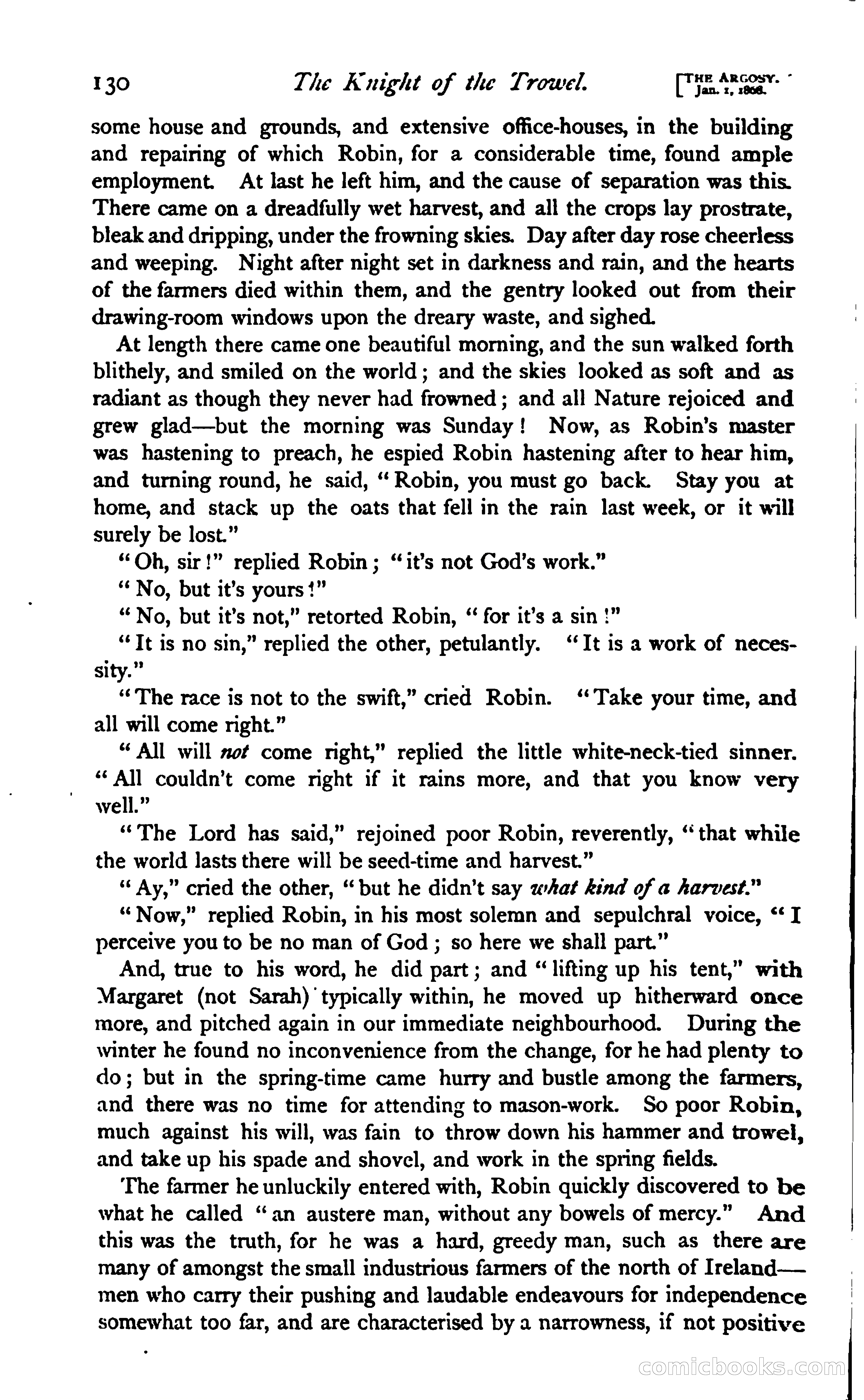
A restored page from Pulp Fiction, 1901. Page through the whole issue in the reader above.
📄 Transcribed text from this page (OCR, searchable)
Machine-transcribed from the original scan — historical spelling and the odd misread are preserved.
130 The Kuight of the Trowel. on sucowr. * some house and grounds, and extensive office-houses, in the building and repairing of which Robin, for a considerable time, found ample employment. At last he left him, and the cause of separation was this. There came on a dreadfully wet harvest, and all the crops lay prostrate, bleak and dripping, under the frowning skies. Day after day rose cheerless and weeping. Night after night set in darkness and rain, and the hearts of the farmers died within them, and the gentry looked out from their drawing-room windows upon the dreary waste, and sighed. At length there came one beautiful morning, and the sun walked forth blithely, and smiled on the world; and the skies looked as soft and as radiant as though they never had frowned ; and all Nature rejoiced and grew glad—but the morning was Sunday! Now, as Robin’s master was hastening to preach, he espied Robin hastening after to hear him, and turning round, he said, “ Robin, you must go back. Stay you at home, and stack up the oats that fell in the rain last week, or it will surely be lost.” ‘Oh, sir!” replied Robin; “it’s not God’s work.” “‘ No, but it’s yours !” “No, but it’s not,” retorted Robin, “ for it’s a sin !” “It is no sin,” replied the other, petulantly. ‘It 1s a work of neces- sity.” “The race is not to the swift,” cried Robin. ‘Take your time, and all will come right.” “ All will sof come mght,” replied the little white-neck-tied sinner. ‘‘ All couldn’t come nght if it rains more, and that you know very well.” ‘“The Lord has said,” rejoined poor Robin, reverently, “that while the world lasts there will be seed-time and harvest.” ‘‘ Ay,” cried the other, “‘ but he didn’t say what Aind of a harvest.” “Now,” replied Robin, in his most solemn and sepulchral voice, “‘ I perceive you to be no man of God; so here we shal! part.” And, true to his word, he did part; and “lifting up his tent,” with Margaret (not Sarah) typically within, he moved up hitherward once more, and pitched again in our immediate neighbourhood. During the winter he found no inconvenience from the change, for he had plenty to do; but in the spring-time came hurry and bustle among the farmers, and there was no time for attending to mason-work. So poor Robin, much against his will, was fain to throw down his hammer and trowel, and take up his spade and shovel, and work in the spring fields. The farmer he unluckily entered with, Robin quickly discovered to be what he called ‘an austere man, without any bowels of mercy.” And this was the truth, for he was a hard, greedy man, such as there are many of amongst the small industrious farmers of the north of Ireland— men who carry their pushing and laudable endeavours for independence somewhat too far, and are characterised by a narrowness, if not positive ECOMicoOolkxs.cO©