
Pulp Fiction, 1904 · page 36 of 122
The Argosy, June 1904 — page 36: what you’re looking at
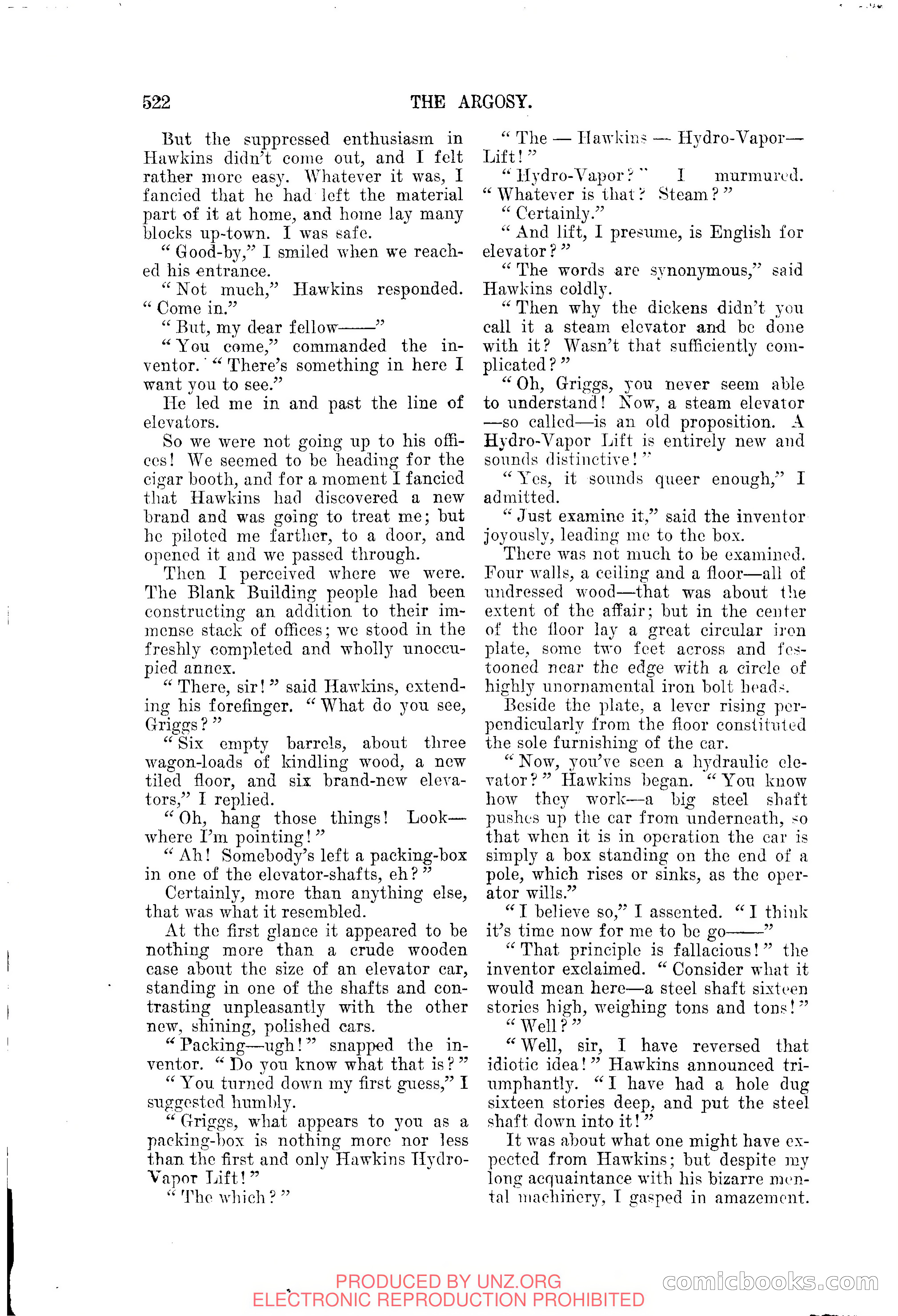
A restored page from Pulp Fiction, 1904. Page through the whole issue in the reader above.
📄 Transcribed text from this page (OCR, searchable)
Machine-transcribed from the original scan — historical spelling and the odd misread are preserved.
22 But the suppressed enthusiasm in Hawkins didn’t come out, and I felt rather more easy. Whatever it was, I fancied that he had left the material part of it at home, and home lay many blocks up-town. I was safe. “ Good-by,” I smiled when we reach- ed his entrance. “Not much,” Hawkins responded. “Come in.” “But, my dear fellow ; “You come,” commanded the in- ventor. “ 'There’s something in here I want you to see.” He led me in and past the line of elevators. So we were not going up to his offi- ees! We seemed to be heading for the cigar booth, and for a moment I fancicd that Hawkins had discovered a new brand and was going to treat me; but he piloted me farther, to a door, and opened it and we passed through. Then I perceived where we were. The Blank Building people had been constructing an addition to their im- mense stack of offices; we stood in the freshly completed and wholly unoceu- pied annex. “There, sir!” said Hawkins, extend- ing his forefinger. “What do you see, Griggs?” “Six empty barrels, about three wagon-loads of kindling wood, a new tiled floor, and six brand-new elera- tors,” I replied. “Oh, hang those things! where I’m pointing!” “ Ah! Somebody’s left a packing-box in one of the elevator-shafts, eh? ” Certainly, more than anything else, that was what it resembled. At the first glance it appeared to be nothing more than a crude wooden case about the size of an elevator car, standing in one of the shafts and con- trasting unpleasantly with the other new, shining, polished cars. “ Packing—ugh!” snapped the in- ventor. “Do you know what that is?” “ You turned down my first guess,” I suggested humbly. “Griggs, what appears to you as a packing-box is nothing more nor less than the first and only Hawkins [ydro- Vapor Lift!” “'The which?” b] Look— _____ PRODUCED BY UNZ.ORG connic ELECTRONIC REPRODUCTION PROHIBITED THE ARGOSY. “The — Hawkins — Hydro-Vapor— Lift!” “Wydro-Vapor?” Lo murmured. “ Whatever is that? Steam?” “ Certainly.” “And lift, I presume, is English for elevator?” “The words are synonymous,” said Hawkins coldly. “Then why the dickens didn’t you eall it a steam elevator and be done with it? Wasn’t that sufficiently com- plicated ? ” “Oh, Griggs, you never seem able to understand! Now, a steam elevator —so called—is an old proposition. A Hydro-Vapor Lift is entirely new and sounds distinctive!” “Yes, it sounds queer enough,” I admitted. “ Just examine it,” said the inventor joyously, leading me to the box. There was not much to be examined. Four walls, a ceiling and a floor—all of undressed wood—that was about the extent of the affair; but in the center of the floor lay a great circular iron plate, some two fcet across and fes- tooned near the edge with a circle of highly unornamental iron bolt heads. Beside the plate, a lever rising per- pendicularly from the floor constituted the sole furnishing of the car. “Now, you’ve scen a hydraulic ele- vator?” Hawkins began. “ You know how they work—a big steel shaft pushcs up the car from underneath, so that when it is in operation the car is simply a box standing on the end of a pole, which rises or sinks, as the oper- ator wills.” “T believe so,” I assented. “I think it’s time now for me to be go 7 “That principle is fallacious!” the inventor exclaimed. “ Consider what it would mean here—a steel shaft sixteen stories high, weighing tons and tons!” “Well? ” “Well, sir, I have reversed that idiotic idea!” Hawkins announced tri- umphantly. “I have had a hole dug sixteen stories deep, and put the steel shaft down into it!” It was about what one might have ex- pected from Hawkins; but despite my long acquaintance with his bizarre men- tal machinery, I gasped in amazement. JOO S mM