
Pulp Fiction, 1904 · page 35 of 122
The Argosy, June 1904 — page 35: what you’re looking at
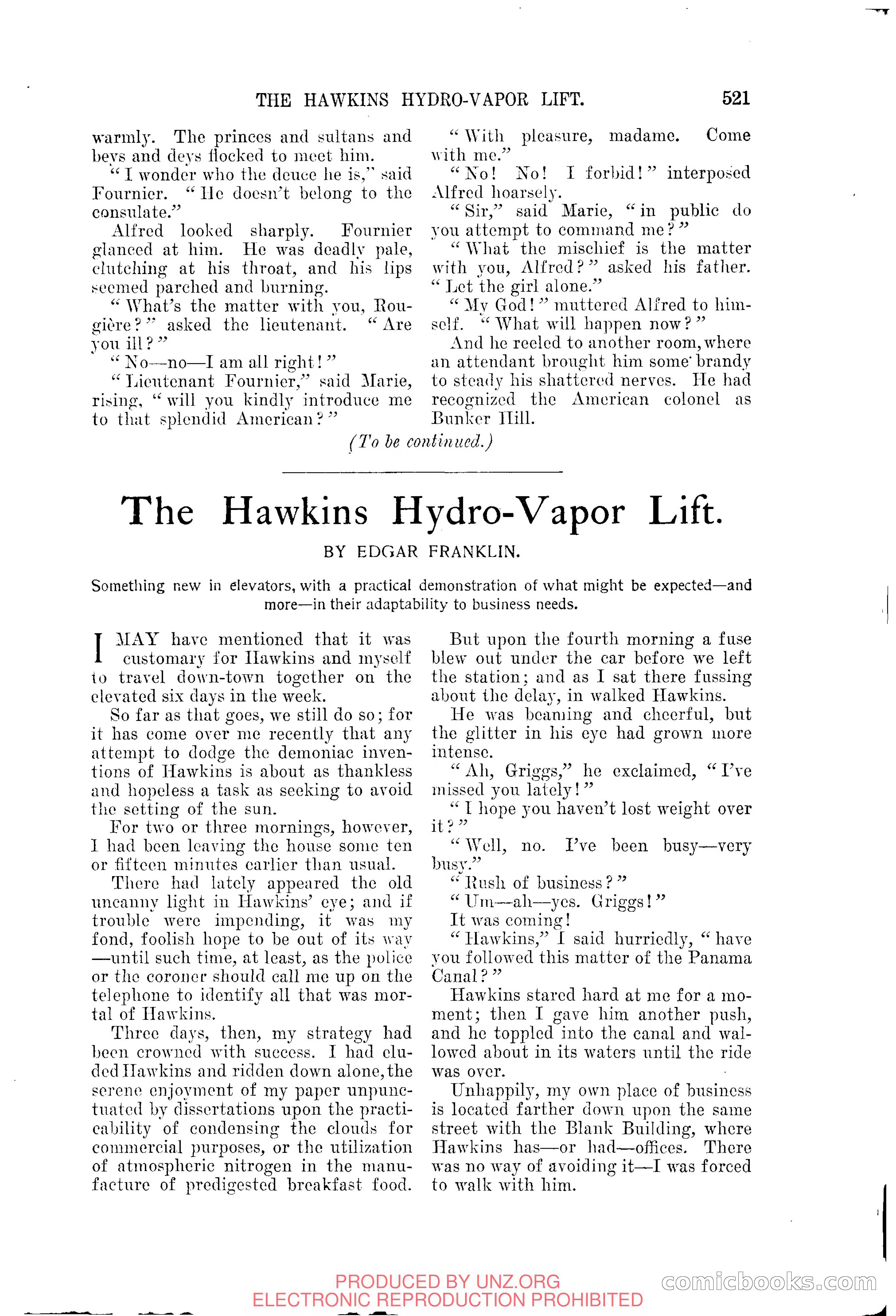
A restored page from Pulp Fiction, 1904. Page through the whole issue in the reader above.
📄 Transcribed text from this page (OCR, searchable)
Machine-transcribed from the original scan — historical spelling and the odd misread are preserved.
THE HAWKINS HYDRO-VAPOR LIFT. o21 warmly. The princes and sultans and bevs and deys flocked to meet him. “ T wonder who the deuce he is,” said Fournier. “ He doesn’t belong to the consulate.” Alfred looked sharply. Fournier glanced at him. He was deadly pale, clutching at his throat, and his lips seemed parched and burning. “ What’s the matter with you, Rou- eiére?*’ asked the lieutenant. “ Are you ill?” ‘“ No-—-no—I am all right!” “ Ticutenant Fournier,” said Marie, rising, “ will you kindly introduce me to that splendid American?” “With pleasure, madame. Come with me.” “No! No! I forbid!” interposed Alfred hoarsely. “Sir,” said Marie, “in public do you attempt to command me? ” “What the mischief is the matter with you, Alfred?” asked his father. “ Let the girl alone.” “ My God!” muttered Alfred to him- self. ‘What will happen now?” And he reeled to another room, where an attendant brought him some’ brandy to steady his shattered nerves. He had recognized the American colonel as Bunker Tull. (To be continued.) The Hawkins Hydro-Vapor Lift. BY EDGAR FRANKLIN. Something new in élevators, with a practical demonstration of what might be expected—and more—in their adaptability to business needs. MAY have mentioned that it was customary for Ilawkins and myself io travel down-town together on the elevated six days in the week. So far as that goes, we still do so; for it has come over me recently that any attempt to dodge the demoniac inven- tions of Hawkins is about as thankless and hopeless a task as seeking to avoid the setting of the sun. For two or three mornings, however, I had been leaving the house some ten or fifteen minutes carlier than usual. There had lately appeared the old uncanny light in Hawkins’ eye; and if trouble were impending, it was my fond, foolish hope to be out of its wav —until such time, at least, as the police or the coroner should call me up on the telephone to identify all that was mor- tal of Hawkins. Three days, then, my strategy had been crowned with suecess. I had elu- ded Hawkins and ridden down alone, the serene enjoyment of my paper unpunc- tuated by dissertations upon the practi- eability of condensing the clouds for commercial purposes, or the utilization of atmospheric nitrogen in the manu- facture of predigested breakfast food. But upon the fourth morning a fuse blew out under the car before we left the station; and as I sat there fussing about the delay, in walked Hawkins. He was beaming and cheerful, but the glitter in his eye had grown more intense. “Ah, Griggs,’ he exclaimed, “ Pye missed you lately!” “T hope you haven’t lost weight over it?” “Well, no. Pve been busy—very busy.” “Rush of business ? ” “Um—ah—yes. Griggs!” It was coming! “ Hawkins,” [ said hurriedly, “ have vou followed this matter of the Panama Canal? ” Hawkins stared hard at me for a mo- ment; then I gave him another push, and he toppled into the canal and wal- lowed about in its waters until the ride was over. Unhappily, my own place of business is located farther down upon the same street with the Blank Building, where Hawkins has—or had—offices. There was no way of avoiding it—I was forced to walk with him. PRODUCED BY UNZ.ORG GOMIGOO ELECTRONIC REPRODUCTION PROHIBITED