
Pulp Fiction, 1897 · page 62 of 192
The Argosy, Vol. XXV, No. 3 — page 62: what you’re looking at
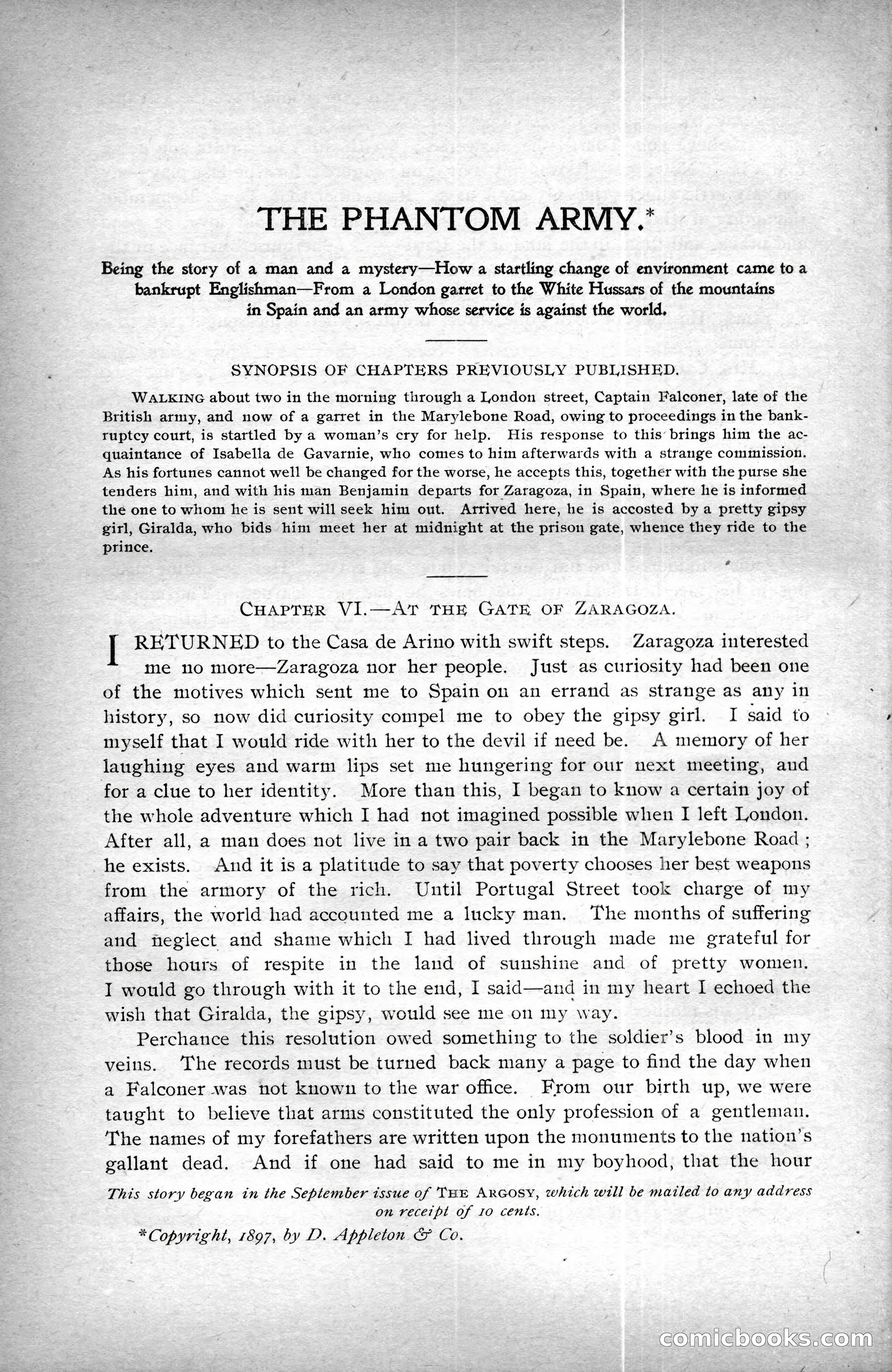
A restored page from Pulp Fiction, 1897. Page through the whole issue in the reader above.
📄 Transcribed text from this page (OCR, searchable)
Machine-transcribed from the original scan — historical spelling and the odd misread are preserved.
THE PHANTOM ARMY.’ Being the story of a man and a mystery—How a startling change of environment came to a bankrupt Englishman—From a London garret to the White Hussars of the mountains in Spain and an army whose service is against the world, SYNOPSIS OF CHAPTERS PREVIOUSLY PUBLISHED. WALKING about two in the morning through a London street, Captain Falconer, late of the British army, and now of a garret in the Marylebone Road, owing to proceedings in the bank- ruptcy court, is startled by a woman’s cry for help. His response to this’ brings him the ac- quaintance of Isabella de Gavarnie, who comes to him afterwards with a strange commission. As his fortunes cannot well be changed for the worse, he accepts this, together with the purse she tenders him, and with his man Benjamin departs for Zaragoza, in Spain, where he is informed the one to whom he is sent will seek him out. Arrived here, he is accosted bya pretty gipsy girl, Giralda, who bids him meet her at midnight at the prison gate, whence they ride to the prince. a CHAPTER VI.—AT THE GATE OF ZARAGOZA. RETURNED to the Casa de Arino with swift steps. Zaragoza interested me no more—Zaragoza nor her people. Just as curiosity had been one of the motives which sent me to Spain on an errand as strange as any in history, so now did curiosity compel me to obey the gipsy girl. I said to myself that I would ride with her to the devil if need be. A memory of her laughing eyes and warm lips set me hungering for our next meeting, aud for a clue to her identity. More than this, I began to know a certain joy of the whole adventure which I had not imagined possible when I left London. After all, a man does not live in a two pair back in the Marylebone Road ; he exists. And it is a platitude to say that poverty chooses her best weapons from the armory of the rich. Until Portugal Street took charge of my affairs, the world had accounted me a lucky man. The months of suffering and neglect and shame which I had lived through made me grateful for those hours of respite in the land of sunshine and of pretty women. I would go through with it to the end, I said—and in my heart I echoed the wish that Giralda, the gipsy, would see me on my way. Perchance this resolution owed something to the soldier’s blood in my veins. The records must be turned back many a page to find the day when a Falconer was not known to the war office. From our birth up, we were taught to believe that arms constituted the only profession of a gentleman. The names of my forefathers are written upon the monuments to the nation’s gallant dead. And if one had said to me in my boyhood, that the hour This story began in the September issue of THE ARGOSY, which will be mailed to any address on receipt of ro cents. * Copyright, 1897, by D. Appleton & Co. Pp. Eomichbooks (E@)