
Pulp Fiction, 1897 · page 61 of 192
The Argosy, Vol. XXV, No. 3 — page 61: what you’re looking at
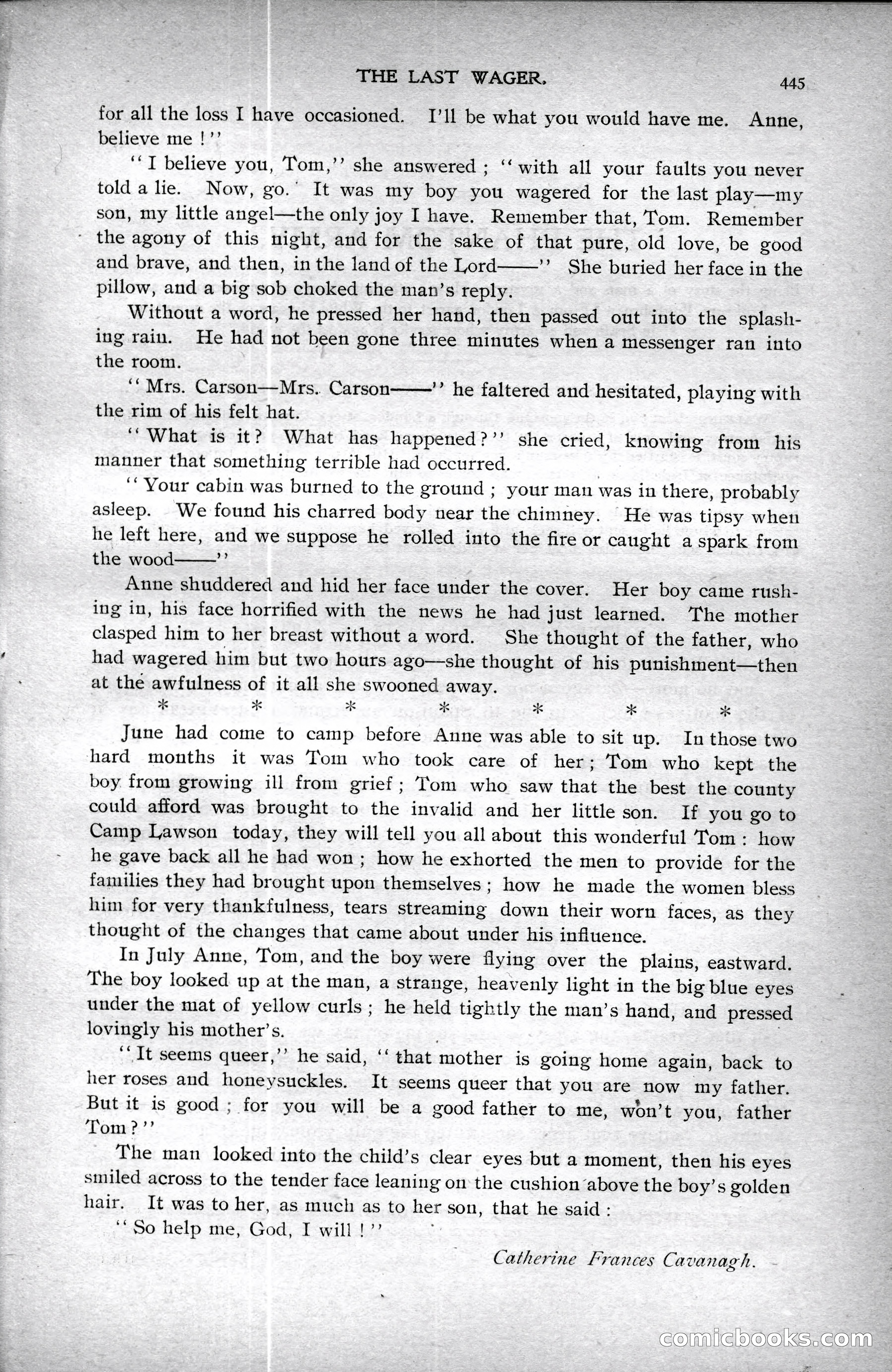
A restored page from Pulp Fiction, 1897. Page through the whole issue in the reader above.
📄 Transcribed text from this page (OCR, searchable)
Machine-transcribed from the original scan — historical spelling and the odd misread are preserved.
THE LAST WAGER. 445 for all the loss I have occasioned. I’ll be what you would have me. Anne, believe me !’’ ‘“I believe you, Tom,’’ she answered ; ‘‘ with all your faults you never told a lie. Now, go.’ It was my boy you wagered for the last play—my son, my little angel—the only joy I have. Remember that, Tom. Remember | the agony of this night, and for the sake of that pure, old love, be good and brave, and then, in the land of the Lord ’? She buried her face in the pillow, and a big sob choked the man’s reply. Without a word, he pressed her hand, then passed out into the splash- ing rain. He had not been gone three minutes when a messenger ran into the room. ‘" Mrs. Carson—Mrs. Carson the rim of his felt hat. What is it? What has happened?” she cried, knowing from his manner that something terrible had occurred. 3 ‘Your cabin was burned to the ground ; your man was in there, probably asleep. We found his charred body near the chimney. He was tipsy when he left here, and we suppose he rolled into the fire or caught aspark from the wood = Anne shuddered and hid her face under the cover. Her boy came rush- ing in, his face horrified with the news he had just learned. The mother clasped him to her breast without a word. She thought of the father, who had wagered him but two hours ago—she thought of his punishment—then at the awfulness of it all she swooned away. ok *K *k ok ok ok aK June had come to camp before Anne was able to sit up. In those two hard months it was Tom who took care of her; Tom who kept the boy from growing ill from grief; Tom who saw that the best the county could afford was brought to the invalid and her little son. If you go to Camp Lawson today, they will tell you all about this wonderful Tom: how he gave back all he had won; how he exhorted the men to provide for the families they had brought upon themselves; how he made the women bless him for very thankfulness, tears streaming down their worn faces, as they thought of the changes that came about under his influence. In July Anne, Tom, and the boy were flying over the plains, eastward. The boy looked up at the man, a strange, heavenly light in the big blue eyes under the mat of yellow curls; he held tightly the man’s hand, and pressed lovingly his mother’s. 3 ; ‘“ It seems queer,’’ he said, ‘‘ that mother is going home again, back to her roses and honeysuckles. It seems queer that you are now my father. But it is good; for you will be a good father to me, won’t you, father Tom ?’’ The man looked into the child’s clear eyes but a moment, then his eyes smiled across to the tender face leaning on the cushion above the boy’s golden hair. It was to her, as much as to her son, that he said: ‘“So help me, God, I will !”’ ’’ he faltered and hesitated, playing with Catherine Frances Cavanagh. Eomichook (E@)