
Pulp Fiction, 1897 · page 58 of 192
The Argosy, Vol. XXV, No. 3 — page 58: what you’re looking at
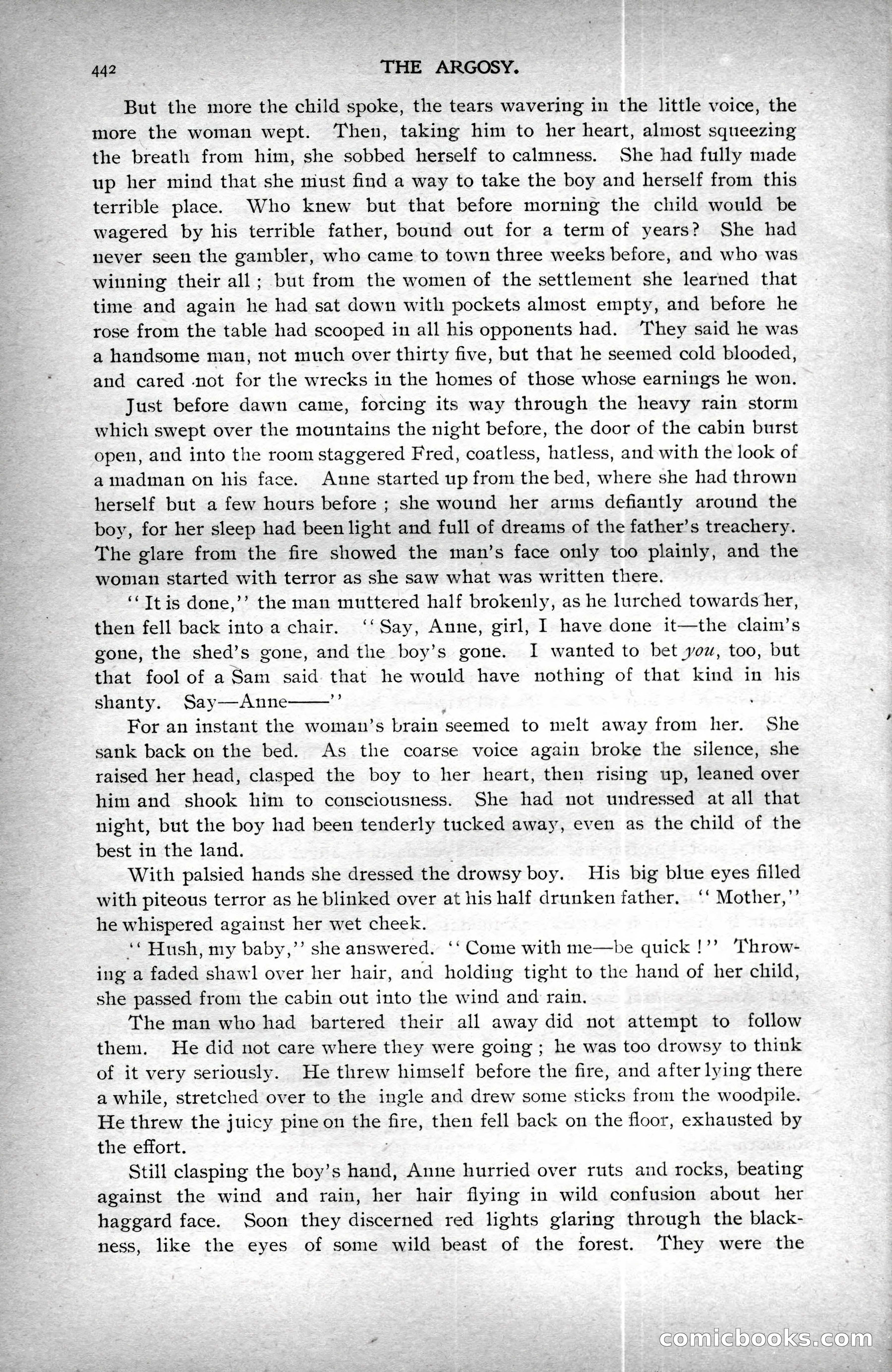
A restored page from Pulp Fiction, 1897. Page through the whole issue in the reader above.
📄 Transcribed text from this page (OCR, searchable)
Machine-transcribed from the original scan — historical spelling and the odd misread are preserved.
442 THE ARGOSY. But the more the child spoke, the tears wavering in the little voice, the — more the woman wept. Then, taking him to her heart, almost squeezing the breath from him, she sobbed herself to calmness. She had fully made up her mind that she must find a way to take the boy and herself from this terrible place. Who knew but that before morning the child would be wagered by his terrible father, bound out for a term of years? She had never seen the gambler, who came to town three weeks before, and who was witining their all; but from the women of the settlement she learned that time and again he had sat down with pockets almost empty, and before he rose from the table had scooped in all his opponents had. ‘They said he was a handsome man, not much over thirty five, but that he seemed cold blooded, and cared -not for the wrecks in the homes of those whose earnings he won. Just before dawn came, forcing its way through the heavy rain storm which swept over the mountains the night before, the door of the cabin burst open, and into the room staggered Fred, coatless, hatless, and with the look of amadman on his face. Anne started up from the bed, where she had thrown herself but a few hours before ; she wound her arms defiantly around the boy, for her sleep had been light and full of dreams of the father’s treachery. The glare from the fire showed the man’s face only too plainly, and the wonian started with terror as she saw what was written there. ‘‘Ttis done,’’ the man muttered half brokenly, as he lurched towards her, then fell back into a chair. ‘‘Say, Anne, girl, I have done it—the claim’s gone, the shed’s gone, and the boy’s gone. I wanted to bet you, too, but that fool of a Sam said that he would have nothing of that kind in his shanty. Say—Anne Sg : For an instant the woman’s brain seemed to melt away from her. She sank back on the bed. As the coarse voice again broke the silence, she raised her head, clasped the boy to her heart, then rising up, leaned over him and shook him to consciousness. She had not undressed at all that night, but the boy had been tenderly tucked away, even as the child of the best in the land. ; 3 With palsied hands she dressed the drowsy boy. His big blue eyes filled with piteous terror as he blinked over at his half drunken father, ‘* Mother,”’ he whispered against her wet cheek. ‘* Hush, my baby,’’ she answered. ‘‘ Come with me—be quick !’’ Throw- ing a faded shawl over her hair, and holding tight to the hand of her child, she passed from the cabin out into the wind and rain. The man who had bartered their all away did not attempt to follow them. He did not care where they were going ; he was too drowsy to think of it very seriously. He threw himself before the fire, and after lying there a while, stretched over to the ingle and drew some sticks from the woodpile. He threw the juicy pine on the fire, then fell back on the floor, exhausted by the effort. ; Still clasping the boy’s hand, Anne hurried over ruts and rocks, beating against the wind and rain, her hair flying in wild confusion about her haggard face. Soon they discerned red lights glaring through the black- ness, like the eyes of some wild beast of the forest. ‘They were the Eomicbooks (GC)