
Pulp Fiction, 1897 · page 67 of 200
The Argosy, Vol. XXIV, No. 3 — page 67: what you’re looking at
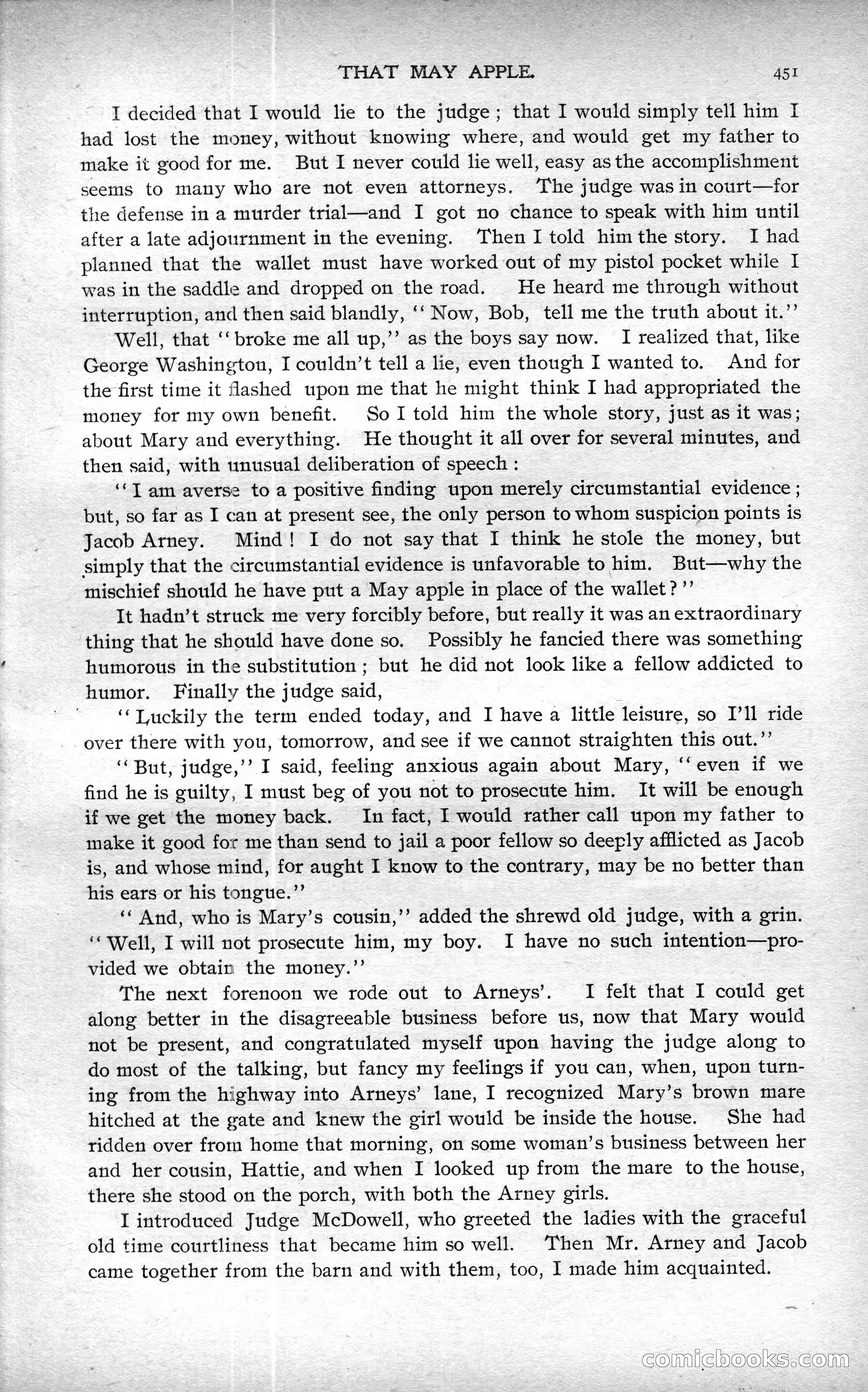
A restored page from Pulp Fiction, 1897. Page through the whole issue in the reader above.
📄 Transcribed text from this page (OCR, searchable)
Machine-transcribed from the original scan — historical spelling and the odd misread are preserved.
THAT MAY APPLE. 451 I decided that I would lie to the judge; that I would simply tell him I had lost the money, without knowing where, and would get my father to make it good for me. But I never could lie well, easy asthe accomplishment seems to many who are not even attorneys. The judge was in court—for the defense in a murder trial—and I got no chance to speak with him until after a late adjournment in the evening. Then I told himthe story. I had planned that the wallet must have worked out of my pistol pocket while I was in the saddle and dropped on the road. He heard me through without interruption, and then said blandly, ‘‘ Now, Bob, tell me the truth about it.” Well, that ‘‘ broke me all up,’’ as the boys say now. I realized that, like George Washington, I couldn’t tell a lie, even though I wanted to. And for the first time it flashed upon me that he might think I had appropriated the money for my own benefit. SoItold him the whole story, just as it was; about Mary and everything. He thought it all over for several minutes, and then said, with unusual deliberation of speech : : ‘‘T am averse to a positive finding upon merely circumstantial evidence ; but, so far as I can at present see, the only person to whom suspicion points is Jacob Arney. Mind! I do not say that I think he stole the money, but simply that the circumstantial evidence is unfavorable to him. But—why the mischief should he have put a May apple in place of the wallet ?”’ It hadn’t struck me very forcibly before, but really it was an extraordinary thing that he should have done so. Possibly he fancied there was something humorous in the substitution ; but he did not look like a fellow addicted to humor. Finally the judge said, ‘Luckily the term ended today, and I have a little leisure, so Ill ride over there with you, tomorrow, and see if we cannot straighten this out.”’ ‘“ But, judge,’ I said, feeling anxious again about Mary, ‘‘even if we find he is guilty, I must beg of you not to prosecute him. It will be enough if we get the money back. In fact, I would rather call upon my father to make it good for me than send to jail a poor fellow so deeply afflicted as Jacob is, and whose mind, for aught I know to the contrary, may be no better than his ears or his tongue.”’ ‘‘ And, who is Mary’s cousin,’’ added the shrewd old judge, with a grin. “Well, I will not prosecute him, my boy. I have no such intention—pro- vided we obtain the money.’’ The next forenoon we rode out to Arneys’. I felt that I could get along better in the disagreeable business before us, now that Mary would not be present, and congratulated myself upon having the judge along to do most of the talking, but fancy my feelings if you can, when, upon turn- ing from the highway into Arneys’ lane, I recognized Mary’s brown mare hitched at the gate and knew the girl would be inside the house. She had ridden over from home that morning, on some woman’s business between her and her cousin, Hattie, and when I looked up from the mare to the house, there she stood on the porch, with both the Arney girls. I introduced Judge McDowell, who greeted the ladies with the graceful old time courtliness that became him so well. Then Mr. Arney and Jacob came together from the barn and with them, too, I made him acquainted. GOMIGOOOKSAGO