
Pulp Fiction, 1897 · page 66 of 200
The Argosy, Vol. XXIV, No. 3 — page 66: what you’re looking at
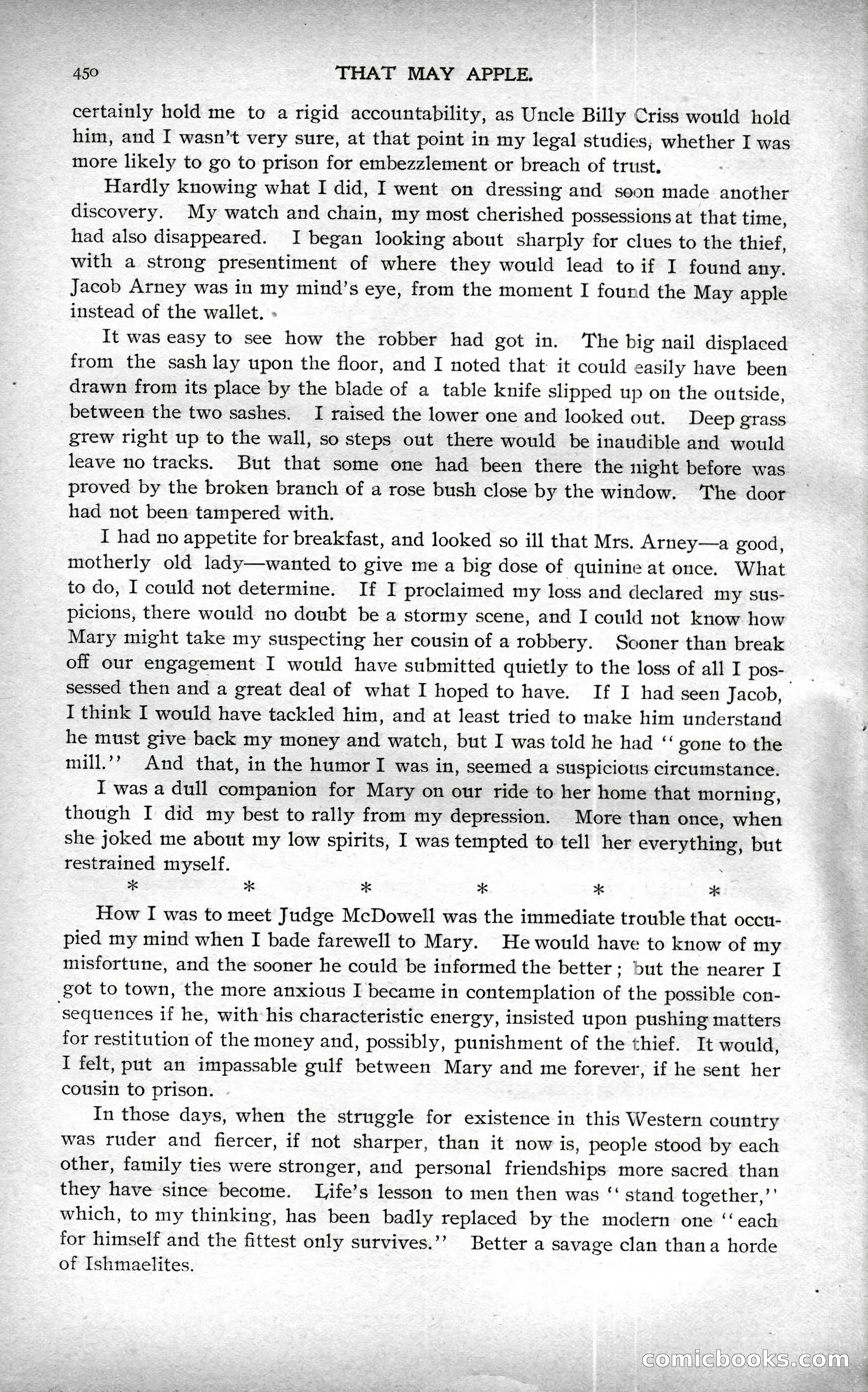
A restored page from Pulp Fiction, 1897. Page through the whole issue in the reader above.
📄 Transcribed text from this page (OCR, searchable)
Machine-transcribed from the original scan — historical spelling and the odd misread are preserved.
450 THAT MAY APPLE, certainly hold me to a rigid accountability, as Uncle Billy Criss would hold him, and I wasn’t very sure, at that point in my legal studies; whether I was more likely to go to prison for embezzlement or breach of trust. Hardly knowing what I did, I went on dressing and soon made another discovery. My watch and chain, my most cherished possessions at that time, had also disappeared. I began looking about sharply for clues to the thief, with a strong presentiment of where they would lead to if I found any. Jacob Arney was in my mind’s eye, from the moment I found the May apple instead of the wallet. - It was easy to see how the robber had got in. The big nail displaced from the sash lay upon the floor, and I noted that it could easily have been drawn from its place by the blade of a table knife slipped up on the outside, between the two sashes. I raised the lower one and looked out. Deep grass grew right up to the wall, so steps out there would be inaudible and would leave no tracks. But that some one had been there the night before was proved by the broken branch of a rose bush close by the window. ‘The door had not been tampered with. I had no appetite for breakfast, and looked so ill that Mrs. Arney—a good, motherly old lady—wanted to give me a big dose of quinine at once. What to do, I could not determine. If I proclaimed my loss and declared my sus- picions, there would no doubt be a stormy scene, and I could not know how Mary might take my suspecting her cousin of a robbery. Sooner than break off our engagement I would have submitted quietly to the loss of all I pos- sessed then and a great deal of what I hoped to have. If I had seen Jacob, I think I would have tackled him, and at least tried to make him understand he must give back my money and watch, but I was told he had ‘“ gone to the mill.’’ And that, in the humor I was in, seemed a suspicious circumstance. I was a dull companion for Mary on our ride to her home that morning, though I did my best to rally from my depression. More than once, when she joked me about my low spirits, I was tempted to tell her everything, but restrained myself. * * * * * oe How I was to meet Judge McDowell was the immediate trouble that occu- pied my mind when I bade farewell to Mary. He would have to know of my misfortune, and the sooner he could be informed the better ; but the nearer I got to town, the more anxious I became in contemplation of the possible con- ‘sequences if he, with his characteristic energy, insisted upon pushing matters for restitution of the money and, possibly, punishment of the thief. It would, I felt, put an impassable gulf between Mary and me forever, if he sent her cousin to prison. | In those days, when the struggle for existence in this Western country was ruder and fiercer, if not sharper, than it now is, people stood by each other, family ties were stronger, and personal friendships more sacred than they have since become. Life’s lesson to men then was ‘‘ stand together,’’ which, to my thinking, has been badly replaced by the modern one ‘‘ each for himself and the fittest only survives.’’ Better a savage clan thana horde of Ishmaelites. 3 Eomicbooks