
Pulp Fiction, 1897 · page 64 of 200
The Argosy, Vol. XXIV, No. 3 — page 64: what you’re looking at
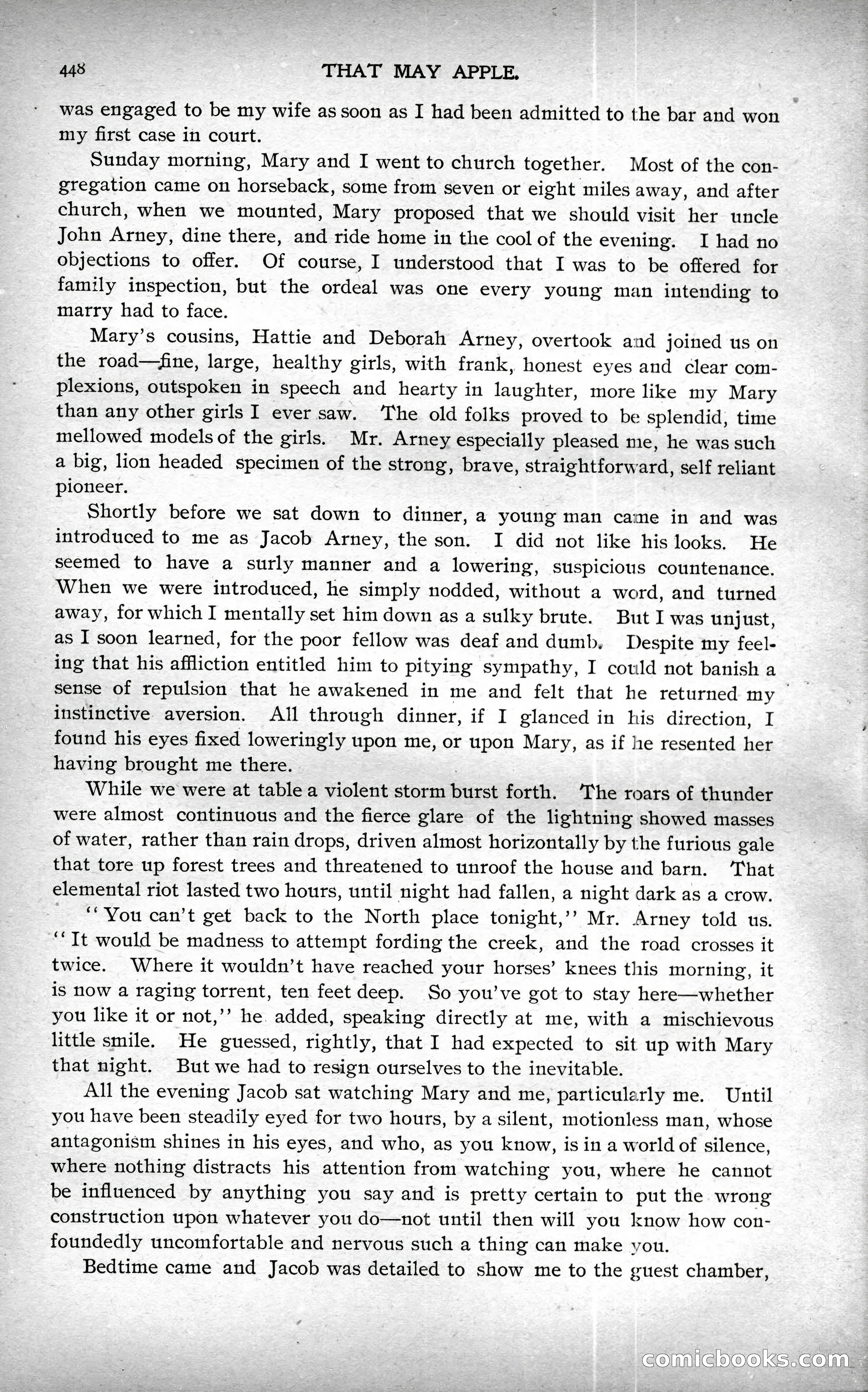
A restored page from Pulp Fiction, 1897. Page through the whole issue in the reader above.
📄 Transcribed text from this page (OCR, searchable)
Machine-transcribed from the original scan — historical spelling and the odd misread are preserved.
448 THAT MAY APPLE, was engaged to be my wife as soon as I had been admitted to the bar and won my first case in court. Sunday morning, Mary and I went to church together. Most of the con- gregation came on horseback, some from seven or eight miles away, and after church, when we mounted, Mary proposed that we should visit her uncle John Arney, dine there, and ride home in the cool of the evening. I had no objections to offer. Of course, I understood that I was to be offered for family inspection, but the ordeal was one every young man intending to marry had to face. Mary’s cousins, Hattie and Deborah Arney, overtook and joined us on the road—fine, large, healthy girls, with frank, honest eyes and clear com- plexions, outspoken in speech and hearty in laughter, more like my Mary than any other girls I ever saw. ‘The old folks proved to be splendid, time mellowed models of the girls. Mr. Arney especially pleased me, he was such a big, lion headed specimen of the strong, brave, straightforward, self reliant pioneer. Shortly before we sat down to dinner, a young man came in and was introduced to me as Jacob Arney, the son. I did not like his looks. He seemed to have a surly manner and a lowering, suspicious countenance. When we were introduced, he simply nodded, without a word, and turned away, for which I mentally set him down as a sulky brute. But I was unjust, as I soon learned, for the poor fellow was deaf and dumb. Despite my feel- ing that his affliction entitled him to pitying sympathy, I could not banish a sense of repulsion that he awakened in me and felt that he returned my | instinctive aversion. All through dinner, if I glanced in his direction, I found his eyes fixed loweringly upon me, or upon Mary, as if he resented her having brought me there. : While we were at table a violent storm burst forth. ‘The roars of thunder were almost continuous and the fierce glare of the lightning showed masses of water, rather than rain drops, driven almost horizontally by the furious gale that tore up forest trees and threatened to unroof the house and barn. ‘That elemental riot lasted two hours, until night had fallen, a night dark as a crow. ‘You can’t get back to the North place tonight,’’ Mr. Arney told us. ‘It would be madness to attempt fording the creek, and the road crosses it twice. Where it wouldn’t have reached your horses’ knees this morning, it is now a raging torrent, ten feet deep. So you’ve got to stay here—whether you like it or not,’’ he. added, speaking directly at me, with a mischievous little smile. He guessed, rightly, that I had expected to sit up with Mary that night. But we had to resign ourselves to the inevitable. All the evening Jacob sat watching Mary and me, particularly me. Until you have been steadily eyed for two hours, by a silent, motionless man, whose antagonism shines in his eyes, and who, as you know, is in a world of silence, _ where nothing distracts his attention from watching you, where he cannot be influenced by anything you say and is pretty certain to put the wrong construction upon whatever you do—not until then will you know how con- foundedly uncomfortable and nervous such a thing can make you. Bedtime came and Jacob was detailed to show me to the guest chamber, ONMIKELOOOKS