
Pulp Fiction, 1897 · page 63 of 200
The Argosy, Vol. XXIV, No. 3 — page 63: what you’re looking at
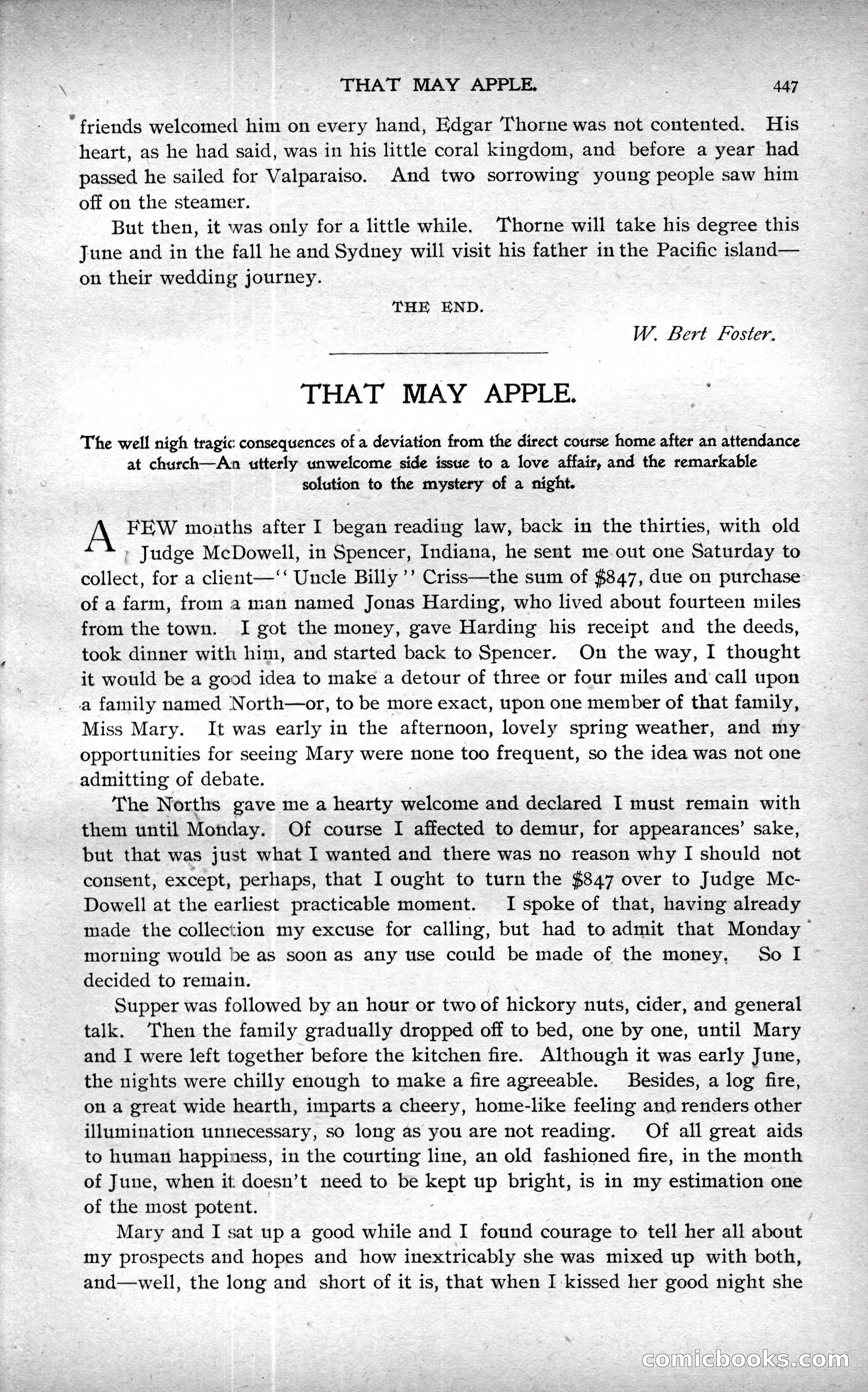
A restored page from Pulp Fiction, 1897. Page through the whole issue in the reader above.
📄 Transcribed text from this page (OCR, searchable)
Machine-transcribed from the original scan — historical spelling and the odd misread are preserved.
THAT MAY APPLE, | | 447 * friends welcomed him on every hand, Edgar Thorne was not contented. His heart, as he had said, was in his little coral kingdom, and before a year had passed he sailed for Valparaiso. And two sorrowing young people saw him off on the steamer. But then, it was only for a little while. Thorne will take his degree this June and in the fall he and Sydney will visit his father in the Pacific island— on their wedding journey. THE END. W. Bert Foster. THAT MAY APPLE. The well nigh tragic consequences of a deviation from the direct course home after an attendance at church—An utterly unwelcome side issue to a love affair, and the remarkable solution to the mystery of a night. A FEW moaths after I began reading law, back in the thirties, with old , Judge McDowell, in Spencer, Indiana, he sent me out one Saturday to collect, for a client—‘‘ Uncle Billy ’’ Criss—the sum of $847, due on purchase’ of a farm, from a man named Jonas Harding, who lived about fourteen miles from the town. I got the money, gave Harding his receipt and the deeds, took dinner with him, and started back to Spencer. On the way, I thought it would be a good idea to make a detour of three or four miles and call upon a family named North—or, to be more exact, upon one member of that family, Miss Mary. It was early in the afternoon, lovely spring weather, and my opportunities for seeing Mary were none too frequent, so the idea was not one admitting of debate. The Norths gave me a hearty welcome and declared I must remain with them until Monday. Of course I affected to demur, for appearances’ sake, but that was just what I wanted and there was no reason why I should not consent, except, perhaps, that I ought to turn the $847 over to Judge Mc- Dowell at the earliest practicable moment. I spoke of that, having already made the collection my excuse for calling, but had to admit that Monday ~ morning would be as soon as any use could be made of the money, So I decided to remain. Supper was followed by an hour or two of hickory nuts, cider, and general talk. Then the family gradually dropped off to bed, one by one, until Mary and I were left together before the kitchen fire. Although it was early June, the nights were chilly enough to make a fire agreeable. Besides, a log fire, on a great wide hearth, imparts a cheery, home-like feeling and renders other illumination unnecessary, so long as you are not reading. Of all great aids to human happiness, in the courting line, an old fashioned fire, in the month of June, when it doesn’t need to be nept up bright, is in my estimation one of the most potent. Mary and I sat up a good while and I found courage to tell her all about my prospects and hopes and how inextricably she was mixed up with both, and—well, the long and short of it is, that when I kissed her good night she CONMMICL COOKS ae) 3