
Pulp Fiction, 1897 · page 156 of 192
The Argosy, Vol. XXIV, No. 1 — page 156: what you’re looking at
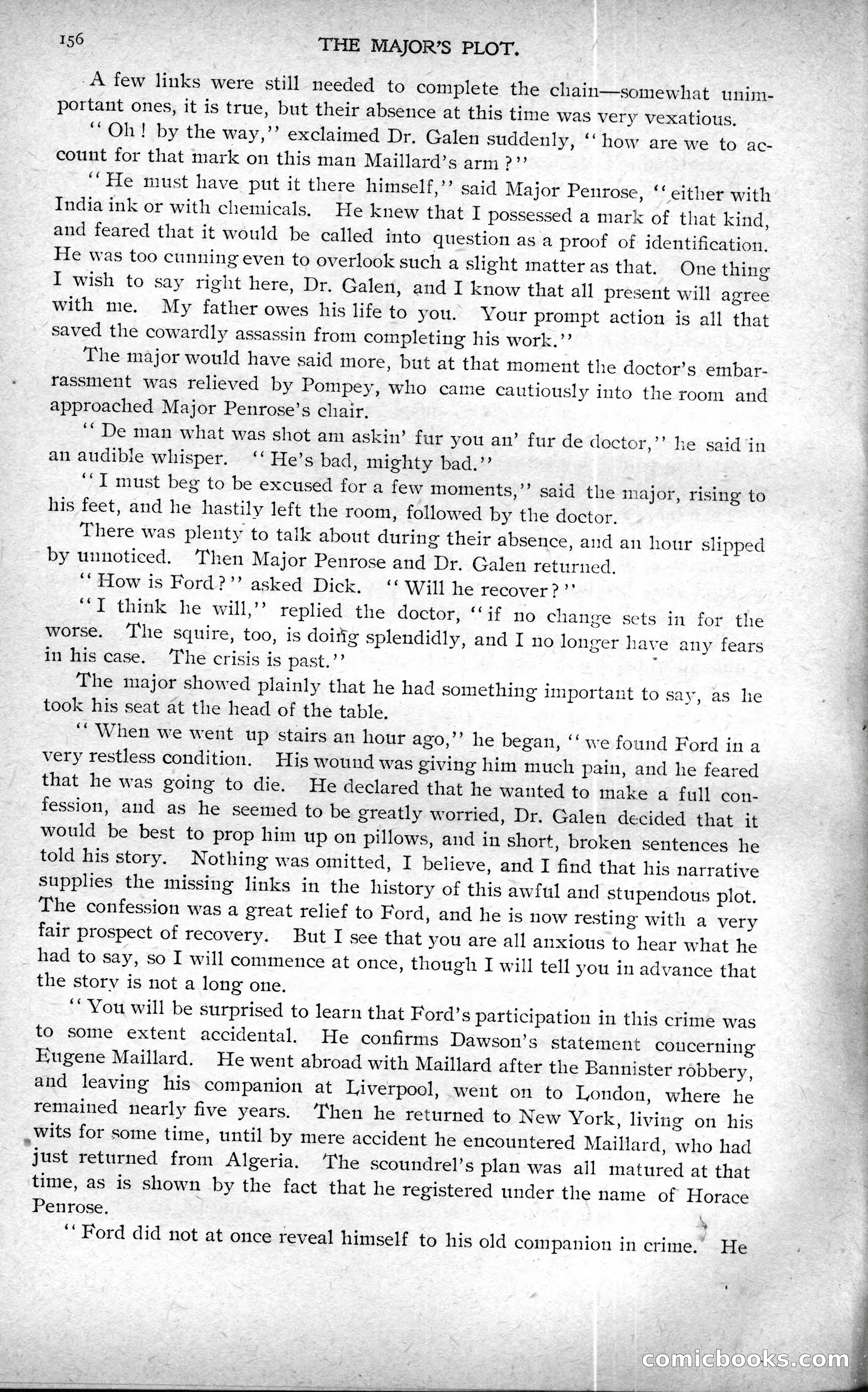
A restored page from Pulp Fiction, 1897. Page through the whole issue in the reader above.
📄 Transcribed text from this page (OCR, searchable)
Machine-transcribed from the original scan — historical spelling and the odd misread are preserved.
156 THE MAJOR’S PLOT, A few links were still needed to complete the chain—somewhat unim- portant ones, it is true, but their absence at this time was very vexatious. ‘Oh! by the way,’’ exclaimed Dr. Galen suddenly, ‘‘ how are we to ac- count for that mark on this man Maillard’s arm ?”’ ‘“He must have put it there himself,’ said Major Penrose, ‘‘ either with India ink or with chemicals. He knew that I possessed a mark of that kind, and feared that it would be called into question as a proof of identification. He was too cunning even to overlook such a slight matteras that. One thing I wish to say right here, Dr, Galen, and I know that all present will agree with me. My father owes his life to you. Your prompt action is all that saved the cowardly assassin from completing his work.’’ The major would have said more, but at that moment the doctor’s embar- rassment was relieved by Pompey, who came cautiously into the room and approached Major Penrose’s chair. ‘’ De man what was shot am askin’ fur you an’ fur de doctor,’’ he said in an audible whisper. ‘‘ He’s bad, mighty bad.” ‘I must beg to be excused for a few moments,’’ said the major, rising to his feet, and he hastily left the room, followed by the doctor. There was plenty to talk about during their absence, and an hour slipped by unnoticed. Then Major Penrose and Dr. Galen returned. ‘’ How is Ford?”’ asked Dick, ‘‘ Will he récover ?" I think he will,’’ replied the doctor, ‘if no change sets in for the worse. ‘The squire, too, is doitig splendidly, and I no longer have any fears in his case. ‘The crisis is past.’’ The major showed plainly that he had something important to say, as he : took his seat at the head of the table. , When we went up stairs an hour ago,’’ he began, ‘‘ we found Ford in a very restless condition. His wound was giving him much pain, and he feared that he was going to die. He declared that he wanted to make a full con- fession, and as he seemed to be greatly worried, Dr. Galen decided that it would be best to prop him up on pillows, and in short, broken sentences he told his story. N othing was omitted, I believe, and I find that his narrative supplies the missing links in the history of this awful and stupendous plot. The confession was a great relief to Ford, and he is now resting with a very fair prospect of recovery. But I see that you are all anxious to hear what he had to say, so I will commence at once, though I will tell you in advance that the story is not a long one, ‘ You will be surprised to learn that Ford’s participation in this crime was to some extent accidental. He confirms Dawson’s statement concerning Eugene Maillard. He went abroad with Maillard after the Bannister robbery, and leaving his companion at Liverpool, went on to London, where he remained nearly five years. ‘‘hen he returned to New York, living on his _wits for some time, until by mere accident he encountered Maillard, who had just returned from Algeria. ‘The scoundrel’s plan was all matured at that time, as is shown by the fact that he registered under the name of Horace Penrose, S ‘‘ Ford did not at once reveal himself to his old companion in crime.’ He fp eee ee oe EGom (eloyo\oy Ss (E(0)