
Pulp Fiction, 1897 · page 155 of 192
The Argosy, Vol. XXIV, No. 1 — page 155: what you’re looking at
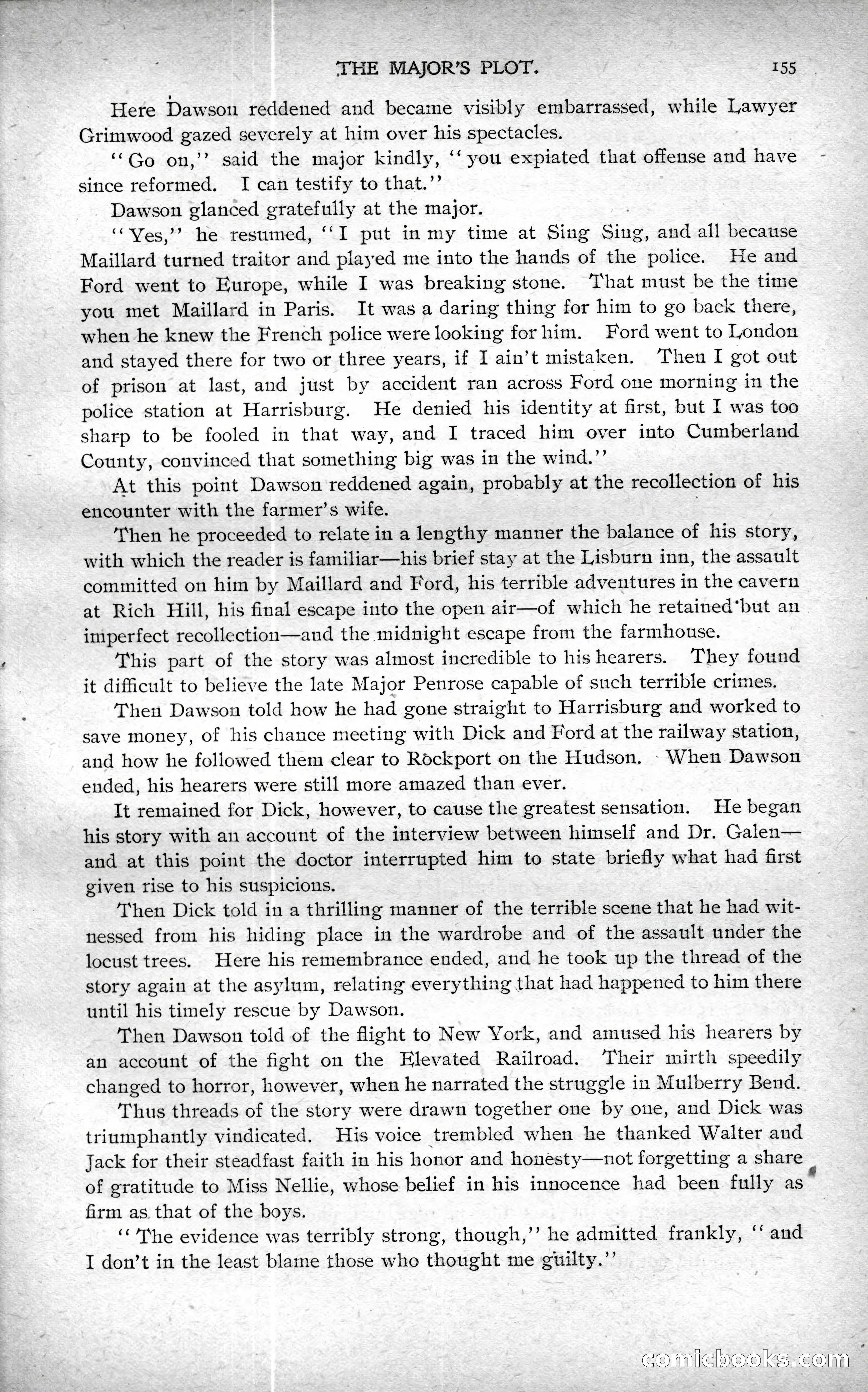
A restored page from Pulp Fiction, 1897. Page through the whole issue in the reader above.
📄 Transcribed text from this page (OCR, searchable)
Machine-transcribed from the original scan — historical spelling and the odd misread are preserved.
THE MAJOR’S PLOT. 155 Here Dawsou reddened and became visibly embarrassed, while Lawyer Grimwood gazed severely at him over his spectacles. ‘Go on,’’ said the major kindly, ‘‘ you expiated that offense and have since reformed. I can testify to that.’ Dawson glanced gratefully at the major. ‘Ves’ he resumed, ‘‘I put in my time at Sing iis and all because Maillard turned traitor and played me into the hands of the police. He and Ford went to Europe, while I was breaking stone. ‘That must be the time you met Maillard in Paris. It was a daring thing for him to go back there, when he knew the French police were looking for him. Ford went to London and stayed there for two or three years, if I ain't mistaken. Then I got out of prison at last, and just by accident ran across Ford one morning in the police station at Harrisburg. He denied his identity at first, but I was too sharp to be fooled in that way, and I traced him over into Cumberland County, convinced that something big was in the wind.’’ At this point Dawson reddened again, probably at the recollection of his encounter with the farmer’s wife. hen he proceeded to relate in a lengthy manner the balance of his story, with which the reader is familiar—his brief stay at the Lisburn inn, the assault committed on him by Maillard and Ford, his terrible adventures in the cavern at Rich Hill, his final escape into the open air—of which he retained*but an imperfect recollection—and the midnight escape from the farmhouse. This part of the story was almost incredible to his hearers. They found it difficult to believe the late Major Penrose capable of such terrible crimes. Then Dawson told how he had gone straight to Harrisburg and worked to save money, of his chance meeting with Dick and Ford at the railway station, and how he followed them clear to Rockport on the Hudson. - When Dawson ended, his hearers were still more amazed than ever. It remained for Dick, however, to cause the greatest sensation. He began his story with an account of the interview between himself and Dr. Galen— and at this point the doctor interrupted him to state briefly what had first given rise to his suspicions. Then Dick told in a thrilling manner of the terrible scene that he had wit- nessed from his hiding place in the wardrobe and of the assault under the locust trees. Here his remembrance ended, and he took up the thread of the story again at the asylum, relating everything that had happened to him there until his timely rescue by Dawson. Then Dawson told of the flight to New York, and amused his hearers by an account of the fight on the Elevated Railroad. Their mirth speedily changed to horror, however, when he narrated the struggle in Mulberry Bend. Thus threads of the story were drawn together one by one, and Dick was triumphantly vindicated. His voice trembled when he thanked Walter and Jack for their steadfast faith in his honor and honesty—not forgetting a share of gratitude to Miss Nellie, whose belief in his innocence had been fully as firm as. that of the boys. ‘Phe evidence was terribly strong, though,’’ he admitted frankly, ‘‘ and I don’t in the least blame those who thought me guilty.”’ GOmMicbooks.co 3