
Pulp Fiction, 1922 · page 124 of 180
Argosy, Vol. 147, No. 1 — page 124: what you’re looking at
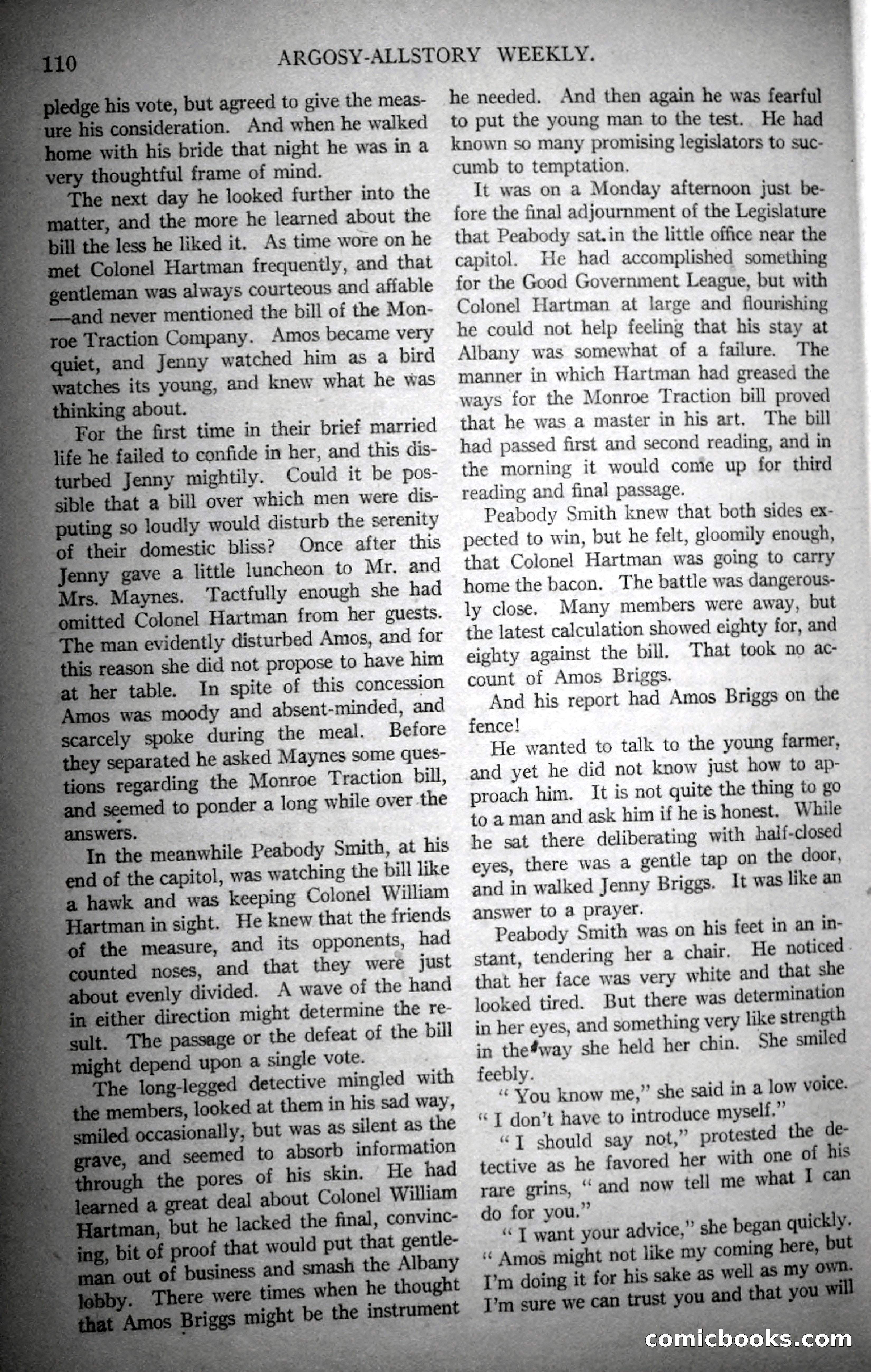
A restored page from Pulp Fiction, 1922. Page through the whole issue in the reader above.
📄 Transcribed text from this page (OCR, searchable)
Machine-transcribed from the original scan — historical spelling and the odd misread are preserved.
-_s * >i Ss but agreed to give the meas- consideration. And when he walked e next day he looked further into the ter, and the more he learned about the the less he liked it. As time wore on he Hartman frequently, and that n was always courteous and affable | never mentioned the bill of the Mon- Traction Company. Amos became very at, and Jenny watched him as a bird tches its young, and knew what he was For the first time in their brief married he failed to confide in her, and this dis- epate ved Jenny mightily. Could it be pos- e that a bill over which men were dis- iting so loudly would disturb the serenity their domestic bliss? Once after this ny gave a little luncheon to Mr. and Tactfully enough she had itted Colonel Hartman from her guests. ¢ man evidently disturbed Amos, and for s reason she did not propose to have him her table. In spite of this concession nos was moody and absent-minded, and rcely spoke during the meal. Before y separated he asked Maynes some ques- as_ regarding the Monroe Traction bill, \d seeme J to ponder a long while over the n the meanw In t ile Peabody Smith, at his d of the capitol, was watching the bill like hawk and was keeping Colonel William rtman in sight. He knew that the friends the measure, and its opponents, had mted noses, and that they were just it evenly divided. A wave of the hand ther direction might determine the re- The passage or the defeat of the bill > long-legged detective mingled with mbers, looked at them in his sad way, yecasionally, but was as silent as the d seemed to absorb information ©CVEL ne are he needed. And then again he was fearful | to put the young man to the test. He had known so many promising legislators to suc- cumb to temptation. It was on a Monday afternoon just be- fore the final adjournment of the Legislature that Peabody sat.in the little office near the capitol. He had accomplished something for the Good Government League, but with Colonel Hartman at large and flourishing he could not help feeling that his stay at Albany was somewhat of a failure. The manner in which Hartman had greased the ways for the Monroe Traction bill proved that he was a master in his art. The bill had passed first and second reading, and in the morning it would conie up for third reading and final passage. Peabody Smith knew that both sides ex- pected to win, but he felt, gloomily enough, that Colonel Hartman was going to carry home the bacon. The battle was dangerous- ly close. Many members were away, but the latest calculation showed eighty for, and eighty against the bill. T hat took no ac- count of Amos Briggs. And his report had Amos Briggs on the fence! He wanted to talk to the young farmer, and yet he did not know just how to ap- proach him. It is not quite the thing to go to a man and ask him if he is honest. While he sat there deliberating with half-closed eyes, there was a gentle tap on the door, and in walked Jenny Briggs. It was like an answer to a prayer. | Peabody Smith was on his feet in an in- stant, tendering her a chair. He noticed - that her face was very white and that she looked tired. But there was determination in her eyes, and something very like strength in thefway she held her chin. She smiled feebly. ‘ “ You know me,” she said in a low voice. — « T don’t have to introduce myself.” “J should say not,” protested the de- her with one of his .; of his skin. He had tective as he favored fis sal about Colonel William rare grins, “ and now tell me what I can — he lacked the final, convinc- do for you.” ae comicbooks.com