
Pulp Fiction, 1922 · page 123 of 180
Argosy, Vol. 147, No. 1 — page 123: what you’re looking at
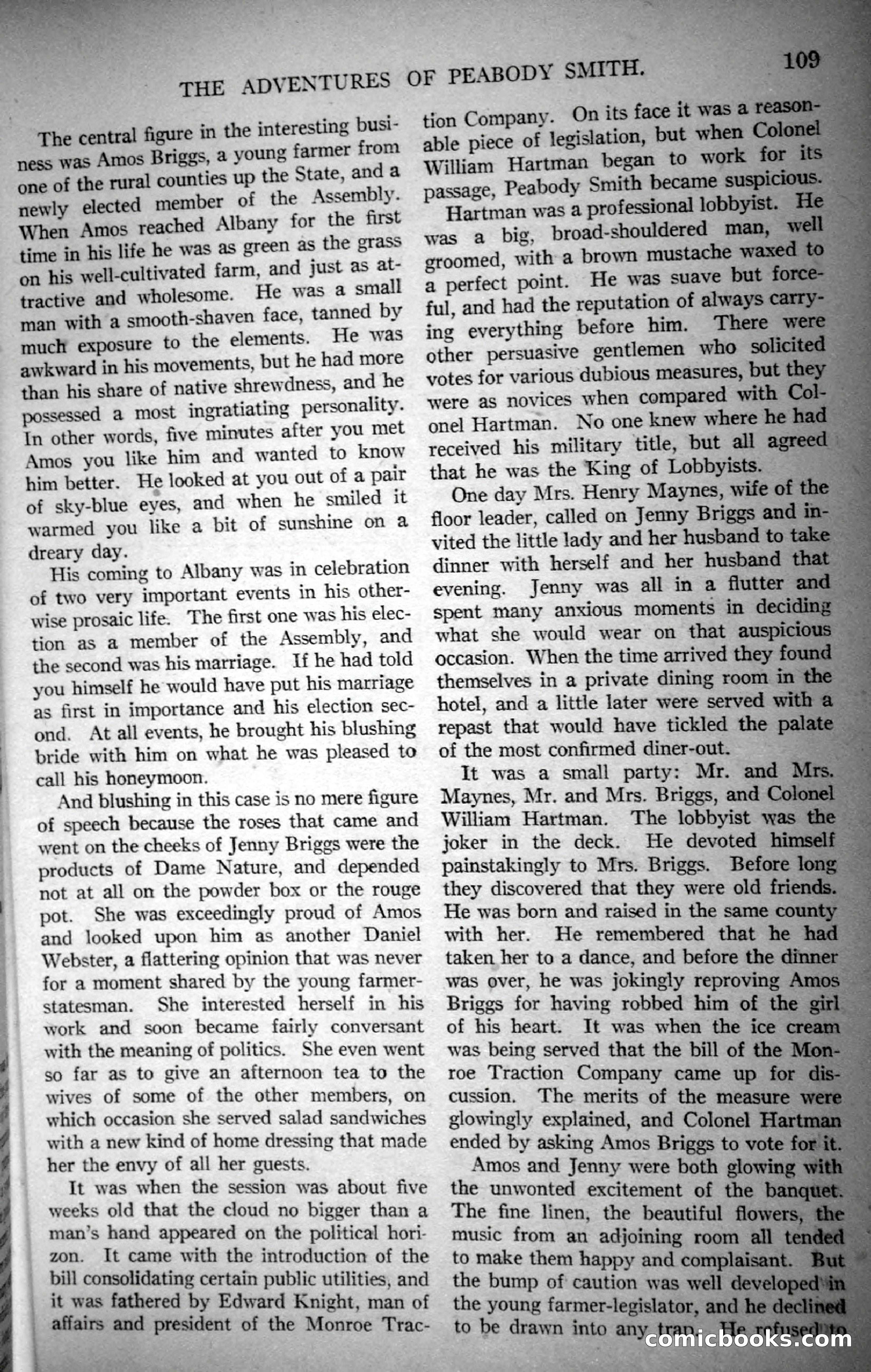
A restored page from Pulp Fiction, 1922. Page through the whole issue in the reader above.
📄 Transcribed text from this page (OCR, searchable)
Machine-transcribed from the original scan — historical spelling and the odd misread are preserved.
; | 1 1 Z “ | an The central figure in the interesting busi- ness was Amos Briggs, 4 young farmer from one of the rural counties up the State, and a newly elected member of the Assembly. When Amos reached Albany for the first time in his life he was as green as the grass on his well-cultivated farm, and just as at- tractive and wholesome. He was 4 small man with a smooth-shaven face, tanned by much exposure to the elements. He was awkward in his movements, but he had more than his share of native shrewdness, and he possessed a most ingratiating personality. In other words, five minutes after you met Amos you like him and wanted to know him better. He looked at you out of a pair of sky-blue eyes, and when he smiled it warmed you like a bit of sunshine on 2 dreary day. His coming to Albany was in celebration of two very important events in his other- wise prosaic life. The first one was his elec- tion as a member of the Assembly, and the second was his marriage. If he had told you himself he would have put his marriage as first in importance and his election sec- ond. At all events, he brought his blushing bride with him on what he was pleased to call his honeymoon. And blushing in this case is no mere figure of speech because the roses that came and went on the cheeks of Jenny Briggs were the products of Dame Nature, and depended not at all on the powder box or the rouge pot. She was exceedingly proud of Amos and looked upon him as another Daniel Webster, a flattering opinion that was never for a moment shared by the young farmer- statesman. She interested herself in his work and soon became fairly conversant with the meaning of politics. She even went so far as to give an afternoon tea to the wives of some of the other members, on which occasion she served salad sandwiches with a new kind of home dressing that made her the envy of all her guests. It was when the session was about five weeks old that the cloud no bigger than a man’s hand appeared on the political hori- zon. It came with the introduction of the bill consolidating certain public utilities, and it was fathered by Edward Knight, man of affairs and president of the Monroe Trac- F s. (ee > THE ADVENTURES OF PEABODY SMITH. Bak #5 & ~ $s tion Company. On its face it was a reas able piece of legislation, but when | — William Hartman began to work for } passage, Peabody Smith became suspicio” Hartman was a professional lobbyist. #4 was a big, broad-shouldered man, ~ groomed, with a brown mustache waxed t a perfect point. He was suave but for ful, and had the reputation of always carr ing everything before him. There wer other persuasive gentlemen who solicit votes for various dubious measures, DUE THE were as novices when compared with Co onel Hartman. No one knew where he hé received his military title, but all agre that he was the King of Lobbyists. One day Mrs. Henry Maynes, wife: floor leader, called on Jenny Briggs and a vited the little lady and her husband to tak dinner with herself and her husband tha evening. Jenny was all in a flutter an spent many anxious moments in decidin what she would wear on that auspiciou occasion. When the time arrived they four themselves in a private dining room - hotel, and a little later were served with : repast that would have tickled the palate of the most confirmed diner-out. = It was a small party: Mr. and Mrs. Maynes, Mr. and Mrs. Briggs, and Colone William Hartman. ‘The lobbyist was the joker in the deck. He devoted himself painstakingly to Mrs. Briggs. Before lol they discovered that they were old frienc He was born and raised in the same county with her. He remembered that he hac taken her to a dance, and before the dinner was over, he was jokingly reproving Am« Briggs for having robbed him of the gi of his heart. It was when the ice cre: was being served that the bill of the M roe Traction Company came up cussion. The merits of the meas glowingly explained, and Colonel | ended by asking Amos Briggs to vi Amos and Jenny were both el the unwonted excitement of tt The fine linen, the beautiful f music from an adjoining room all - to make them happy and complaisant. the bump of caution was well deve the young farmer-l zista ( to ke Seen ae: =.comicbooks.com <_ Se s oe ee sa he