
Pulp Fiction, 1907 · page 46 of 228
The Argosy, March 1907 — page 46: what you’re looking at
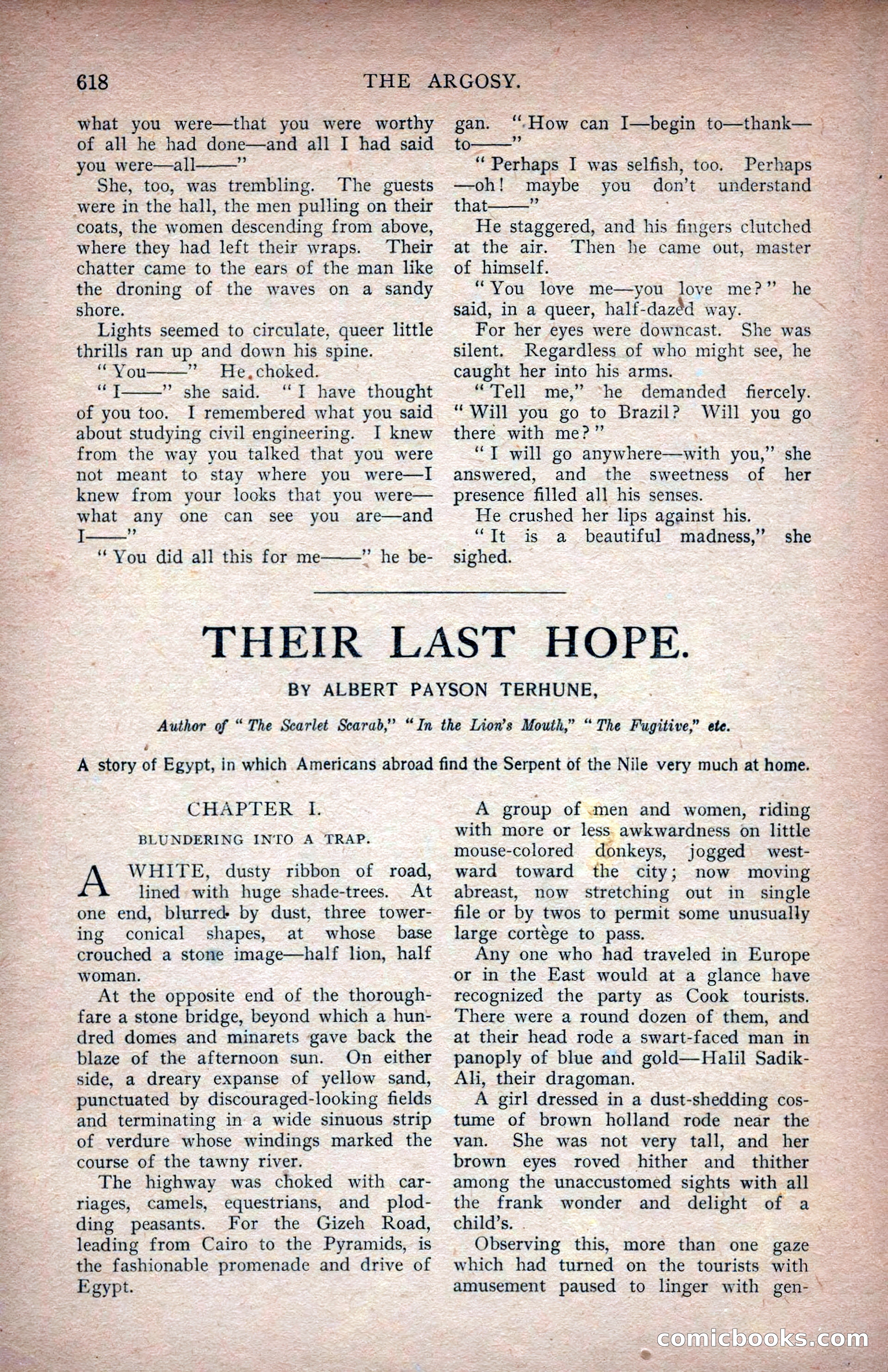
A restored page from Pulp Fiction, 1907. Page through the whole issue in the reader above.
📄 Transcribed text from this page (OCR, searchable)
Machine-transcribed from the original scan — historical spelling and the odd misread are preserved.
o<. ~- —— errs "iG we * Ape Ee ie ie a; a Por ae or Se — ated _—< =; — — oe . ST a) pee 3 oe? a » ST oo ~< + sat _ where they had left their wraps. : sehes you were—that you were way of all he had done—and all i had said you were—al]——” She, too, was trembling. The guests were in the hall, the men pulling on their coats, the women descending from above, Their chatter came to the ears of the man like the droning of the waves on a sandy shore. Lights seemed to circulate, queer little thrills ran up and down his spine. “You He, choked. i ” she said. “I have thought of you too. I remembered what you said about studying civil engineering. I knew from the way you talked that you were not meant to stay where you were—lI knew from your looks that you were— what any one can see you are—and I ”? ‘You did all this for me ” he be- “THE “ARGOSY.. ee ee gan. “ How can ‘I—begin to—thank— * ‘ pea I was selfish, too. Perhaps —oh! maybe you don’t understand that——” : | He staggered, and his fingers clutched at the air. Then he came out, master of himself. “You love me—you love me?” he said, in a queer, half-dazéd way. For her eyes were downcast. She was silent. Regardless of who might see, he caught her into his arms. “Tell me,” “he demanded fiercely. “Will you go to Brazil? Will you go there with me?” “TIT will go ake you,’ ahs answered, and the sweetness of her presence filled all his senses. He crushed her lips against his. “Tt is a beautiful madness,” she sighed. THEIR LAST HOPE. BY ALBERT PAYSON TERHUNE, Author of “The Scarlet Scarab,” “In the Lion’s Mouth,” “The Fugitive,” ete. “ A story of Egypt, in which Americans abroad find the Serpent of the Nile very much at home. CHAPTER 1. BLUNDERING INTO A TRAP. A WHITE, dusty ribbon of road, lined with huge shade-trees. At one end, blurred. by dust, three tower- ing conical shapes, at whose base crouched a stone image—half lion, half woman. At the opposite end of the thorough- fare a stone bridge, beyond which a hun- dred domes and minarets ‘gave back the blaze of the afternoon sun. On either side, a dreary expanse of yellow sand, punctuated by discouraged-looking fields and terminating in a wide sinuous strip of verdure whose windings marked the course of the tawny river. The highway was choked with car- riages, camels, equestrians, and plod- ding peasants. For the Gizeh Road, leading from Cairo to the Pyramids, is the fashionable promenade and drive of Egypt. A group of .men and women, riding with more or less awkwardness on little mouse-colored donkeys, jogged west- ward toward the city; now moving abreast, now stretching out in single file or by twos to permit some unusually large cortege to pass. Any one who had traveled in Europe — or in the East would at a glance have recognized the party as Cook tourists. There were a round dozen of them, and at their head rode a swart-faced man in panoply of blue and gold—Halil Sadik- Ali, their dragoman. A girl dressed in a dust-shedding cos- tume of brown holland rode near the van. She was not very tall, and her brown eyes roved hither and _ thither among the unaccustomed sights with all the frank wonder and delight of a child’s. Observing this, more than one gaze which had turned on the tourists with amusement paused to linger with gen- ‘ ‘ x COMICHOOKs,.co