
Pulp Fiction, 1907 · page 45 of 228
The Argosy, March 1907 — page 45: what you’re looking at
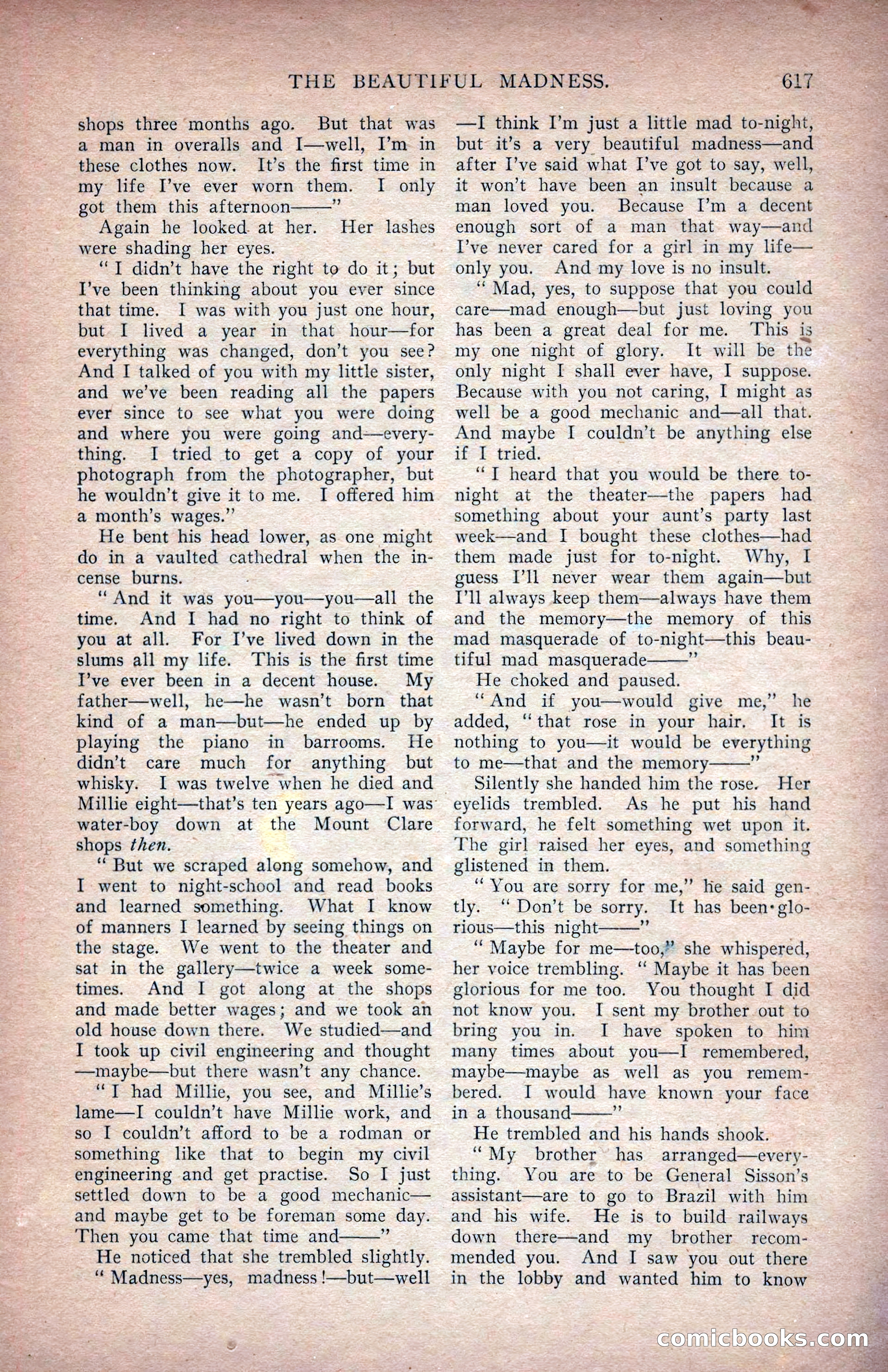
A restored page from Pulp Fiction, 1907. Page through the whole issue in the reader above.
📄 Transcribed text from this page (OCR, searchable)
Machine-transcribed from the original scan — historical spelling and the odd misread are preserved.
shops three months ago. But that was a man in overalls and I—well, I’m in these clothes now. It’s the first time in my life I’ve ever worn them. I only got them this afternoon——’ Again he looked at her. Her lashes were shading her eyes. “J didn’t have the right to do it; but I’ve been thinking about you ever since that time. I was with you just one hour, but. I lived a year in that hour—for everything was changed, don’t you see? And I talked of you with my little sister, and we've been reading all the papers ever since to see what you were doing and where you were going and-—every- thing. I tried to get a copy of your photograph from the photographer, but he wouldn’t give it to me. I offered him a month’s wages.”’ He bent his head lower, as one might do in a vaulted cathedral when the in- cense burns. : ‘And it was you—you—you—all the time. And I had no right to think of you at all. For I’ve lived down in the slums all my life. This is the first time I’ve ever been in a decent house. My father—well, he—he wasn’t born that kind of a man—but—he ended up by playing the piano in barrooms. He didn’t care much for anything but whisky. I was twelve when he died and Millie eight—that’s ten years ago—I was water-boy down at the Mount Clare shops then. — “But we scraped along somehow, and I went to night-school and read books and learned something. What I know of manners I learned by seeing things on the stage. We went to the theater and sat in the gallery—twice a week some- times. And I got along at the shops and made better wages; and we took an old house down there. We studied—and I took up civil engineering and thought —maybe—but there wasn’t any chance. “T had Millie, you see, and Millie’s lame—I couldn’t have Millie work, and so I couldn’t afford to be a rodman or something like that to begin my civil engineering and get practise. So I just settled down to be a good mechanic— and maybe get to be foreman some day. Then you came that time and——” He noticed that she trembled slightly. ‘“ Madness—yes, madness !—but—well THE BEAUTIFUL MADNESS. —TI think I’m just a little mad to-night, but it’s a very beautiful madness—and after I’ve said what I’ve got to say, well, it won't have been an insult because a man loved you. Because I’m a decent enough sort of a man that way—and I’ve never cared for a girl in my life— only you. And my love is no insult. ‘“ Mad, yes, to suppose that you could care—mad enough—but just loving you has been a great deal for me. This is my one night of glory. It will be the only night [ shall ever have, I suppose. Because with you not caring, I might as well be a good mechanic and—all that. And maybe [I couldn’t be anything else if I tried. . “T heard that you would be there to- night at the theater—the papers had something about your aunt’s party last week—and I bought these clothes—had them made just for to-night. Why, I guess I’ll never wear them again—but I'll always keep them—always have them and the memory—the memory of this mad masquerade of to-night—this beau- tiful mad masquerade = He choked and paused. ‘“And if you—would give me,” he added, ‘“‘that rose in your hair. It is nothing to you—it would be everything to me—that and the memory——’” Silently she handed him the rose. Her eyelids trembled. As he put his hand forward, he felt something wet upon it. The girl raised her eyes, and something glistened in them. “You are sorry for me,” lie said gen- tly. ‘“ Don’t be sorry. It has been:glo- rious—this night = ‘Maybe for me—too,” she whispered, her voice trembling. “ Maybe it has been glorious for me too. You thought I did not know you. I sent my brother out to bring you in. I have spoken to him many times about you—I remembered, maybe—maybe as well as you remem- bered. I would have known your face in a thousand——’”’ He trembled and his hands shook. “My brother’ has arranged—every- thing. You are to be General Sisson’s assistant—are to go to Brazil with him and his wife. He is to build railways down there—and my brother recom- mended you. And I saw you out there in the lobby and wanted him to know ? ~ pa — es * ~ one eae comicbooks.com —