
Pulp Fiction, 1925 · page 9 of 168
Argosy All-Story Weekly, June 27, 1925 — page 9: what you’re looking at
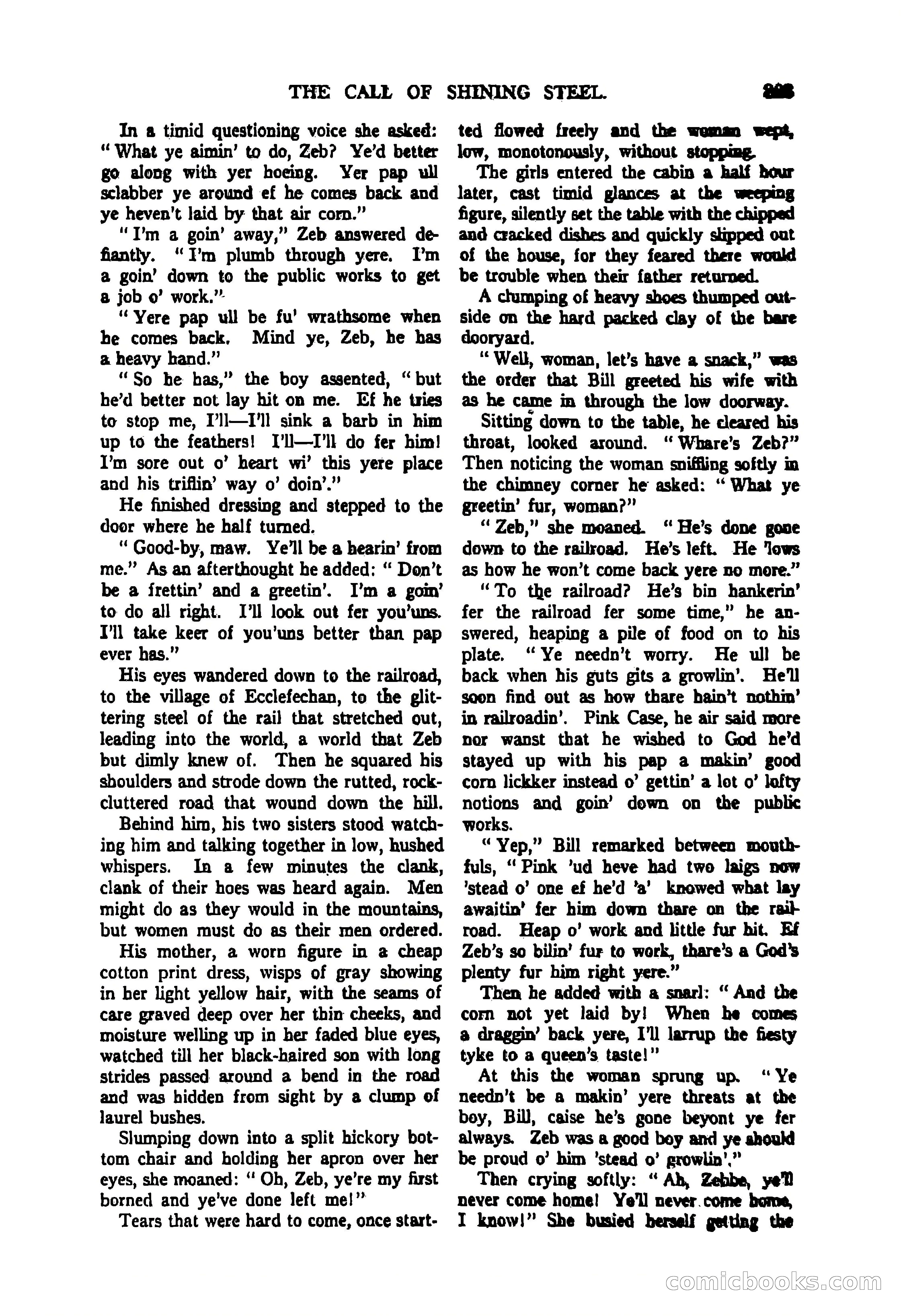
A restored page from Pulp Fiction, 1925. Page through the whole issue in the reader above.
📄 Transcribed text from this page (OCR, searchable)
Machine-transcribed from the original scan — historical spelling and the odd misread are preserved.
THE CALE OF SHINING STEEL. In a timid questioning voice she asked: “What ye aimin’ to do, Zeb? Ye’d better go along with yer hoeing. Yer pap ull sclabber ye around ef he comes back and ye heven't laid by that air corn.” ‘I’m a goin’ away,” Zeb answered de- fiantly. ‘I’m plumb through yere. I’m a goin’ down to the public works to get a job o’ work,” Yere pap ull be fu’ wrathsome when he comes back. Mind ye, Zeb, he has a heavy hand.” “So he has,” the boy assented, “ but he’d better not lay hit on me. Ef he tries to stop me, PII—I'll sink a barb in him up to the feathers! T’U—I'll do fer him! I’m sore out o’ heart wi’ this yere place and his triflin’ way o’ doin’.” He finished dressing and stepped to the door where he half turned. ‘Good-by, maw. Ye’ll be a hearin’ from me.” As an afterthought he added: “ Don’t be a frettin’ and a greetin’. I’m a goin’ to do all right. I'll look out fer you’uns. I'll take keer of you’uns better than pap ever has.”’ His eyes wandered down to the railroad, to the village of Ecclefechan, to the glit- tering steel of the rail that stretched out, leading into the world, a world that Zeb but dimly knew of. Then he squared his shoulders and strode down the rutted, rock- cluttered road that wound down the hill. Behind him, his two sisters stood watch- ing him and talking together in low, hushed whispers. In a few minutes the clank, clank of their hoes was heard again. Men might do as they would in the mountains, but women must do as their men ordered. His mother, a worn figure in a cheap cotton print dress, wisps of gray showing in her light yellow hair, with the seams of care graved deep over her thin cheeks, and moisture welling up in her faded blue eyes, watched till her black-haired son with long strides passed around a bend in the road and was hidden from sight by a clump of laurel bushes. Slumping down into a split hickory bot- tom chair and holding her apron over her eyes, she moaned: “ Oh, Zeb, ye’re my first borned and ye've done left me!” Tears that were hard to come, once start- ted flowed freely and the woman wept, low, monotonously, without stoppmeg. The girls entered the cabin a half hour later, cast timid glances at the weeping figure, silently set the table with the chipped and cracked dishes and quickly slipped out of the house, for they feared there would be trouble when their father returned. A clumping of heavy shoes thumped out- side on the hard packed clay of the bare dooryard. “Well, woman, let’s have a snack,” was the order that Bill greeted his wife with as he came in through the low doorway. Sitting down to the table, he cleared his throat, looked around. ‘“ Whare’s Zeb?” Then noticing the woman sniffling softly in the chimney corner he asked: “‘ What ye greetin’ fur, woman?” “ Zeb,”’ she moaned. “ He’s done gone down to the railroad. He’s left. He ‘ows as how he won’t come back yere no more.” ‘To the railroad? He’s bin hankerin’ fer the railroad fer some time,” he an- swered, heaping a pile of food on to his plate. ‘“‘ Ye needn’t worry. He ull be back when his guts gits a growlin’. He'll soon find out as how thare hain’t nothm’ in railroadin’. Pink Case, he air said more nor wanst that he wished to God he’d stayed up with his pap a makin’ good corn lickker instead o’ gettin’ a lot o’ lofty notions and goin’ down on the public works. “Yep,” Bill remarked between mouth- fuls, ‘ Pink ’ud heve had two laigs now ‘stead o’ one ef he'd ‘a’ knowed what lay awaitin’ fer him down thare on the rail road. Heap o’ work and little fur hit. Ef Zeb’s so bilin’ fur to work, thare’s a God’s plenty fur him right yere.” Then he added with a snarl: “ And the corn not yet laid by! When he come @ draggin’ back yere, I'll larrup the fiesty tyke to a queen’s taste!” At this the woman sprung up. “Ye needn't be a makin’ yere threats at the boy, Bill, caise he’s gone beyont ye fer always. Zeb was a good bey and ye should be proud o’ him 'stead o’ growlin’,” Then crying softly: “Ah, Zebbe, yell never come home! Ye'll never.come bome, I know!” She busied herself getting the COnniEaoo () SS Co