
Pulp Fiction, 1925 · page 10 of 168
Argosy All-Story Weekly, June 27, 1925 — page 10: what you’re looking at
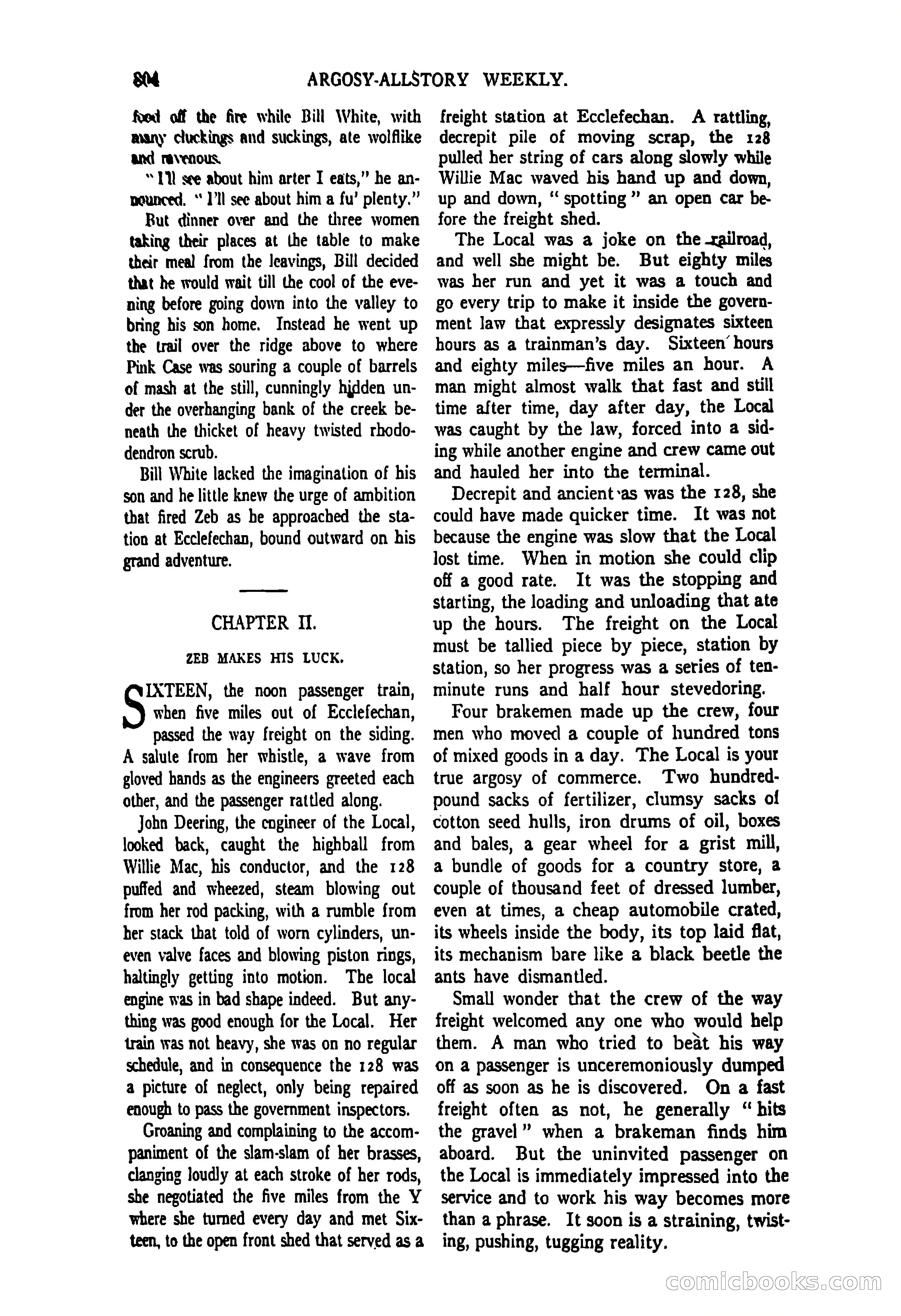
A restored page from Pulp Fiction, 1925. Page through the whole issue in the reader above.
📄 Transcribed text from this page (OCR, searchable)
Machine-transcribed from the original scan — historical spelling and the odd misread are preserved.
St food aff the fire while Bill White, with many cluckings and suckings, ate wolflike and ravenous. “TN see about him arter I eats,” he an- pounced. ‘‘]’ll see about him a fu’ plenty.” But dinner over and the three women taking their places at the table to make their meal from the leavings, Bill decided that he would wait till the cool of the eve- ning before going down into the valley to bring his son home. Instead he went up the trail over the ridge above to where Pink Case was souring a couple of barrels of mash at the still, cunningly hidden un- der the overhanging bank of the creek be- neath the thicket of heavy twisted rhodo- dendron scrub. Bill White lacked the imagination of his son and he little knew the urge of ambition that fired Zeb as he approached the sta- tion at Ecclefechan, bound outward on his grand adventure. CHAPTER II. ZEB MAKES HIS LUCK. IXTEEN, the noon passenger train, S when five miles out of Ecclefechan, passed the way freight on the siding. A salute from her whistle, a wave from gloved hands as the engineers greeted each other, and the passenger rattled along. John Deering, the engineer of the Local, looked back, caught the highball from Willie Mac, his conductor, and the 128 puffed and wheezed, steam blowing out from her rod packing, with a rumble from her stack that told of worn cylinders, un- even valve faces and blowing piston rings, haltingly getting into motion. The local engine was in bad shape indeed. But any- thing was good enough for the Local. Her train was not heavy, she was on no regular schedule, and in consequence the 128 was a picture of neglect, only being repaired enough to pass the government inspectors. Groaning and complaining to the accom- paniment of the slam-slam of her brasses, clanging loudly at each stroke of her rods, she negotiated the five miles from the Y where she turned every day and met Six- teen, to the open front shed that served as a ARGOSY-ALLSTORY WEEKLY. freight station at Ecclefechan. A rattling, decrepit pile of moving scrap, the 128 pulled her string of cars along slowly while Willie Mac waved his hand up and down, up and down, “ spotting ”’ an open car be- fore the freight shed. The Local was a joke on the -zailroad, and well she might be. But eighty miles was her run and yet it was a touch and go every trip to make it inside the govern- ment law that expressly designates sixteen hours as a trainman’s day. Sixteen’ hours and eighty miles—five miles an hour. A man might almost walk that fast and still time after time, day after day, the Local was caught by the law, forced into a sid- ing while another engine and crew came out and hauled her into the terminal. Decrepit and ancient‘as was the 128, she could have made quicker time. It was not because the engine was slow that the Local lost time. When in motion she could clip off a good rate. It was the stopping and starting, the loading and unloading that ate up the hours. The freight on the Local must be tallied piece by piece, station by station, so her progress was a series of ten- minute runs and half hour stevedoring. Four brakemen made up the crew, four men who moved a couple of hundred tons of mixed goods in a day. The Local is your true argosy of commerce. Two hundred- pound sacks of fertilizer, clumsy sacks of cotton seed hulls, iron drums of oil, boxes and bales, a gear wheel for a grist mill, a bundle of goods for a country store, a couple of thousand feet of dressed lumber, even at times, a cheap automobile crated, its wheels inside the body, its top laid flat, its mechanism bare like a black beetle the ants have dismantled. Small wonder that the crew of the way freight welcomed any one who would help them. A man who tried to beat his way on a passenger is unceremoniously dumped off as soon as he is discovered. On a fast freight often as not, he generally “hits the gravel” when a brakeman finds him aboard. But the uninvited passenger on the Local is immediately impressed into the service and to work his way becomes more than a phrase. It soon is a straining, twist- ing, pushing, tugging reality. COnniEaoo () SS Co