
Pulp Fiction, 1925 · page 82 of 168
Argosy All-Story Weekly, June 27, 1925 — page 82: what you’re looking at
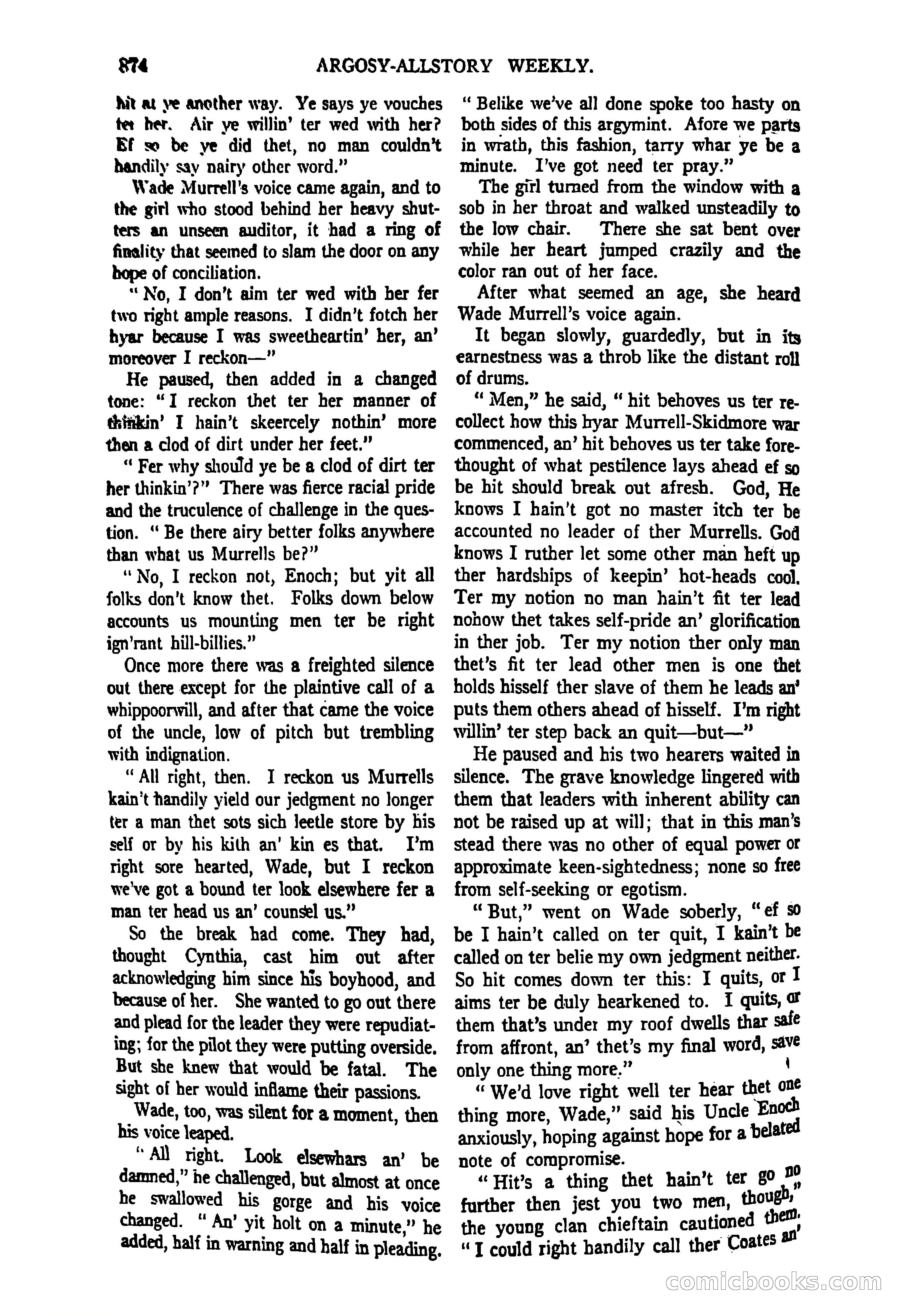
A restored page from Pulp Fiction, 1925. Page through the whole issue in the reader above.
📄 Transcribed text from this page (OCR, searchable)
Machine-transcribed from the original scan — historical spelling and the odd misread are preserved.
R74 hit at ye another way. Ye says ye vouches te: her. Air ye willin’ ter wed with her? Bf w be ye did thet, no man couldn't handily say nairy other word.” Wade Murrell’s voice came again, and to the girl who stood behind her heavy shut- ters an unseen auditor, it had a ring of finality that seemed to slam the door on any hope of conciliation. ‘No, I don’t aim ter wed with her fer two right ample reasons. I didn’t fotch her hyar because I was sweetheartin’ her, an’ moreover I reckon—” He paused, then added in a changed tone: “I reckon thet ter her manner of thinkin’ I hain’t skeercely nothin’ more then a clod of dirt under her feet.” “ Fer why should ye be a clod of dirt ter her thinkin’?”” There was fierce racial pride and the truculence of challenge in the ques- tion. ‘ Be there airy better folks anywhere than what us Murrells be?” “No, I reckon not, Enoch; but yit all folks don’t know thet. Folks down below accounts us mounting men ter be right ign’rant hill-billies.” Once more there was a freighted silence out there except for the plaintive call of a whippoorwill, and after that came the voice of the uncle, low of pitch but trembling with indignation. “All right, then. I reckon us Murrells kain’t handily yield our jedgment no longer ter a man thet sots sich leetle store by his self or by his kith an’ kin es that. [’m right sore hearted, Wade, but I reckon we've got a bound ter look elsewhere fer a man ter head us an’ counsel us.” So the break had come. They had, thought Cynthia, cast him out after acknowledging him since his boyhood, and because of her. She wanted to go out there and plead for the leader they were repudiat- ing; for the pilot they were putting overside. But she knew that would be fatal. The sight of her would inflame their passions. Wade, too, was silent for a moment, then his voice leaped. “ All right. Look elsewhars an’ be damned,” he challenged, but almost at once he swallowed his gorge and his voice changed. ‘An’ yit holt on a minute.” he added, half in warning and half in pleading. ARGOSY-ALLSTORY WEEKLY. ‘‘ Belike we’ve all done spoke too hasty on both sides of this argymint. Afore we parts in wrath, this fashion, tarry whar ye be a minute. I’ve got need ter pray.” The girl tumed from the window with a sob in her throat and walked unsteadily to the low chair. There she sat bent over while her heart jumped crazily and the color ran out of her face. After what seemed an age, she heard Wade Murrell’s voice again. It began slowly, guardedly, but in its earnestness was a throb like the distant roll of drums. “ Men,” he said, “ hit behoves us ter re- collect how this byar Murrell-Skidmore war commenced, an’ hit behoves us ter take fore- thought of what pestilence lays ahead ef sp be hit should break out afresh. God, He knows [I hain’t got no master itch ter be accounted no leader of ther Murrells. God knows I ruther let some other man heft up ther hardships of keepin’ hot-heads cool, Ter my notion no man hain’t fit ter lead nohow thet takes self-pride an’ glorification in ther job. Ter my notion ther only man thet’s fit ter lead other men is one thet holds hisself ther slave of them he leads an’ puts them others ahead of hisself. I’m right willin’ ter step back an quit—but—” He paused and his two hearers waited in silence. The grave knowledge lingered with them that leaders with inherent ability can not be raised up at will; that in this man’s stead there was no other of equal power or approximate keen-sightedness; none so free from self-seeking or egotism. “But,” went on Wade soberly, “ef s0 be I hain’t called on ter quit, I kain’t be called on ter belie my own jedgment neither. So hit comes down ter this: I quits, or J aims ter be duly hearkened to. I quits, @ them that’s under my roof dwells thar safe from affront, an’ thet’s my final word, save only one thing more.” ' “We'd love right well ter hear thet on¢ thing more, Wade,” said his Uncle Enoch anxiously, hoping against hope for a bela note of compromise. “Hit’s a thing thet hain’t ter 6° ne further then jest you two men, thoug, the young clan chieftain cautioned ae “T could right handily call ther Coates COMmica@oo SS Co