
Pulp Fiction, 1925 · page 81 of 168
Argosy All-Story Weekly, June 27, 1925 — page 81: what you’re looking at
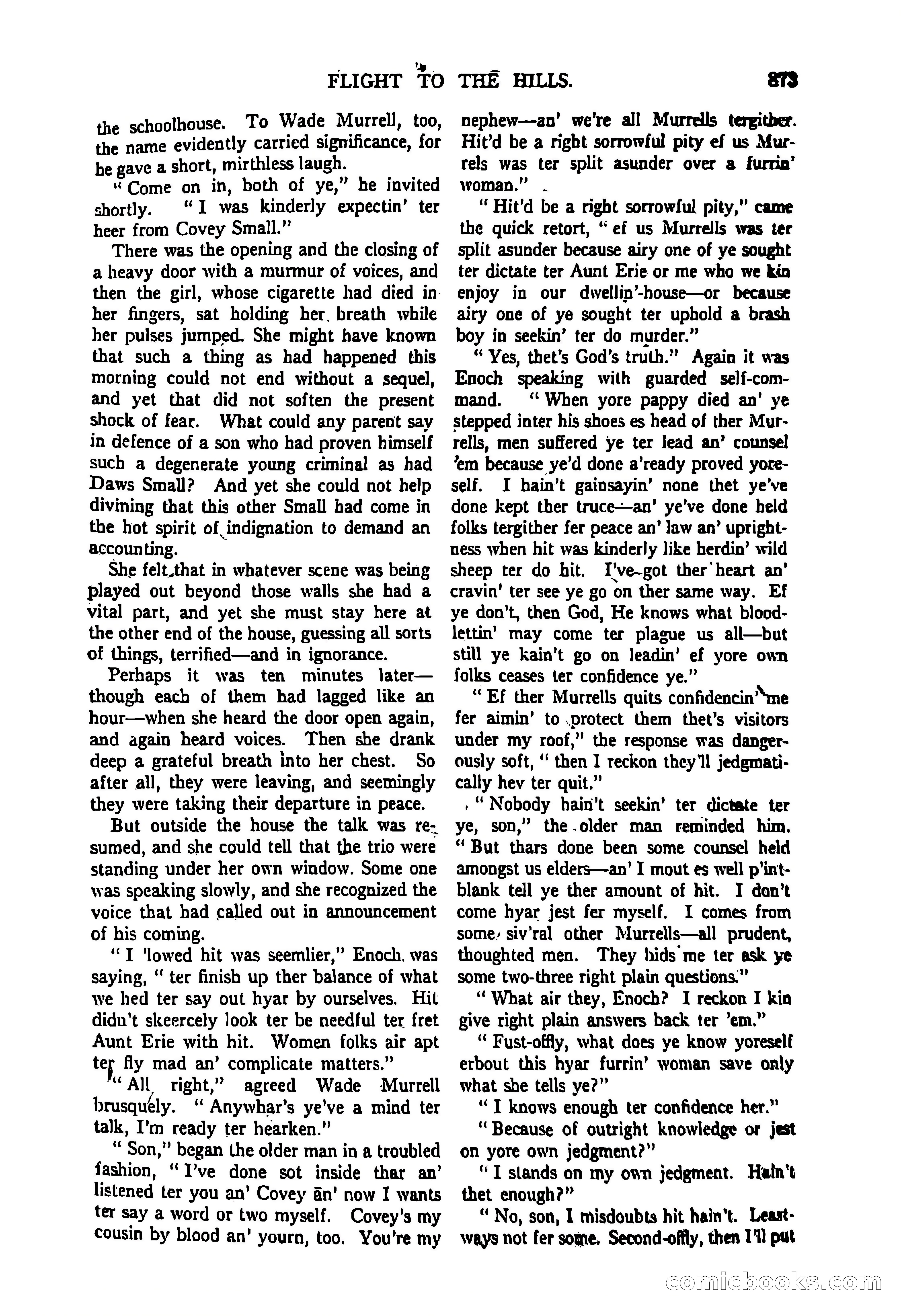
A restored page from Pulp Fiction, 1925. Page through the whole issue in the reader above.
📄 Transcribed text from this page (OCR, searchable)
Machine-transcribed from the original scan — historical spelling and the odd misread are preserved.
FLIGHT TO the schoolhouse. To Wade Murrell, too, the name evidently carried significance, for he gave a short, mirthless laugh. “Come on in, both of ye,” he invited shortly. “IT was kinderly expectin’ ter heer from Covey Small.” There was the opening and the closing of a heavy door with a murmur of voices, and then the girl, whose cigarette had died in. her fingers, sat holding her. breath while her pulses jumped. She might have known that such a thing as had happened this morning could not end without a sequel, and yet that did not soften the present Shock of fear. What could any parent say in defence of a son who had proven himself such a degenerate young criminal as had Daws Small? And yet she could not help divining that this other Small had come in the hot spirit of indignation to demand an accounting. She felt.that in whatever scene was being played out beyond those walls she had a vital part, and yet she must stay here at the other end of the house, guessing all sorts of things, terrified—and in ignorance. Perhaps it was ten minutes later— though each of them had lagged like an hour—when she heard the door open again, and again heard voices. Then she drank deep a grateful breath into her chest. So after all, they were leaving, and seemingly they were taking their departure in peace. But outside the house the talk was re- sumed, and she could tell that the trio were standing under her own window. Some one was speaking slowly, and she recognized the voice that had called out in announcement of his coming. ““T ‘lowed hit was seemlier,’’ Enoch, was saying, “‘ ter finish up ther balance of what we hed ter say out hyar by ourselves. Hit didn't skeercely look ter be needful ter fret Aunt Erie with hit. Women folks air apt tes fly mad an’ complicate matters.” “ All right,” agreed Wade Murrell brusquely. ‘ Anywhar’s ye’ve a mind ter talk, I’m ready ter hearken.” “ Son,” began the older man in a troubled fashion, “I’ve done sot inside thar an’ listened ter you an’ Covey dn’ now I wants ter say a word or two myself. Covey’s my cousin by blood an’ yourn, too. You're my THE HILLS. 873 nephew—an’ we're all Murrells tergitber. Hit’d be a right sorrowful pity ef us Mur- rels was ter split asunder over a furrin’ woman.” . “ Hit’d be a right sorrowful pity,” came the quick retort, “ef us Murrells was ter split asunder because airy one of ye sought ter dictate ter Aunt Erie or me who we kin enjoy in our dvwellin’-house—or because airy one of ye sought ter uphold a brash boy in seekin’ ter do murder.” “Yes, thet’s God’s truth.” Again it was Enoch speaking with guarded self-com- mand. ‘‘ When yore pappy died an’ ye stepped inter his shoes es head of ther Mur- rells, men suffered ye ter lead an’ counsel ‘em because ye’d done a’ready proved yore- self. I hain’t gainsayin’ none thet ye’ve done kept ther truce—an’ ye’ve done held folks tergither fer peace an’ law an’ upright- ness when hit was kinderly like herdin’ wild sheep ter do hit. I’ve-got ther heart an’ cravin’ ter see ye go on ther same way. Ef ye don’t, then God, He knows what blood- lettin’ may come ter plague us all—but still ye kain’t go on leadin’ ef yore own folks ceases ter confidence ye.” “Ef ther Murrells quits confidencin™me fer aimin’ to .protect them thet’s visitors under my roof,”’ the response was danger- ously soft, “ then 1 reckon they'll jedgmati- cally hev ter quit.” . ““ Nobody hain’t seekin’ ter dictate ter ye, son,” the-older man reminded him. “But thars done been some counsel held amongst us elders—an’ I mout es well p'int- blank tell ye ther amount of hit. I don't come hyar jest fer myself. I comes from some, siv’ral other Murrells—all prudent, thoughted men. They hids me ter ask ye some two-three right plain questions.” ‘What air they, Enoch? I reckon I kin give right plain answers back ter 'em.” ‘« Fust-offly, what does ye know yoreself erbout this hyar furrin’ woman save only what she tells ye?” “T knows enough ter confidence her.” “Because of outright knowledge or jest on yore own jedgment?” “T stands on my own jedgment. Hain't thet enough?” “ No, son, I misdoubts hit hain't. Least- ways not fer some. Second-ofily, then I'll put GOMIGDOOo C SS Co