
Pulp Fiction, 1925 · page 35 of 168
Argosy All-Story Weekly, June 27, 1925 — page 35: what you’re looking at
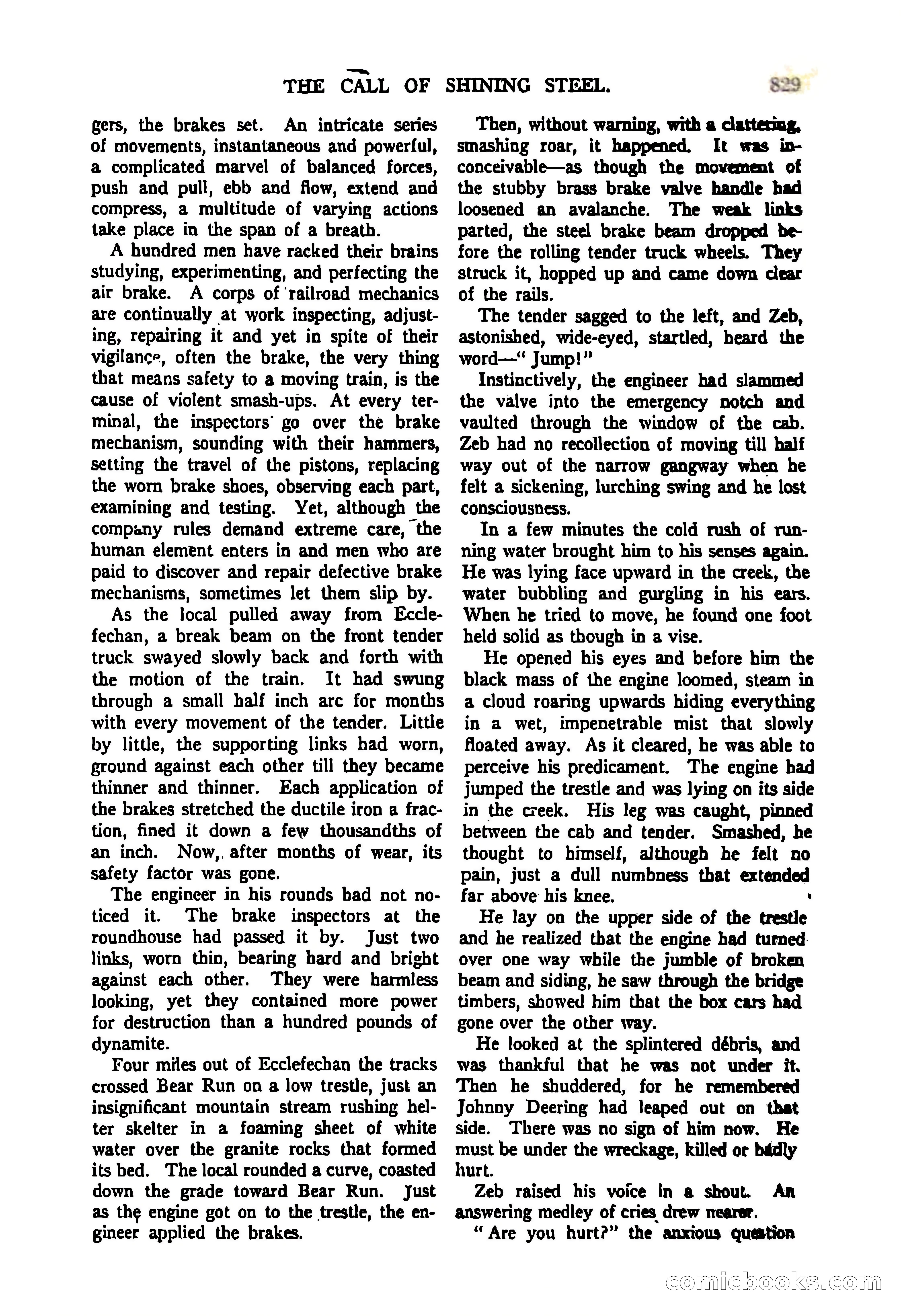
A restored page from Pulp Fiction, 1925. Page through the whole issue in the reader above.
📄 Transcribed text from this page (OCR, searchable)
Machine-transcribed from the original scan — historical spelling and the odd misread are preserved.
THE CALL OF SHINING STEEL. gers, the brakes set. An intricate series of movements, instantaneous and powerful, a complicated marvel of balanced forces, push and pull, ebb and flow, extend and compress, a multitude of varying actions take place in the span of a breath. A hundred men have racked their brains studying, experimenting, and perfecting the air brake. A corps of ‘railroad mechanics are continually at work inspecting, adjust- ing, repairing it and yet in spite of their vigilance, often the brake, the very thing that means safety to a moving train, is the cause of violent smash-ups. At every ter- minal, the inspectors’ go over the brake mechanism, sounding with their hammers, Setting the travel of the pistons, replacing the worn brake shoes, observing each part, examining and testing. Yet, although the company rules demand extreme care, the human element enters in and men who are paid to discover and repair defective brake mechanisms, sometimes let them slip by. As the local pulled away from Eccle- fechan, a break beam on the front tender truck swayed slowly back and forth with the motion of the train. It had swung through a small half inch arc for months with every movement of the tender. Little by little, the supporting links had worn, ground against each other till they became thinner and thinner. Each application of the brakes stretched the ductile iron a frac- tion, fined it down a few thousandths of an inch. Now,, after months of wear, its safety factor was gone. The engineer in his rounds had not no- ticed it. The brake inspectors at the roundhouse had passed it by. Just two links, worn thin, bearing bard and bright against each other. They were harmless looking, yet they contained more power for destruction than a hundred pounds of dynamite. Four miles out of Ecclefechan the tracks crossed Bear Run on a low trestle, just an insignificant mountain stream rushing hel- ter skelter in a foaming sheet of white water over the granite rocks that formed its bed. The local rounded a curve, coasted down the grade toward Bear Run. Just as the engine got on to the trestle, the en- gineer applied the brakes. 829 Then, without warning, with a clattering, smashing roar, it happened. It was in- conceivable—as though the movement of the stubby brass brake valve handle had loosened an avalanche. The weak links parted, the steel brake beam dropped be- fore the rolling tender truck wheels. They struck it, hopped up and came down clear of the rails. The tender sagged to the left, and Zeb, astonished, wide-eyed, startled, heard the word—“ Jump!” Instinctively, the engineer had slammed the valve into the emergency notch and vaulted through the window of the cab. Zeb had no recollection of moving till half way out of the narrow gangway when he felt a sickening, lurching swing and he lost consciousness. In a few minutes the cold rush of run- ning water brought him to his senses again. He was lying face upward in the creek, the water bubbling and gurgling in his ears. When he tried to move, he found one foot held solid as though in a vise. He opened his eyes and before him the black mass of the engine loomed, steam in a cloud roaring upwards hiding everything in a wet, impenetrable mist that slowly floated away. As it cleared, he was able to perceive his predicament. The engine had jumped the trestle and was lying on its side in the creek. His leg was caught, pinned between the cab and tender. Smashed, he thought to himself, although he felt no pain, just a dull numbness that extended far above his knee. ' He lay on the upper side of the trestle and he realized that the engine had turned. over one way while the jumble of broken beam and siding, he saw through the bridge timbers, showed him that the box cars had gone over the other way. He looked at the splintered débris, and was thankful that he was not under it. Then he shuddered, for he remembered Johnny Deering had leaped out on that side. There was no sign of him now. He must be under the wreckage, killed or badly hurt. Zeb raised his voice In a shout. An answering medley of cries drew nearer. “Are you hurt?” the anxious question COMmica@oo SS Co