
Pulp Fiction, 1925 · page 34 of 168
Argosy All-Story Weekly, June 27, 1925 — page 34: what you’re looking at
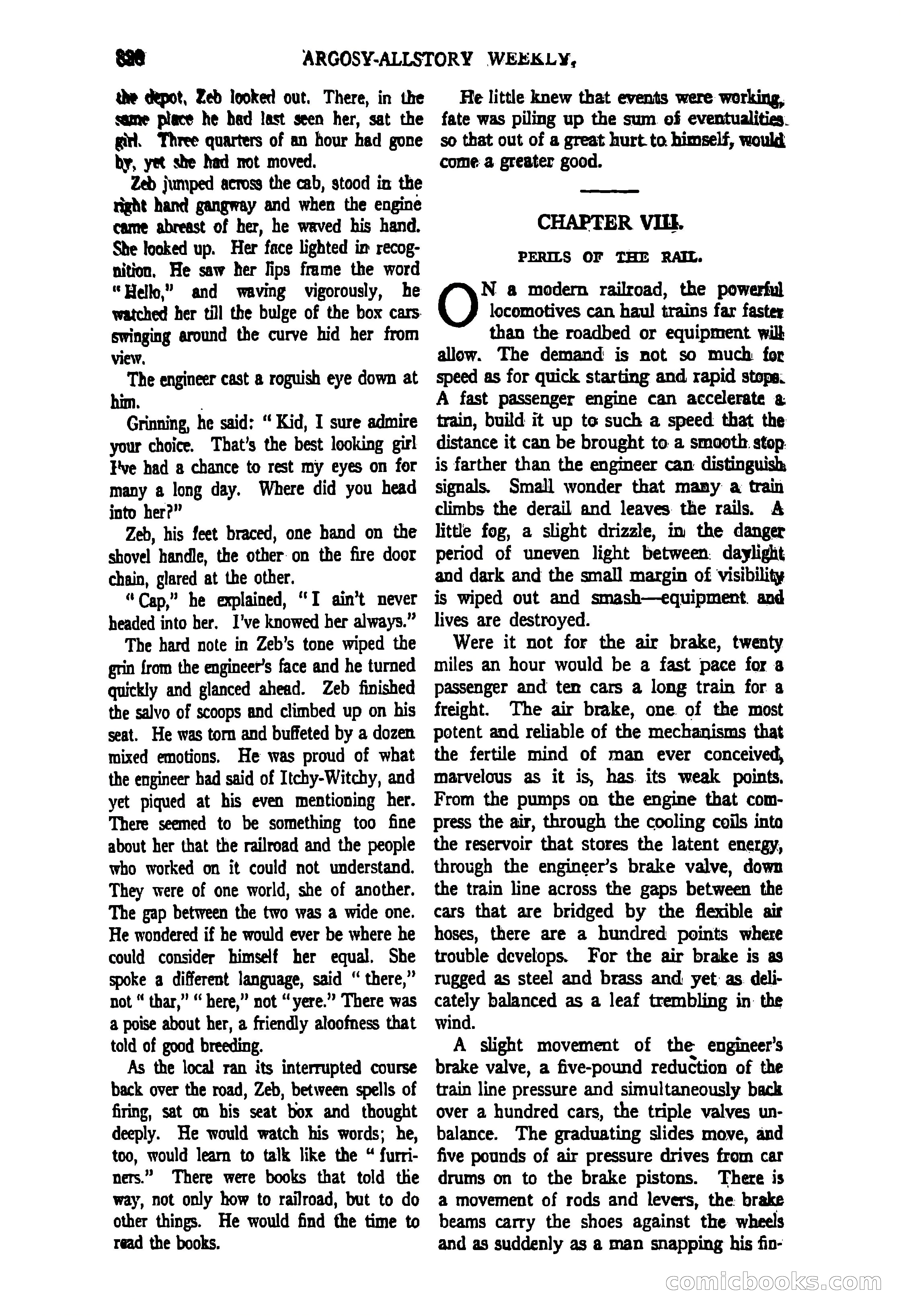
A restored page from Pulp Fiction, 1925. Page through the whole issue in the reader above.
📄 Transcribed text from this page (OCR, searchable)
Machine-transcribed from the original scan — historical spelling and the odd misread are preserved.
e908 the depot, Zeb looked out. There, in the same place he had last seen her, sat the gir. Three quarters of an hour had gone y, yet she had not moved. Zeb jumped across the cab, stood in the right hand gangway and when the engine came abreast of her, he waved his hand. She looked up. Her face lighted im recog- nition, He saw her lips frame the word Hello,” and waving vigorously, he watched her till the bulge of the box cars. swinging around the curve hid her from View, The engineer cast a roguish eye down at Grinning, he said: “ Kid, I sure admire your choice. That’s the best looking girl I've had 2 chance to rest my eyes on for many a long day. Where did you head into her?” Zeb, his feet braced, one hand on the shovel handle, the other on the fire door chain, glared at the other. “Cap,” he explained, “I ain’t never headed into ber. I’ve knowed her always.” The hard note in Zeb’s tone wiped the grin from the engineer's face and he turned quickly and glanced ahead. Zeb finished the salvo of scoops and climbed up on his seat. He was torn and buffeted by a dozen mixed emotions. He was proud of what the engineer had said of Itchy-Witchy, and yet piqued at his even mentioning her. There seemed to be something too fine about her that the railroad and the people who worked on it could not understand. They were of one world, she of another. The gap between the two was a wide one. He wondered if he would ever be where he could consider himself her equal. She spoke a different language, said “ there,” not “ thar,” “ here,” not “yere.” There was a poise about her, a friendly aloofness that told of good breeding. As the local ran its interrupted course back over the road, Zeb, between spells of firing, sat on his seat box and thought deeply. He would watch his words; he, too, would learn to talk like the “ furri- ners.” There were books that told the way, not only how to railroad, but to do other things. He would find the time to read the books. ARGOSY-ALLSTORY WEEKLY, Re little knew that events were working, fate was piling up the s sum. of eventualities. so that out of a great hurt to. himself, would come a greater good. PERILS OF THE RAIL. N a modern railroad, the powerful O locomotives can haul trains far faster than the roadbed or equipment will allow. The demand is not so much for speed as for quick starting and rapid stops. A fast passenger engine can accelerate a train, build it up to such a speed that the distance it can be brought to a smooth. stop. is farther than the engineer can distinguish, signals. Small wonder that many a train climbs the derail and leaves the rails. A little fog, a slight drizzle, in the danger period of uneven light between. daylight and dark and the small margin of visibility is wiped out and smash—equipment. and lives are destroyed. Were it not for the air brake, twenty miles an hour would be a fast pace for a passenger and ten cars a long train for a freight. The air brake, one of the most potent and reliable of the mechanisms that the fertile mind of man ever conceived, marvelous as it is, has. its weak points, From the pumps on the engine that com- press the air, through the cooling coils into the reservoir that stores the latent energy, through the engineer’s brake valve, down the train line across the gaps between the cars that are bridged by the flexible air hoses, there are a hundred points where trouble develops. For the air brake is as rugged as steel and brass and: yet. as. deli- cately balanced as a leaf trembling in: the wind. A slight movement of the engineer's brake valve, a five-pound reduction of the train line pressure and simultaneously back over a hundred cars, the triple valves un- balance. The graduating slides move, and five pounds of air pressure drives from car drums on to the brake pistons. There is a movement of rods and levers, the: brake beams carry the shoes against the wheels and as suddenly as a man snapping his fin- GOMIGDOOo C SS Co