
Pulp Fiction, 1925 · page 22 of 168
Argosy All-Story Weekly, June 27, 1925 — page 22: what you’re looking at
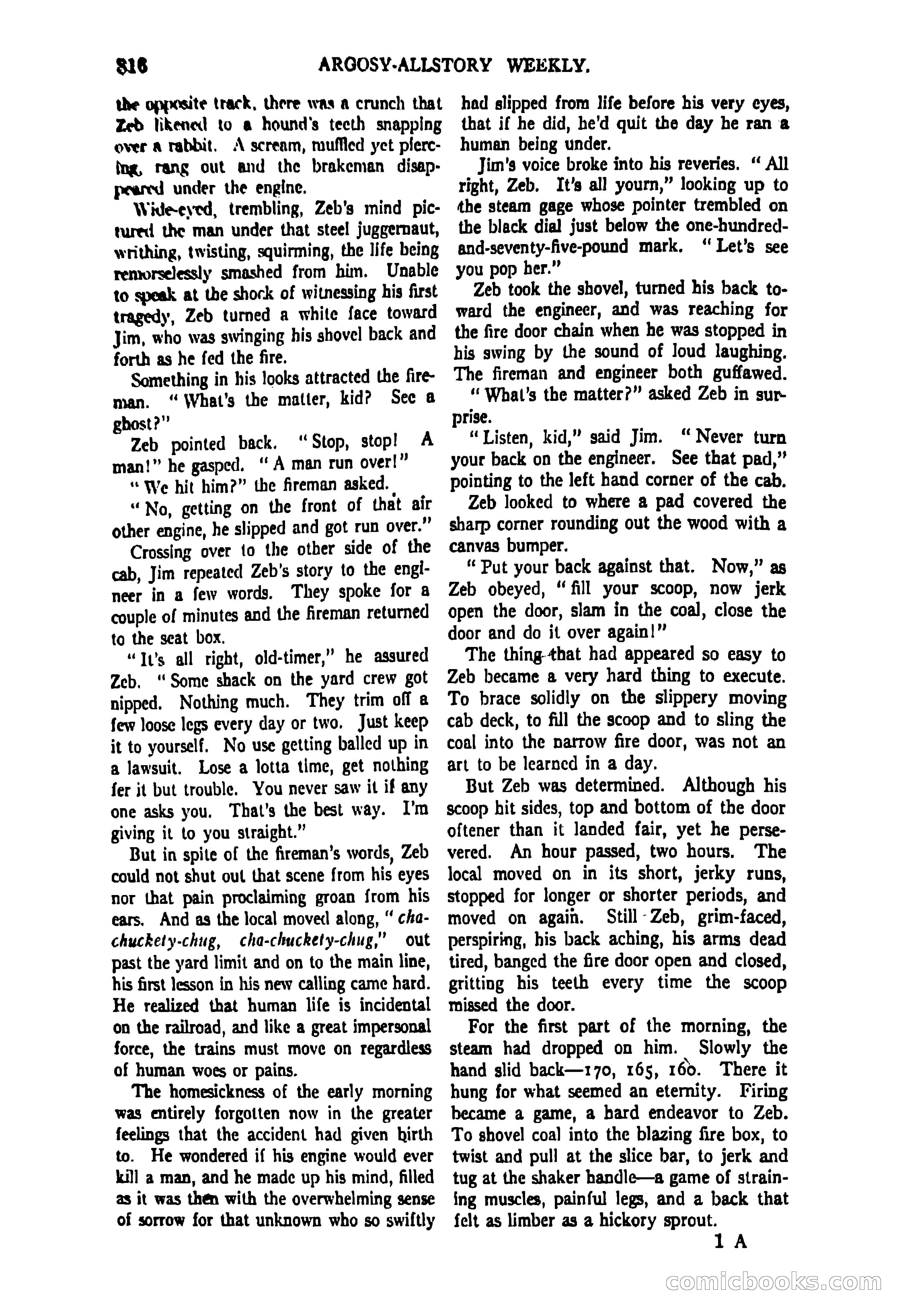
A restored page from Pulp Fiction, 1925. Page through the whole issue in the reader above.
📄 Transcribed text from this page (OCR, searchable)
Machine-transcribed from the original scan — historical spelling and the odd misread are preserved.
$16 the opposite track, there was a crunch that Zed likened to a hound's teeth snapping over a rabbit. A scream, muffled yet plerc- ing, rang out and the brakeman disap- peared under the engine. Wideeyed, trembling, Zeb’s mind pic- tured the man under that steel juggernaut, writhing, twisting, squirming, the life being renvorselessly smashed from him. Unable to speak at the shock of witnessing his first tragedy, Zeb turned a white face toward Jim, who was swinging his shovel back and forth as he fed the fire. Something in his looks attracted the fire- man. “What's the matter, kid? See a ghost?” Zeb pointed back. ‘Stop, stop! A man!” he gasped. ‘A man run over!” ‘We hit him?” the fireman asked. “No, getting on the front of that air other engine, he slipped and got run over.” Crossing over to the other side of the cab, Jim repeated Zeb’s story to the engi- neer in a few words. They spoke for a couple of minutes and the fireman returned to the seat box. “T's all right, old-timer,” he assured Zeb. ‘Some shack on the yard crew got nipped. Nothing much. They trim off a few loose legs every day or two. Just keep it to yourself. No use getting balled up in a lawsuit. Lose a lotta time, get nothing fer it but trouble. You never saw it if any one asks you. That’s the best way. I’m giving it to you straight.” But in spite of the fireman’s words, Zeb could not shut out that scene from his eyes nor that pain proclaiming groan from his ears. And as the local moved along, “ cha- chuckety-chug, cha-chuckety-chug,’ out past the yard limit and on to the main line, his first lesson in his new calling came hard. He realized that human life is incidental on the railroad, and like a great impersonal force, the trains must move on regardless of human woes or pains. The homesickness of the early morning was entirely forgotten now in the greater feelings that the accident had given hirth to. He wondered if his engine would ever kill a man, and he made up his mind, filled as it was thén with the overwhelming sense of sorrow for that unknown who so swiftly ARGOSY-ALLSTORY WEEKLY. had slipped from life before his very eyes, that if he did, he'd quit the day he ran a human being under. Jim's voice broke into his reveries. ‘ All right, Zeb. It’s all yourn,” looking up to the steam gage whose pointer trembled on the black dial just below the one-hundred- and-seventy-five-pound mark. ‘ Let’s see you pop her.” Zeb took the shovel, turned his back to- ward the engineer, and was reaching for the fire door chain when he was stopped in his swing by the sound of loud laughing. The fireman and engineer both guffawed. ‘What's the matter?” asked Zeb in sur prise. “Listen, kid,” said Jim. “ Never turn your back on the engineer. See that pad,” pointing to the left hand corner of the cab. Zeb looked to where a pad covered the sharp corner rounding out the wood with a canvas bumper. “ Put your back against that. Now,” as Zeb obeyed, “fill your scoop, now jerk open the door, slam in the coal, close the door and do it over again!” The thing-that had appeared so easy to Zeb became a very hard thing to execute. To brace solidly on the slippery moving cab deck, to fill the scoop and to sling the coal into the narrow fire door, was not an art to be learned in a day. But Zeb was determined. Although his scoop hit sides, top and bottom of the door oftener than it landed fair, yet he perse- vered. An hour passed, two hours. The local moved on in its short, jerky runs, stopped for longer or shorter periods, and moved on again. Still- Zeb, grim-faced, perspiring, his back aching, his arms dead tired, banged the fire door open and closed, gritting his teeth every time the scoop missed the door. For the first part of the morning, the steam had dropped on him. Slowly the hand slid back—170, 165, 160. There it hung for what seemed an etemity. Firing became a game, a hard endeavor to Zeb. To shovel coal into the blazing fire box, to twist and pull at the slice bar, to jerk and tug at the shaker handle—a game of strain- ing muscles, painful legs, and a back that felt as limber as a hickory sprout. 1A COnniEaoo () SS Co