
Pulp Fiction, 1925 · page 21 of 168
Argosy All-Story Weekly, June 27, 1925 — page 21: what you’re looking at
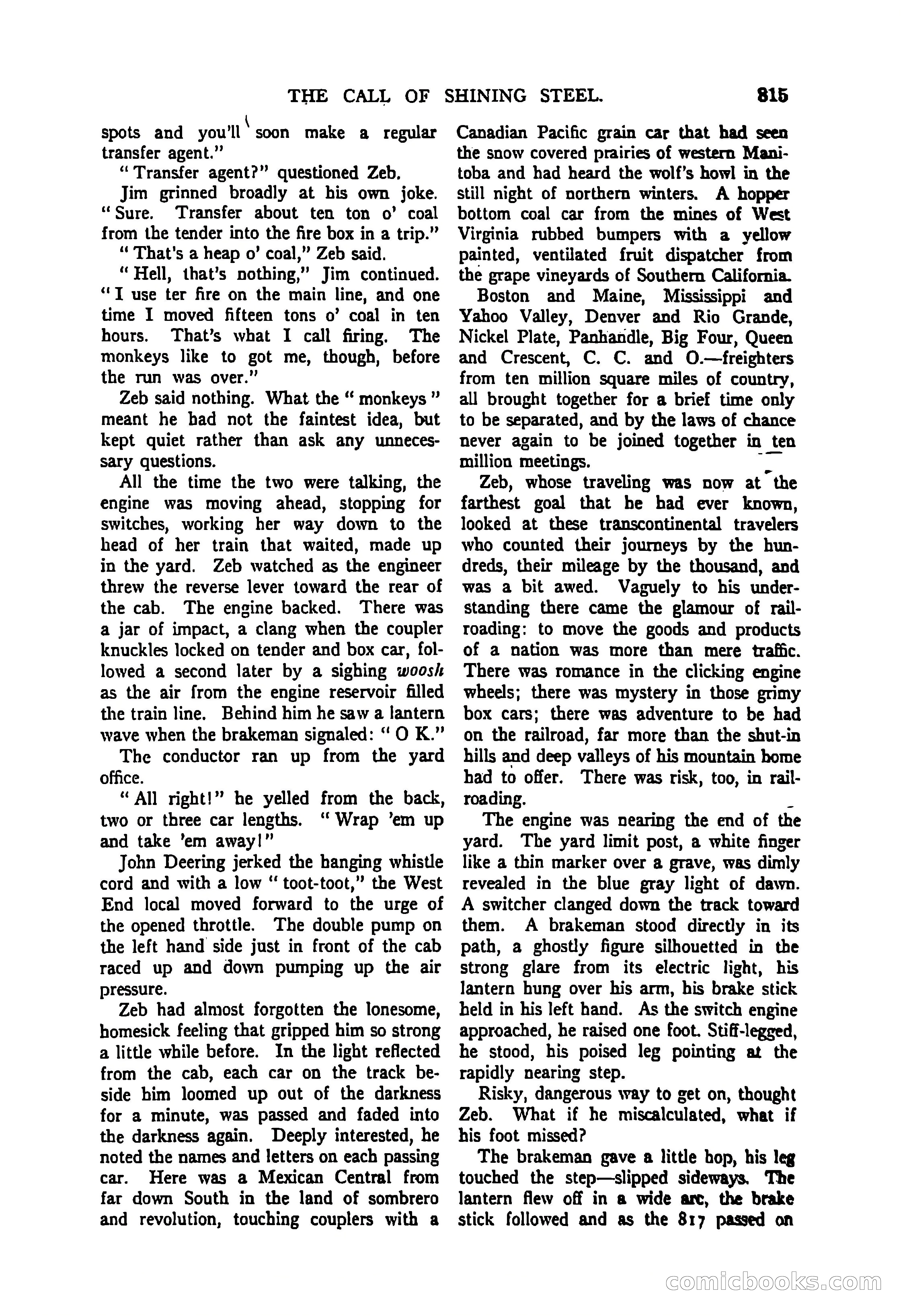
A restored page from Pulp Fiction, 1925. Page through the whole issue in the reader above.
📄 Transcribed text from this page (OCR, searchable)
Machine-transcribed from the original scan — historical spelling and the odd misread are preserved.
THE CALL OF SHINING STEEL. spots and you'll * soon make a regular transfer agent.” “Transfer agent?” questioned Zeb. Jim grinned broadly at his own joke. “Sure. Transfer about ten ton o’ coal from the tender into the fire box in a trip.” “That's a heap o’ coal,” Zeb said. “Hell, that’s nothing,” Jim continued. “‘T use ter fire on the main line, and one time I moved fifteen tons o’ coal in ten hours. That’s what I call firing. The monkeys like to got me, though, before the run was over.” Zeb said nothing. What the “ monkeys ” meant he had not the faintest idea, but kept quiet rather than ask any unneces- sary questions. All the time the two were talking, the engine was moving ahead, stopping for switches, working her way down to the head of her train that waited, made up in the yard. Zeb watched as the engineer threw the reverse lever toward the rear of the cab. The engine backed. There was a jar of impact, a clang when the coupler knuckles locked on tender and box car, fol- lowed a second later by a sighing woos as the air from the engine reservoir filled the train line. Behind him he saw a lantern wave when the brakeman signaled: “‘O K.” The conductor ran up from the yard office. “ All right!” he yelled from the back, two or three car lengths. “ Wrap ’em up and take ’em away!” John Deering jerked the hanging whistle cord and with a low “‘ toot-toot,” the West End local moved forward to the urge of the opened throttle. The double pump on the left hand side just in front of the cab raced up and down pumping up the air pressure. Zeb had almost forgotten the lonesome, homesick feeling that gripped him so strong a little while before. In the light reflected from the cab, each car on the track be- side him loomed up out of the darkness for a minute, was passed and faded into the darkness again. Deeply interested, he noted the names and letters on each passing car. Here was a Mexican Central from far down South in the land of sombrero and revolution, touching couplers with a 815 Canadian Pacific grain car that had seen the snow covered prairies of western Mani- toba and had heard the wolf’s howl in the still night of northern winters. A hopper bottom coal car from the mines of West Virginia rubbed bumpers with a yellow painted, ventilated fruit dispatcher from the grape vineyards of Southern California. Boston and Maine, Mississippi and Yahoo Valley, Denver and Rio Grande, Nickel Plate, Panhandle, Big Four, Queen and Crescent, C. C. and O.—freighters from ten million square miles of country, all brought together for a brief time only to be separated, and by the laws of chance Never again to be joined together in ten million meetings. a Zeb, whose traveling was now at the farthest goal that be had ever known, looked at these transcontinental travelers who counted their journeys by the hun- dreds, their mileage by the thousand, and was a bit awed. Vaguely to his under- standing there came the glamour of rail- roading: to move the goods and products of a nation was more than mere traffic. There was romance in the clicking engine wheels; there was mystery in those grimy box cars; there was adventure to be had on the railroad, far more than the shut-in hills and deep valleys of his mountain home had to offer. There was risk, too, in rail- roading. _ The engine was nearing the end of the yard. The yard limit post, a white finger like a thin marker over a grave, was dimly revealed in the blue gray light of dawn. A switcher clanged down the track toward them. A brakeman stood directly in its path, a ghostly figure silhouetted in the strong glare from its electric light, his lantern hung over his arm, his brake stick held in his left hand. As the switch engine approached, he raised one foot. Stiff-legged, he stood, his poised leg pointing at the rapidly nearing step. Risky, dangerous way to get on, thought Zeb. What if he miscalculated, what if his foot missed? The brakeman gave a little hop, his leg touched the step—slipped sideways. The lantern flew off in a wide ar, the brake stick followed and as the 817 passed on COMmica@oo SS Co