
Pulp Fiction, 1924 · page 45 of 172
Argosy All-Story Weekly, October 25, 1924 — page 45: what you’re looking at
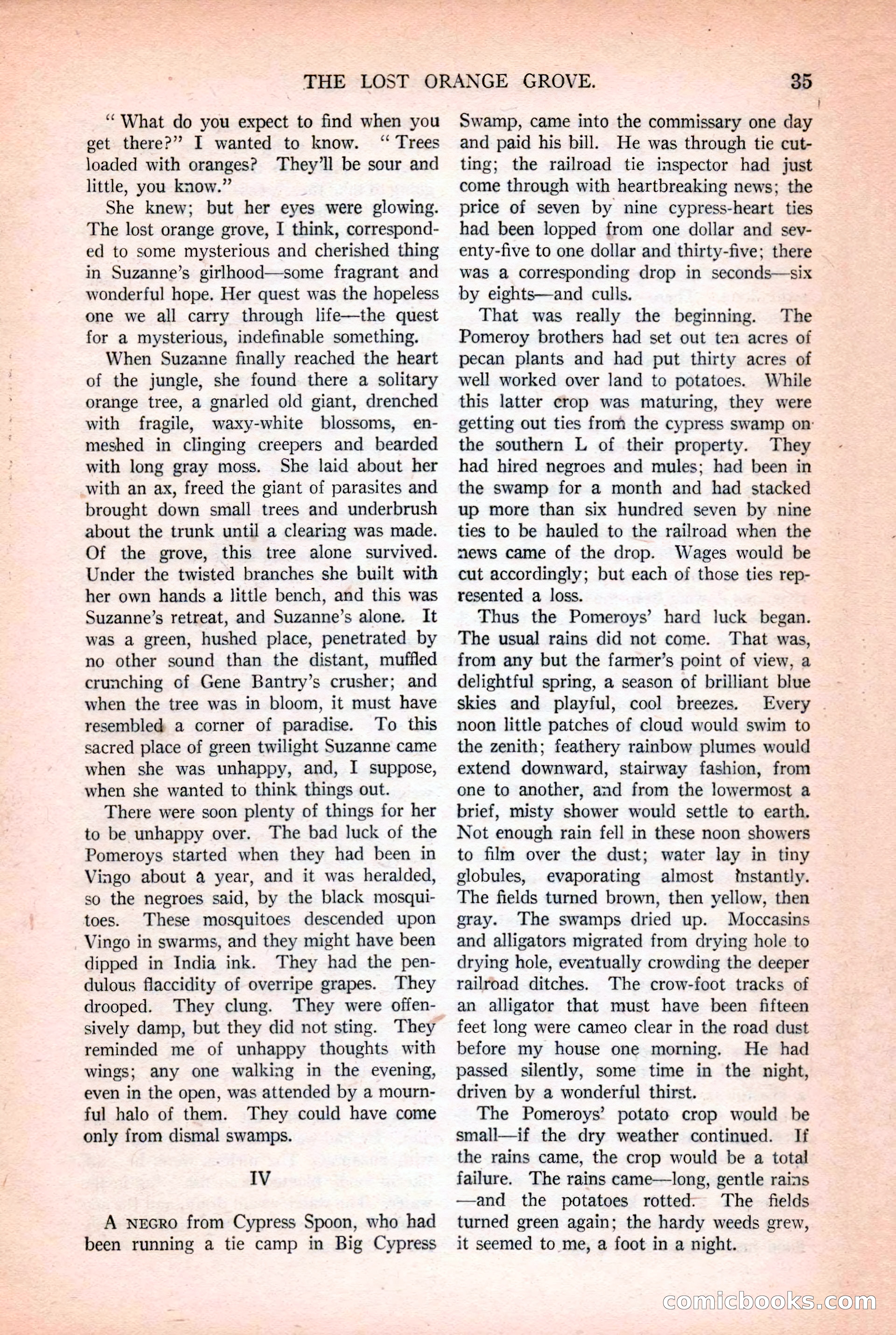
A restored page from Pulp Fiction, 1924. Page through the whole issue in the reader above.
📄 Transcribed text from this page (OCR, searchable)
Machine-transcribed from the original scan — historical spelling and the odd misread are preserved.
THE LOST ORANGE GROVE. ‘““What do you expect to find when you cet there?’ I wanted to know. ‘“‘ Trees loaded with oranges? They’ll be sour and little, you know.” She knew; but her eyes were glowing. The lost orange grove, I think, correspond- ed to some mysterious and cherished thing in Suzanne’s girlhood—some fragrant and wonderful hope. Her quest was the hopeless one we all carry through life—the quest for a mysterious, indefinable something. When Suzanne finally reached the heart of the jungle, she found there a solitary orange tree, a gnarled old giant, drenched with fragile, waxy-white blossoms, en- meshed in clinging creepers and bearded with long gray moss. She laid about her with an ax, freed the giant of parasites and brought down small trees and underbrush about the trunk until a clearing was made. Of the grove, this tree alone survived. Under the twisted branches she built with her own hands a little bench, and this was Suzanne’s retreat, and Suzanne’s alone. It was a green, hushed place, penetrated by no other sound than the distant, muffled crunching of Gene Bantry’s crusher; and when the tree was in bloom, it must have resembled a corner of paradise. To this sacred place of green twilight Suzanne came when she was unhappy, and, I suppose, when she wanted to think things out. There were soon plenty of things for her to be unhappy over. The bad luck of the Pomeroys started when they had been in Vingo about 4 year, and it was heralded, so the negroes said, by the black mosqui- toes. These mosquitoes descended upon Vingo in swarms, and they might have been dipped in India ink. They had the pen- dulous flaccidity of overripe grapes. They drooped. They clung. They were offen- sively damp, but they did not sting. They reminded me of unhappy thoughts with wings; any one walking in the evening, even in the open, was attended by a mourn- ful halo of them. They could have come only from dismal swamps. IV A necRO from Cypress Spoon, who had been running a tie camp in Big Cypress 30 Swamp, came into the commissary one day and paid his bill. He was through tie cut- ting; the railroad tie inspector had just come through with heartbreaking news; the price of seven by nine cypress-heart ties had been lopped from one dollar and sev- enty-five to one dollar and thirty-five; there was a corresponding drop in seconds—six by eights—and culls. That was really the beginning. The Pomeroy brothers had set out ten acres of pecan plants and had put thirty acres of well worked over land to potatoes. While this latter crop was maturing, they were getting out ties from the cypress swamp on: the southern L of their property. They had hired negroes and mules; had been in the swamp for a month and had stacked up more than six hundred seven by nine ties to be hauled to the railroad when the mews came of the drop. Wages would be cut accordingly; but each of those ties rep- resented a loss. Thus the Pomeroys’ hard luck began. The usual rains did not come. That was, from any but the farmer’s point of view, a delightful spring, a season of brilliant blue skies and playful, cool breezes. Every noon little patches of cloud would swim to the zenith; feathery rainbow plumes would extend downward, stairway fashion, from one to another, and from the lowermost a brief, misty shower would settle to earth. Not enough rain fell in these noon showers to film over the dust; water lay in tiny globules, evaporating almost instantly. The fields turned brown, then yellow, then gray. The swamps dried up. Moccasins and alligators migrated from drying hole to drying hole, eventually crowding the deeper railroad ditches. The crow-foot tracks of an alligator that must have been fifteen feet long were cameo clear in the road dust before my house one morning. He had passed silently, some time in the night, driven by a wonderful thirst. The Pomeroys’ potato crop would be small—if the dry weather continued. If the rains came, the crop would be a total failure. The rains came—long, gentle rains —and the potatoes rotted: The fields turned green again; the hardy weeds grew, it seemed to me, a foot in a night. COmiclboooks (E@)