
Pulp Fiction, 1924 · page 39 of 172
Argosy All-Story Weekly, October 25, 1924 — page 39: what you’re looking at
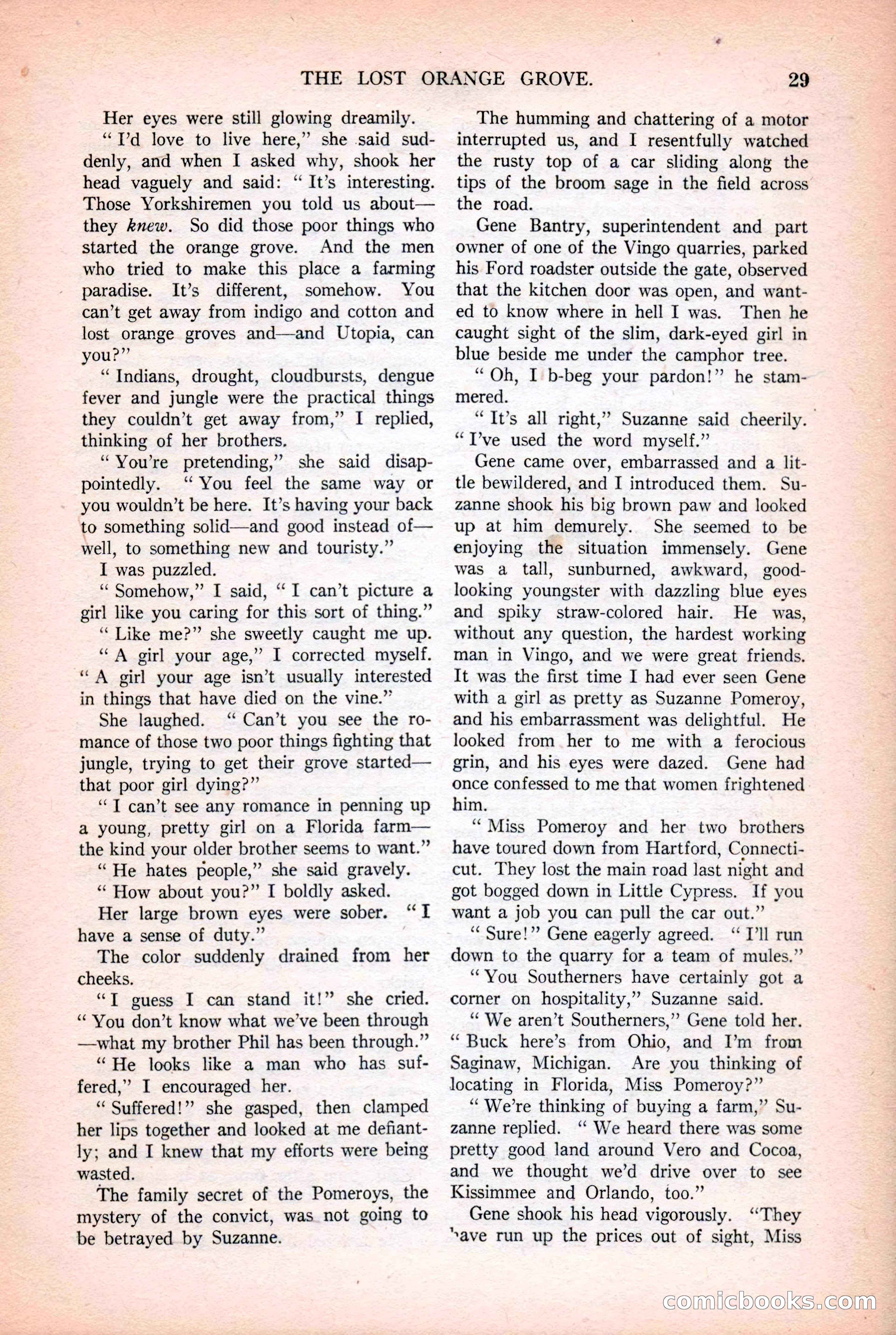
A restored page from Pulp Fiction, 1924. Page through the whole issue in the reader above.
📄 Transcribed text from this page (OCR, searchable)
Machine-transcribed from the original scan — historical spelling and the odd misread are preserved.
i THE LOST ORANGE GROVE. 29 Her eyes were still glowing dreamily. “1d love to live here,” she said sud- denly, and when I asked why, shook her head vaguely and said: “ It’s interesting. Those Yorkshiremen you told us about— they knew. So did those poor things who started the orange grove. And the men who tried to make this place a farming paradise. It’s different, somehow. You can’t get away from indigo and cotton and lost orange groves and—and Utopia, can you?”’ “Indians, drought, cloudbursts, dengue fever and jungle were the practical things they couldn’t get away from,” I replied, thinking of her brothers, ‘“You’re pretending,” she said disap- pointedly. ‘ You feel the same way or you wouldn’t be here. It’s having your back to something solid—and good instead of— well, to something new and touristy.” I was puzzled. ‘‘ Somehow,” I said, ‘‘ I can’t picture a girl like you caring for this sort of thing.” ‘Like me?” she sweetly caught me up. “ A girl your age,” I corrected myself. “A girl your age isn’t usually interested in things that have died on the vine.” She laughed. ‘“ Can’t you see the ro- mance of those two poor things fighting that jungle, trying to get their grove started— that poor girl dying?” ‘“T can’t see any romance in penning up a young, pretty girl on a Florida farm— the kind your older brother seems to want.” “He hates people,” she said gravely. “ How about you?” I boldly asked. Her large brown eyes were sober. “I have a sense of duty.” The color suddenly drained from her cheeks. “T guess I can stand it!” she cried. “ You don’t know what we’ve been through —what my brother Phil has been through.” “He looks like a man who has suf- fered,’ I encouraged her. “ Suffered!” she gasped, then clamped her lips together and looked at me defiant- ly; and I knew that my efforts were being wasted. The family secret of the Pomeroys, the mystery of the convict, was not going to be betrayed by Suzanne. The humming and chattering of a motor interrupted us, and I resentfully watched the rusty top of a car sliding along the tips of the broom sage in the field across the road. Gene Bantry, superintendent and part owner of one of the Vingo quarries, parked his Ford roadster outside the gate, observed that the kitchen door was open, and want- ed to know where in hell I was. Then he caught sight of the slim, dark-eyed girl in blue beside me under the camphor tree. “Oh, I b-beg your pardon!” he stam- mered. “Tt’s all right,” Suzanne said cheerily. “T’ve used the word myself.” Gene came over, embarrassed and a lit- tle bewildered, and I introduced them. Su- zanne shook his big brown paw and looked up at him demurely. She seemed to be enjoying the situation immensely. Gene was a tall, sunburned, awkward, good- looking youngster with dazzling blue eyes and spiky straw-colored hair. He was, without any question, the hardest working man in Vingo, and we were great friends. It was the first time I had ever seen Gene with a girl as pretty as Suzanne Pomeroy, and his embarrassment was delightful. He looked from her to me with a ferocious grin, and his eyes were dazed. Gene had once confessed to me that women frightened him. ‘““Miss Pomeroy and her two brothers have toured down from Hartford, Connecti- cut. They lost the main road last night and got bogged down in Little Cypress. If you want a job you can pull the car out.” ‘“‘ Sure!” Gene eagerly agreed. “ I'll run down to the quarry for a team of mules.” “You Southerners have certainly got a corner on hospitality,” Suzanne said. “We aren’t Southerners,” Gene told her. “Buck here’s from Ohio, and I’m from Saginaw, Michigan. Are you thinking of locating in Florida, Miss Pomeroy?” “We're thinking of buying a farm,” Su- zanne replied. “‘ We heard there was some pretty good land around Vero and Cocoa, and we thought we’d drive over to see Kissimmee and Orlando, too.” Gene shook his head vigorously. “They ‘ave run up the prices out of sight, Miss COnmmicloool< (C@