
Pulp Fiction, 1924 · page 38 of 172
Argosy All-Story Weekly, October 25, 1924 — page 38: what you’re looking at
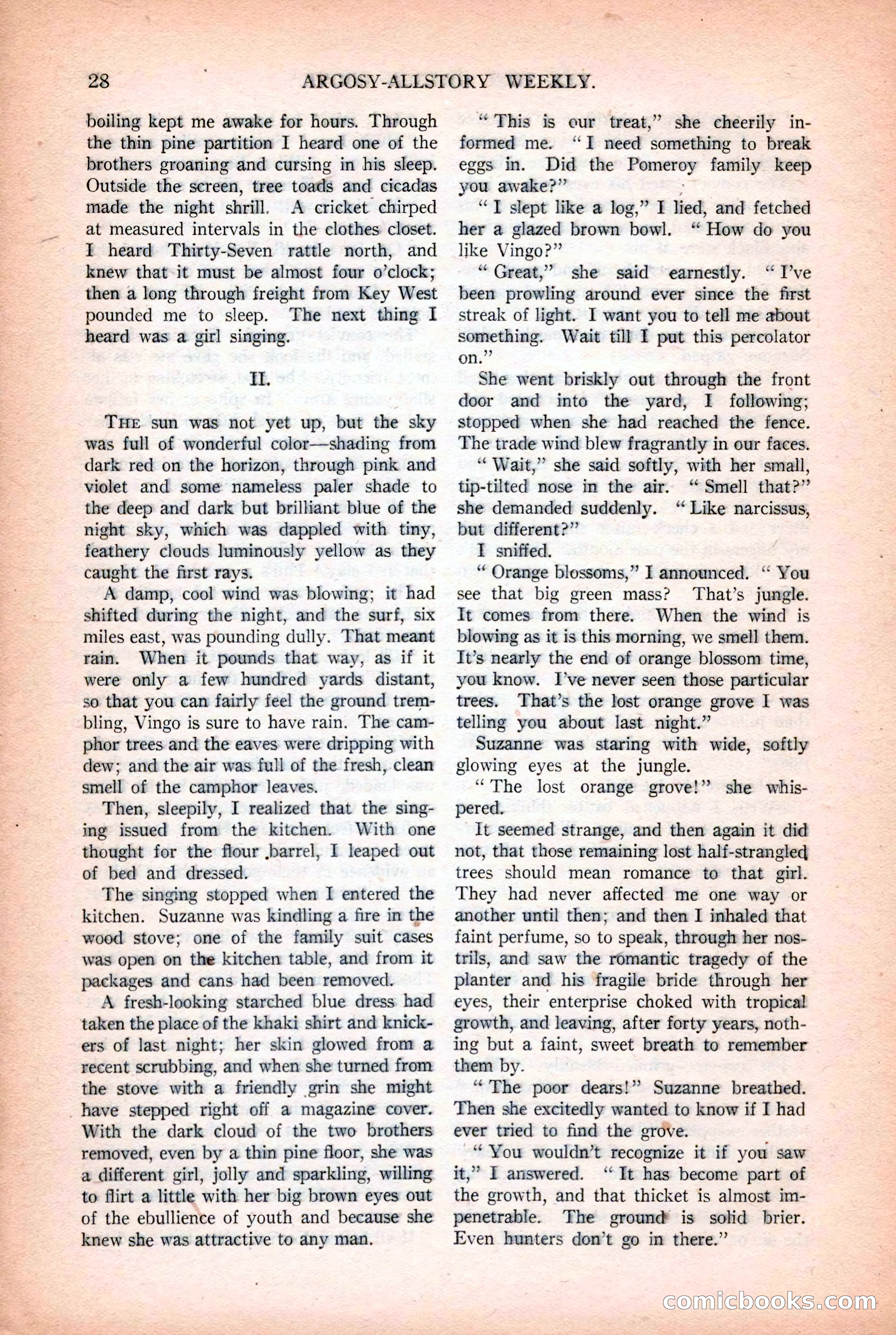
A restored page from Pulp Fiction, 1924. Page through the whole issue in the reader above.
📄 Transcribed text from this page (OCR, searchable)
Machine-transcribed from the original scan — historical spelling and the odd misread are preserved.
28 ARGOSY-ALLSTORY WEEKLY. boiling kept me awake for hours. Through the thin pine partition I heard one of the brothers groaning and cursing in his sleep. Outside the screen, tree toads and cicadas made the night shrill. A cricket chirped at measured intervals in the clothes closet. I heard Thirty-Seven rattle north, and knew that it must be almost four o’clock; then a long through freight from Key West pounded me to sleep. The next thing I heard was a girl singing. Il. THE sun was not yet up, but the sky was full of wonderful color—shading from dark red on the horizon, through pink and violet and some nameless paler shade to the deep and dark but brilliant blue of the night sky, which was dappled with tiny, feathery clouds luminously yellow as they caught the first rays. A damp, cool wind was blowing; it had shifted during the night, and the surf, six miles east, was pounding dully. That meant rain. When it pounds that way, as if it were only a few hundred yards distant, so that you can fairly feel the ground trem- bling, Vingo is sure to have rain. The cam- phor trees and the eaves were dripping with dew; and the air was full of the fresh, clean smell of the camphor leaves. Then, sleepily, I realized that the sing- ing issued from the kitchen. With one thought for the flour .barrel, I leaped out of bed and dressed. The singing stopped when I entered the kitchen. Suzanne was kindling a fire in the wood stove; one of the family suit cases was open on the kitchen table, and from it packages and cans had been removed. A fresh-looking starched blue dress had taken the place of the khaki shirt and knick- ers of last night; her skin glowed from a recent scrubbing, and when she turned from the stove with a friendly grin she might _have stepped right off a magazine cover. With the dark cloud of the two brothers removed, even by a thin pine floor, she was a different girl, jolly and sparkling, willing to flirt a little with her big brown eyes out of the ebullience of youth and because she knew she was attractive to any man. “This is our treat,” she cheerily in- formed me. “I need something to break eggs in. Did the Pomeroy family keep you awake?” * ‘““T slept like a log,” I lied, and fetched her a glazed brown bowl. “ How do you like Vingo?” “Great,” she said earnestly. “I’ve been prowling around ever since the first streak of light. I want you to tell me about something. Wait till I put this percolator on.” She went briskly out through the front door and into the yard, I following; stopped when she had reached the fence. The trade wind blew fragrantly in our faces. “Wait,” she said softly, with her small, tip-tilted nose in the air. “ Smell that?” she demanded suddenly. “ Like narcissus, but different?” I sniffed. “Orange blossoms,” I announced. ‘“‘ You see that big green mass? That’s jungle. It comes from there. When the wind is blowing as it is this morning, we smell them. It’s nearly the end of orange blossom time, you know. I’ve never seen those particular trees. That’s the lost orange grove I was telling you about last night.” Suzanne was staring with wide, softly glowing eyes at the jungle. “The lost orange grove!” she whis- pered. It seemed strange, and then again it did not, that those remaining lost half-strangled trees should mean romance to that girl. They had never affected me one way or another until then; and then I inhaled that faint perfume, so to speak, through her nos- trils, and saw the romantic tragedy of the planter and his fragile bride through her eyes, their enterprise choked with tropical growth, and leaving, after forty years, noth- ing but a faint, sweet breath to remember them by. “The poor dears!” Suzanne breathed. Then she excitedly wanted to know if I had ever tried to find the grove. “ You wouldn’t recognize it if you saw it,’ I answered. ‘It has become part of the growth, and that thicket is almost im- penetrable. The ground is solid brier. Even hunters don’t go in there.” COMMICLOokKsS (E@)