
Pulp Fiction, 1924 · page 148 of 172
Argosy All-Story Weekly, October 25, 1924 — page 148: what you’re looking at
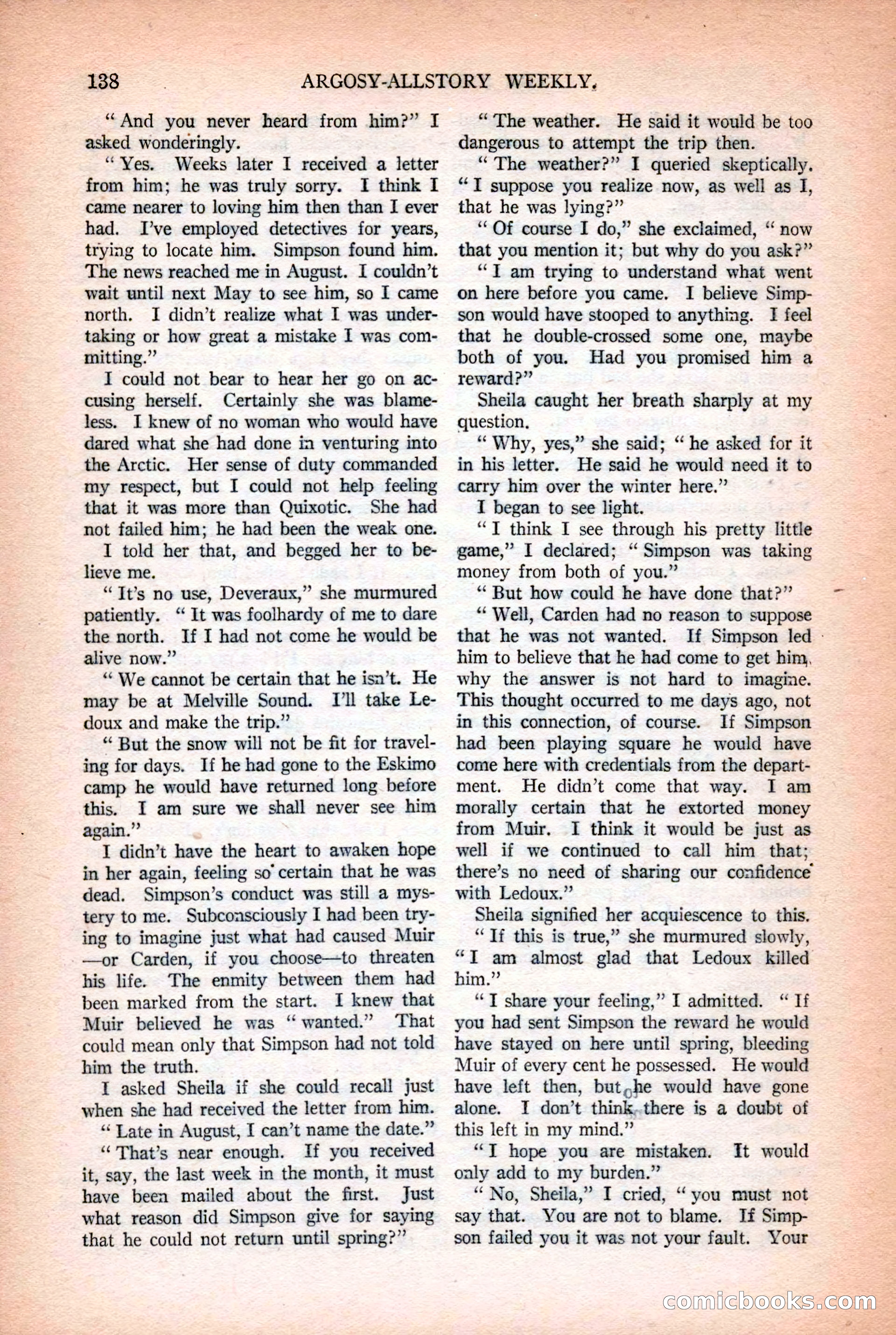
A restored page from Pulp Fiction, 1924. Page through the whole issue in the reader above.
📄 Transcribed text from this page (OCR, searchable)
Machine-transcribed from the original scan — historical spelling and the odd misread are preserved.
138 “And you never heard from him?” I asked wonderingly. “Yes. Weeks later I received a letter from him; he was truly sorry. I think I came nearer to loving him then than I ever had. I’ve employed detectives for years, trying to locate him. Simpson found him. The news reached me in August. I couldn’t wait until next May to see him, so I came north. I didn’t realize what I was under- taking or how great a mistake I was com- mitting.”’ I could not bear to hear her go on ac- cusing herself. Certainly she was blame- less. I knew of no woman who would have dared what she had done in venturing into the Arctic. Her sense of duty commanded my respect, but I could not help feeling that it was more than Quixotic. She had not failed him; he had been the weak one. I told her that, and begged her to be- lieve me. “Tt’s no use, Deveraux,” she murmured patiently. “ It was foolhardy of me to dare the north. If I had not come he would be alive now.” “We cannot be certain that he isn’t. He may be at Melville Sound. I'll take Le- doux and make the trip.” “ But the snow will not be fit for travel- ing for days. If he had gone to the Eskimo camp he would have returned long before this. I am sure we shall never see him again.” I didn’t have the heart to awaken hope in her again, feeling so’ certain that he was dead. Simpson’s conduct was still a mys- tery to me. Subconsciously I had been try- ing to imagine just what had caused Muir —or Carden, if you choose—to threaten his life. The enmity between them had been marked from the start. I knew that Muir believed he was “wanted.” That could mean only that Simpson had not told him the truth. I asked Sheila if she could recall just when she had received the letter from him. “Late in August, I can’t name the date.” ‘‘'That’s near enough. If you received it, say, the last week in the month, it must have been mailed about the first. Just what reason did Simpson give for saying that he could not return until spring?” ARGOSY-ALLSTORY WEEKLY, “The weather. He said it would be too dangerous to attempt the trip then. “The weather?” I queried skeptically. “TI suppose you realize now, as well as I, that he was lying?” “Of course I do,” she exclaimed, ‘ now that you mention it; but why do you ask?” “1 am trying to understand what went on here before you came. I believe Simp- son would have stooped to anything. I feel that he double-crossed some one, maybe both of you. Had you promised him a reward?” Sheila caught her breath sharply at my question, “Why, yes,” she said; “ he asked for it in his letter. He said he would need it to carry him over the winter here.” I began to see light. ‘“‘T think I see through his pretty little game,” I declared; “ Simpson was taking money from both of you.” “But how could he have done that?” “‘ Well, Carden had no reason to suppose that he was not wanted. him to believe that he had come to get him, why the answer is not hard to imagine. This thought occurred to me days ago, not in this connection, of course. If Simpson had been playing square he would have come here with credentials from the depart- ment. He didn’t come that way. I am morally certain that he extorted money from Muir. I think it would be just as well if we continued to call him that; there’s no need of sharing our confidence with Ledoux.” Sheila signified her acquiescence to this. “If this is true,” she murmured slowly, “T am almost glad that Ledoux killed him.” “T share your feeling,” I admitted. “If you had sent Simpson the reward he would have stayed on here until spring, bleeding Muir of every cent he possessed. He would have left then, but,he would have gone alone. I don’t think,.there is a doubt of this left in my mind.” “T hope you are mistaken. only add to my burden.” “No, Sheila,” I cried, “you must not say that. You are not to blame. If Simp- son failed you it was not your fault. Your It would CORMMICLOOKS -- - - eg a — ee ee Pan DS _. —— > a oA — eo m ae m4 Ses eke 4 - * “— If Simpson led - (F@)