
Pulp Fiction, 1924 · page 147 of 172
Argosy All-Story Weekly, October 25, 1924 — page 147: what you’re looking at
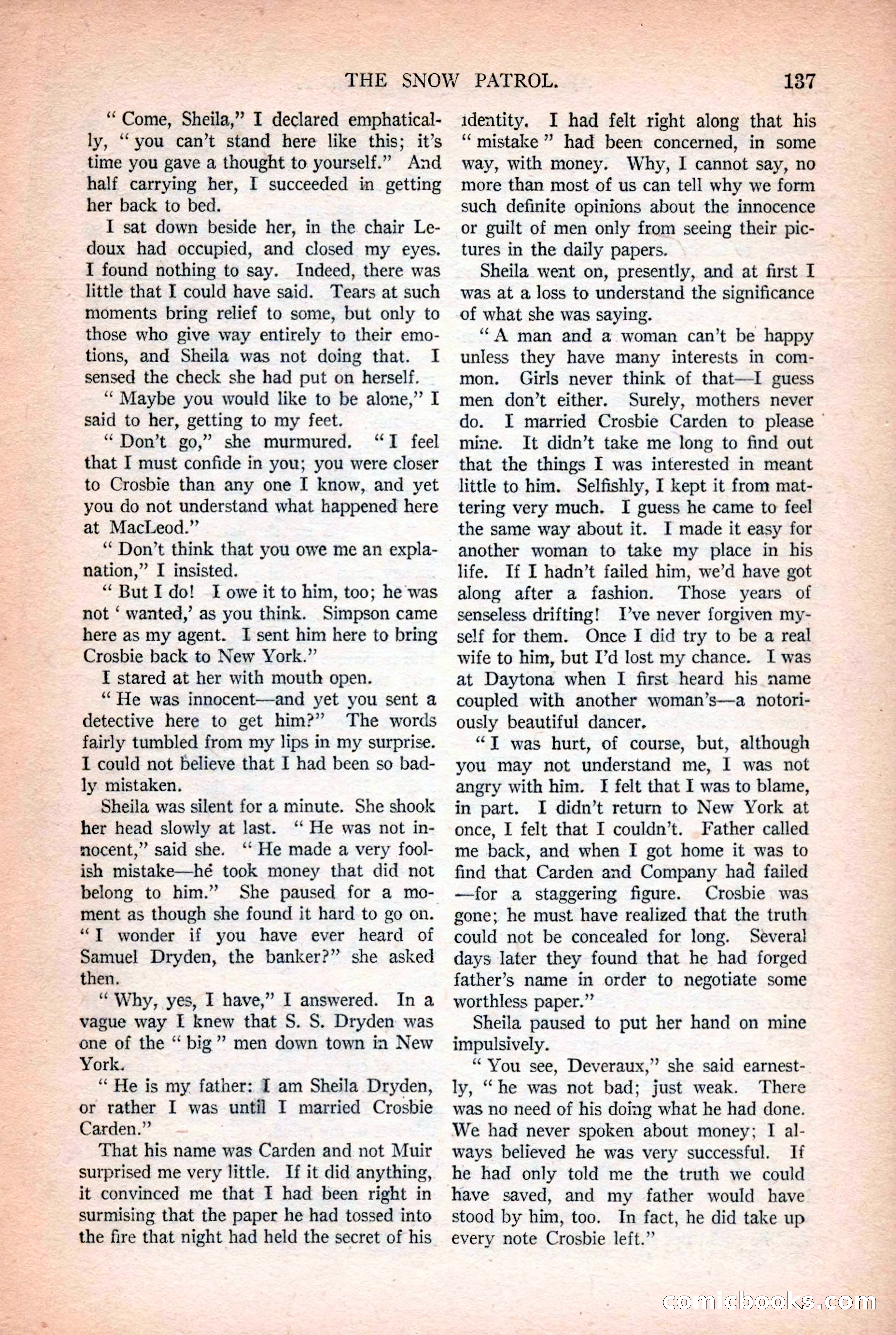
A restored page from Pulp Fiction, 1924. Page through the whole issue in the reader above.
📄 Transcribed text from this page (OCR, searchable)
Machine-transcribed from the original scan — historical spelling and the odd misread are preserved.
THE SNOW PATROL. “Come, Sheila,” I declared emphatical- ly, “‘you can’t stand here like this; it’s time you gave a thought to yourself.” And half carrying her, I succeeded in getting her back to bed. I sat down beside her, in the chair Le- doux had occupied, and closed my eyes. { found nothing to say. Indeed, there was _ little that I could have said. Tears at such moments bring relief to some, but only to those who give way entirely to their emo- tions, and Sheila was not doing that. I sensed the check she had put on herself. ““ Maybe you would like to be alone,” I said to her, getting to my feet. “ Don’t go,” she murmured. “TI feel that I must confide in you; you were closer to Crosbie than any one I know, and yet you do not understand what happened here at MacLeod.” “Don’t think that you owe me an expla- nation,” I insisted. “But I do! I owe it to him, too; he was not ‘ wanted,’ as you think. Simpson came here as my agent. I sent him here to bring Crosbie back to New York.” I stared at her with mouth open. “He was innocent—and yet you sent a detective here to get him?” The words fairly tumbled from my lips in my surprise. I could not believe that I had been so bad- ly mistaken. Sheila was silent for a minute. She shook her head slowly at last. ‘‘ He was not in- mocent,” said she. ‘‘ He made a very fool- ish mistake—hé took money that did not belong to him.” She paused for a mo- ment as though she found it hard to go on. “I wonder if you have ever heard of Samuel Dryden, the banker?” she asked then. “Why, yes, I have,” I answered. In a vague way I knew that S. S. Dryden was one of the “ big”? men down town in New York. ‘He is my father: I am Sheila Dryden, or rather I was until I married Crosbie Carden.” That his name was Carden and not Muir surprised me very little. If it did anything, it convinced me that I had been right in surmising that the paper he had tossed into the fire that night had held the secret of his 137 identity. I had felt right along that his “mistake ” had been concerned, in some way, with money. Why, I cannot say, no more than most of us can tell why we form such definite opinions about the innocence or guilt of men only from seeing their pic- tures in the daily papers. Sheila went on, presently, and at first I was at a loss to understand the significance of what she was saying. ‘‘A man and a woman can’t be happy unless they have many interests in com- mon. Girls never think of that—I guess men don’t either. Surely, mothers never do. mine. It didn’t take me long to find out that the things I was interested in meant little to him. Selfishly, I kept it from mat- tering very much. I guess he came to feel the same way about it. I made it easy for another woman to take my place in his life. If I hadn’t failed him, we’d have got along after a fashion. Those years of senseless drifting! I’ve never forgiven my- self for them. Once I did try to be a real wife to him, but I’d lost my chance. I was at Daytona when I first heard his name coupled with another woman’s—a_ notori- ously beautiful dancer. “JT was hurt, of course, but, although you may not understand me, I was not angry with him. [ felt that I was to blame, in part. I didn’t return to New York at once, I felt that I couldn’t. Father called me back, and when I got home it was to find that Carden and Company had failed —for a staggering figure. Crosbie was gone; he must have realized that the truth could not be concealed for long. Several days later they found that he had forged father’s name in order to negotiate some worthless paper.” Sheila paused to put her hand on mine impulsively. “You see, Deveraux,” she said earnest- ly, “he was not bad; just weak. There was no need of his doing what he had done. We had never spoken about money; I al- ways believed he was very successful. If he had only told me the truth we could have saved, and my father would have stood by him, too. In fact, he did take up every note Crosbie left.” IY married Crosbie Carden to please © = a (C@ NnOO“KS (C@