
Pulp Fiction, 1924 · page 139 of 172
Argosy All-Story Weekly, October 25, 1924 — page 139: what you’re looking at
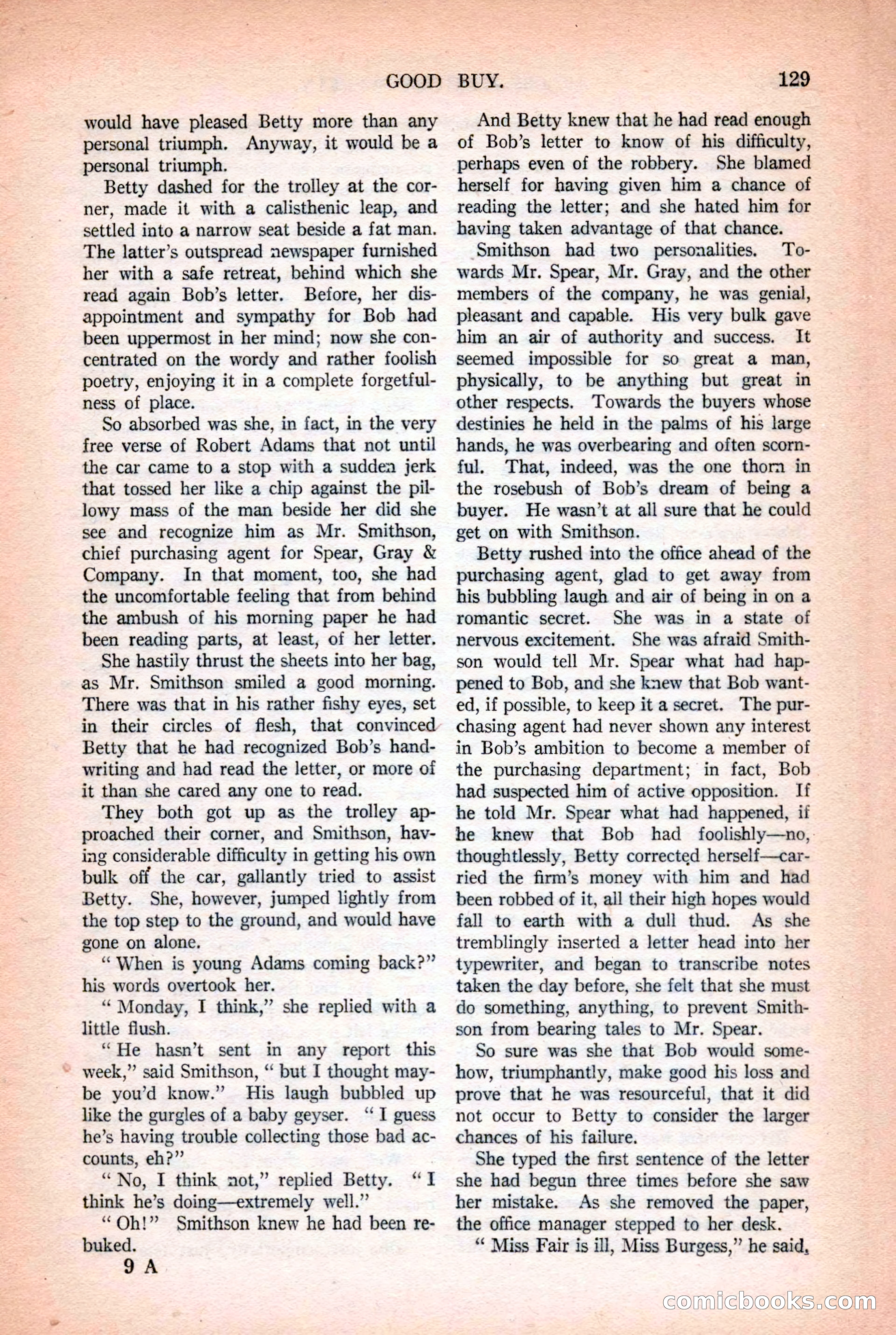
A restored page from Pulp Fiction, 1924. Page through the whole issue in the reader above.
📄 Transcribed text from this page (OCR, searchable)
Machine-transcribed from the original scan — historical spelling and the odd misread are preserved.
hg GOOD would have pleased Betty more than any personal triumph. Anyway, it would be a personal triumph. Betty dashed for the trolley at the cor- ner, made it with a calisthenic leap, and settled into a narrow seat beside a fat man. The latter’s outspread newspaper furnished her with a safe retreat, behind which she read again Bob’s letter. Before, her dis- appointment and sympathy for Bob had been uppermost in her mind; now she con- centrated on the wordy and rather foolish poetry, enjoying it in a complete forgetful- ness of place. So absorbed was she, in fact, in the very free verse of Robert Adams that not until the car came to a stop with a suddea jerk that tossed her like a chip against the pil- lowy mass of the man beside her did she see and recognize him as Mr. Smithson, chief purchasing agent for Spear, Gray & Company. In that moment, too, she had the uncomfortable feeling that from behind the ambush of his morning paper he had been reading parts, at least, of her letter. She hastily thrust the sheets into her bag, as Mr. Smithson smiled a good morning. There was that in his rather fishy eyes, set in their circles of flesh, that convinced Betty that he had recognized Bob’s hand- writing and had read the letter, or more oi it than she cared any one to read. They both got up as the trolley ap- proached their corner, and Smithson, hav- ing considerable difficulty in getting his own bulk off the car, gallantly tried to assist Betty. She, however, jumped lightly from the top step to the ground, and would have gone on alone. “When is young Adams coming back?” his words overtook her. “ Monday, I think,” she replied with a little flush. “He hasn’t sent in any report this ~ week,” said Smithson, “ but I thought may- be you’d know.” His laugh bubbled up like the gurgles of a baby geyser. ‘“‘ I guess he’s having trouble collecting those bad ac- counts, eh?” “No, I think not,” replied Betty. think he’s doing—extremely well.” “Oh!” Smithson knew he had been re- buked. 9A “TF BUY. 129 And Betty knew that he had read enough of Bob’s letter to know of his difficulty, perhaps even of the robbery. She blamed herself for having given him a chance of reading the letter; and she hated him for having taken advantage of that chance. Smithson had two personalities. To- wards Mr. Spear, Mr. Gray, and the other members of the company, he was genial, pleasant and capable. His very bulk gave him an air of authority and success. It seemed impossible for so great a man, physically, to be anything but great in other respects. Towards the buyers whose destinies he held in the palms of his large hands, he was overbearing and often scorn- ful. That, indeed, was the one thorn in the rosebush of Bob’s dream of being a buyer. He wasn’t at all sure that he could get on with Smithson. Betty rushed into the office ahead of the purchasing agent, glad to get away from his bubbling laugh and air of being in on a romantic secret. She was in a state of nervous excitement. She was afraid Smith- son would tell Mr. Spear what had hap- pened to Bob, and she knew that Bob want- ed, if possible, to keep it a secret. The pur- chasing agent had never shown any interest in Bob’s ambition to become a member of the purchasing department; in fact, Bob had suspected him of active opposition. If he told Mr. Spear what had happened, if he knew that Bob had foolishly—no,. thoughtlessly, Betty corrected herself—car- ried the firm’s money with him and had been robbed of it, all their high hopes would fall to earth with a dull thud. As she tremblingly inserted a letter head into her typewriter, and began to transcribe notes taken the day before, she felt that she must do something, anything, to prevent Smith- son from bearing tales to Mr. Spear. So sure was she that Bob would some- how, triumphantly, make good his loss and prove that he was resourceful, that it did not occur to Betty to consider the larger chances of his failure. She typed the first sentence of the letter she had begun three times before she saw her mistake. As she removed the paper, the office manager stepped to her desk. “‘ Miss Fair is ill, Miss Burgess,” he said, COmmiclboookKs (C@) A Oe