
Pulp Fiction, 1924 · page 138 of 172
Argosy All-Story Weekly, October 25, 1924 — page 138: what you’re looking at
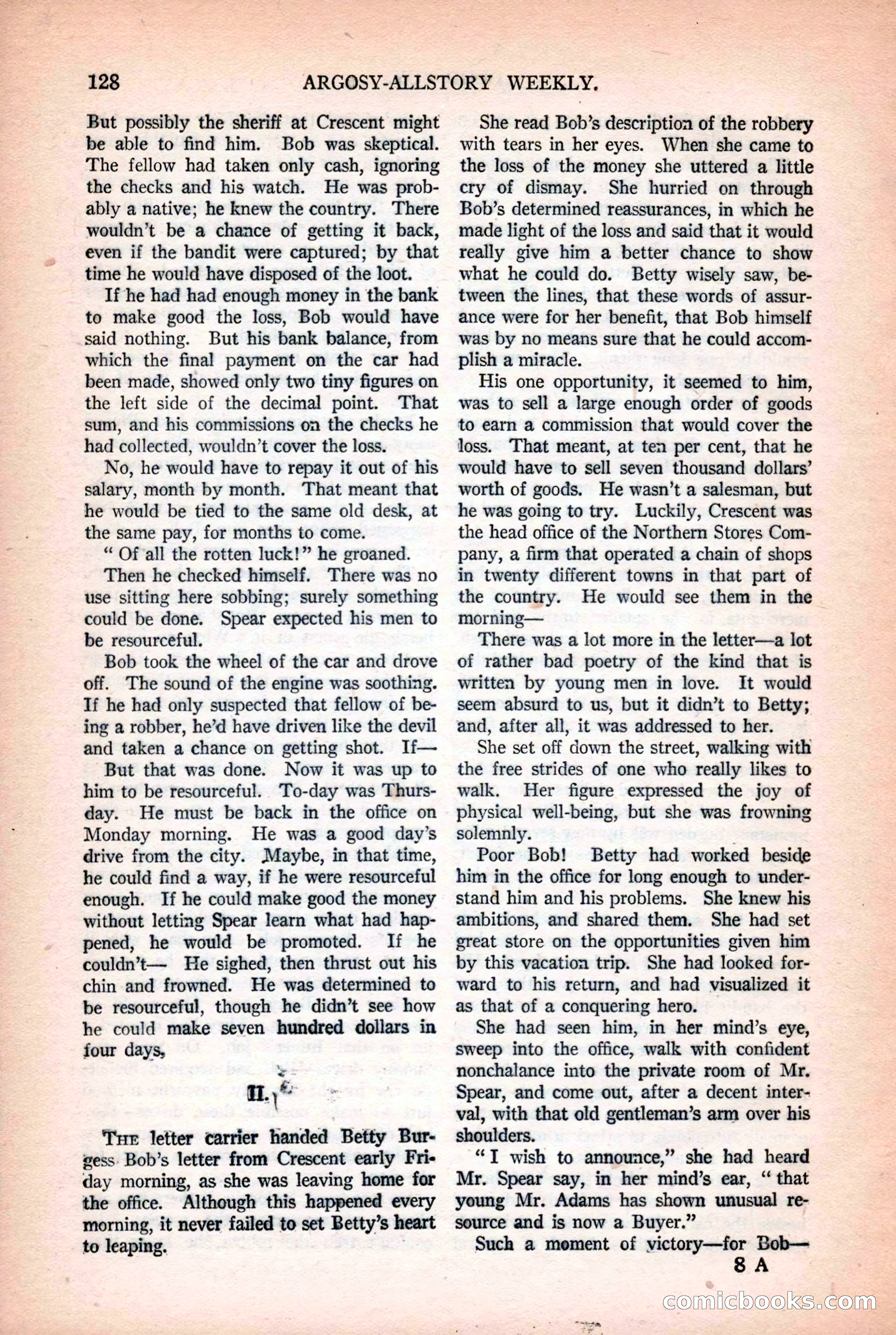
A restored page from Pulp Fiction, 1924. Page through the whole issue in the reader above.
📄 Transcribed text from this page (OCR, searchable)
Machine-transcribed from the original scan — historical spelling and the odd misread are preserved.
128 ARGOSY-ALLSTORY WEEKLY. But possibly the sheriff at Crescent might be able to find him. Bob was skeptical. The fellow had taken only cash, ignoring the checks and his watch. He was prob- ably a native; he knew the country. There wouldn’t be a chance of getting it back, even if the bandit were captured; by that time he would have disposed of the loot. If he had had enough money in the bank to make good the loss, Bob would have said nothing. But his bank balance, from which the final payment on the car had been made, showed only two tiny figures on the left side of the decimal point. That sum, and his commissions on the checks he had collected, wouldn’t cover the loss. No, he would have to repay it out of his salary, month by month. That meant that he would be tied to the same old desk, at the same pay, for months to come. “ Of all the rotten luck!” he groaned. Then he checked himself. There was no use sitting here sobbing; surely something could be done. Spear expected his men to be resourceful. Bob took the wheel of the car and drove off. The sound of the engine was soothing. If he had only suspected that fellow of be- ing a robber, he’d have driven like the devil and taken a chance on getting shot. If— But that was done. Now it was up to him to be resourceful. To-day was Thurs- day. He must be back in the office on Monday morning. He was a good day’s drive from the city. Maybe, in that time, he could find a way, if he were resourceful enough. If he could make good the money without letting Spear learn what had hap- pened, he would be promoted. If he couldn’t— He sighed, then thrust out his chin and frowned. He was determined to be resourceful, though he didn’t see how he could make seven hundred dollars in four days, 1. &; Tre letter carrier handed Betty Bur- wess Bob’s letter from Crescent early Fri- day morning, as she was leaving home for the office. Although this happened every morning, it never failed to set Betty’s heart to leaping. She read Bob’s description of the robbery with tears in her eyes. When she came to the loss of the money she uttered a little cry of dismay. She hurried on through Bob’s determined reassurances, in which he made light of the loss and said that it would really give him a better chance to show what he could do. Betty wisely saw, be- tween the lines, that these words of assur- ance were for her benefit, that Bob himself was by no means sure that he could accom- plish a miracle. His one opportunity, it seemed to him, was to sell a large enough order of goods to earn a commission that would cover the loss. That meant, at ten per cent, that he would have to sell seven thousand dollars’ worth of goods. He wasn’t a salesman, but he was going to try. Luckily, Crescent was the head office of the Northern Stores Com- pany, a firm that operated a chain of shops in twenty different towns in that part of the country. He would see them in the morning— There was a lot more in the letter—a lot of rather bad poetry of the kind that is written by young men in love. It would seem absurd to us, but it didn’t to Betty; and, after all, it was addressed to her. She set off down the street, walking with the free strides of one who really likes to walk. Her figure expressed the joy of physical well-being, but she was frowning solemnly. Poor Bob! Betty had worked beside him in the office for long enough to under- stand him and his problems. She knew his ambitions, and shared them. She had set great store on the opportunities given him by this vacation trip. She had looked for- ward to his return, and had visualized it as that of a conquering hero. She had seen him, in her mind’s eye, sweep into the office, walk with confident nonchalance into the private room of Mr. Spear, and come out, after a decent inter- val, with that old gentleman’s arm over his shoulders. “T wish to announce,” she had heard Mr. Spear say, in her mind’s ear, “ that young Mr. Adams has shown unusual re- source and is now a Buyer.” Such a moment of victory—for Bob— SA COmicloookKs (C@