
Pulp Fiction, 1924 · page 91 of 172
Argosy All-Story Weekly, August 9, 1924 — page 91: what you’re looking at
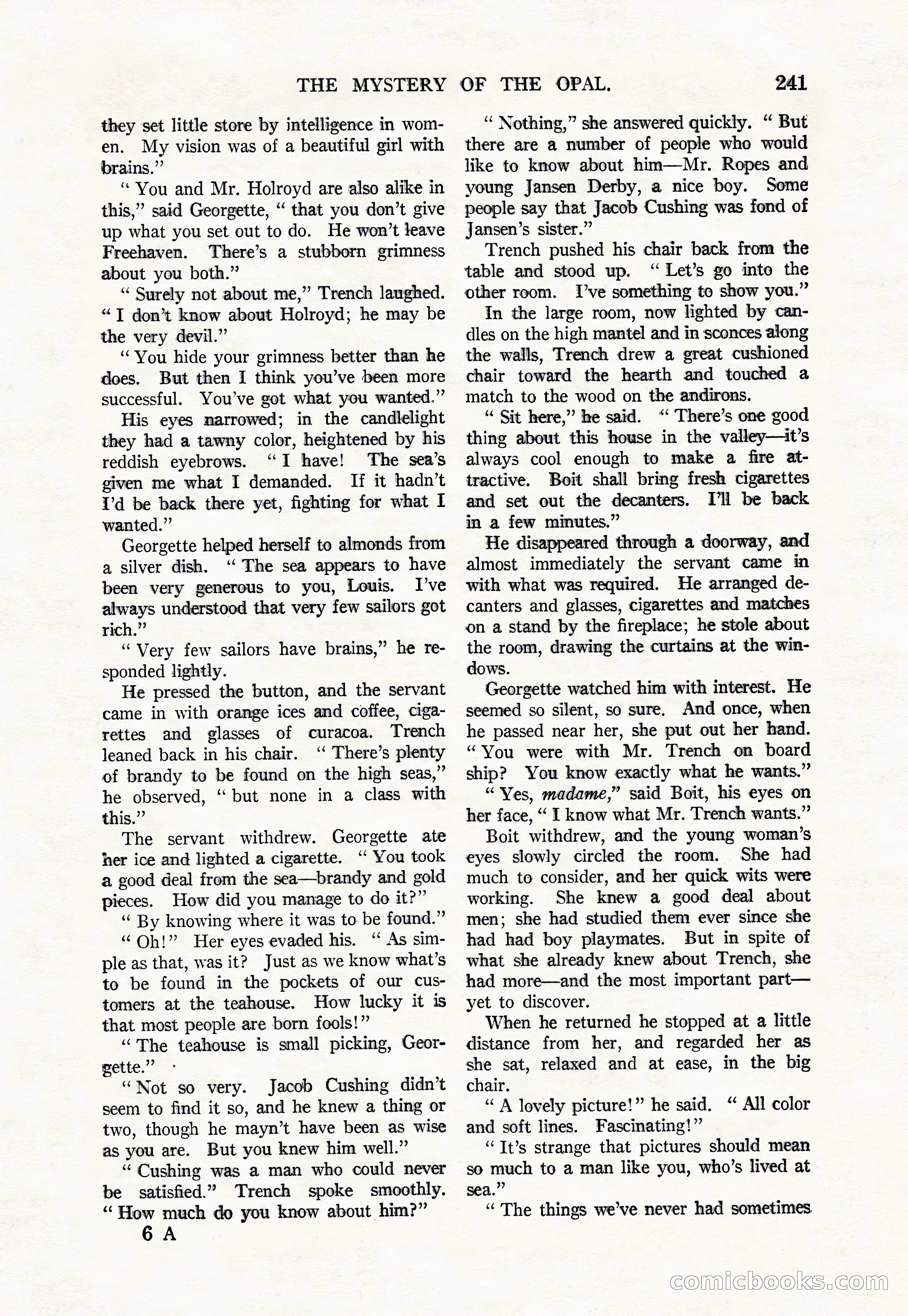
A restored page from Pulp Fiction, 1924. Page through the whole issue in the reader above.
📄 Transcribed text from this page (OCR, searchable)
Machine-transcribed from the original scan — historical spelling and the odd misread are preserved.
THE MYSTERY they set little store by intelligence in wom- en. My vision was of a beautiful girl with brains.” “ You and Mr. Holroyd are also alike in this,” said Georgette, “ that you don’t give up what you set out to do. He won’t leave Freehaven. There’s a stubborn grimness about you both.” “ Surely not about me,” Trench laughed. “J don’t know about Holroyd; he may be the very devil.” ‘Vou hide your grimness better than he does. But then I think you’ve been more successful. You’ve got what you wanted.” His eyes narrowed; in the candlelight they had a tawny color, heightened by his reddish eyebrows. “I have! The sea’s given me what I demanded. If it hadn’t I’d be back there yet, fighting for what I wanted.” Georgette helped herself to almonds from a silver dish. ‘‘ The sea appears to have been very generous to you, Louis. I’ve always understood that very few sailors got rich.” “Very few sailors have brains,” he re- sponded lightly. He pressed the button, and the servant came in with orange ices and coffee, ciga- rettes and glasses of curacoa. Trench leaned back in his chair. ‘‘ There’s plenty of brandy to be found on the high seas,” he observed, ‘ but none in a class with this.”’ The servant withdrew. Georgette ate her ice and lighted a cigarette. ‘“ You took a good deal from the sea—brandy and gold pieces. How did you manage to do it?” “ By knowing where it was to be found.” “Oh!” Her eyes evaded his. ‘ As sim- ple as that, was it? Just as we know what’s to be found in the pockets of our cus- tomers at the teahouse. How lucky it is that most people are born fools!” “The teahouse is small picking, Geor- gette.”’ “Not so very. Jacob Cushing didn’t seem to find it so, and he knew a thing or two, though he mayn’t have been as wise as you are. But you knew him well.” “Cushing was a man who could never be satisfied.” Trench spoke smoothly. “How much do you know about him?” 6A OF THE OPAL. 241 ‘“ Nothing,” she answered quickly. “ But there are a number of people who would like to know about him—Mr. Ropes and young Jansen Derby, a nice boy. Some people say that Jacob Cushing was fond of Jansen’s sister.” Trench pushed his chair back from the table and stood up. “ Let’s go into the other room. I’ve something to show you.” In the large room, now lighted by can- dles on the high mantel and in sconces along the walls, Trench drew a great cushioned chair toward the hearth and touched a match to the wood on the andirons. “ Sit here,” he said. “‘ There’s one good thing about this house in the valley—it’s always cool enough to make a fire at- tractive. Boit shall bring fresh cigarettes and set out the decanters. Ill be back in a few minutes.” He disappeared through a doorway, and almost immediately the servant came in with what was required. He arranged de- canters and glasses, cigarettes and matches on a stand by the fireplace; he stole about the room, drawing the curtains at the win- dows. Georgette watched him with interest. He seemed so silent, so sure. And once, when he passed near her, she put out her hand. “Vou were with Mr. Trench on board ship? You know exactly what he wants.” “Ves, madame,” said Boit, his eyes on her face, “ I know what Mr. Trench wants.” Boit withdrew, and the young woman’s eyes slowly circled the room. She had much to consider, and her quick wits were working. She knew a good deal about men; she had studied them ever since she had had boy playmates. But in spite of what she already knew about Trench, she had more—and the most important part— yet to discover. When he returned he stopped at a little distance from her, and regarded her as she sat, relaxed and at ease, in the big chair. “A lovely picture!” he said. “ All color and soft lines. Fascinating!” “Tt’s strange that pictures should mean so much to a man like you, who’s lived at sea.” “The things we’ve never had sometimes LO@OO G © = S (C(O)