
Pulp Fiction, 1924 · page 90 of 172
Argosy All-Story Weekly, August 9, 1924 — page 90: what you’re looking at
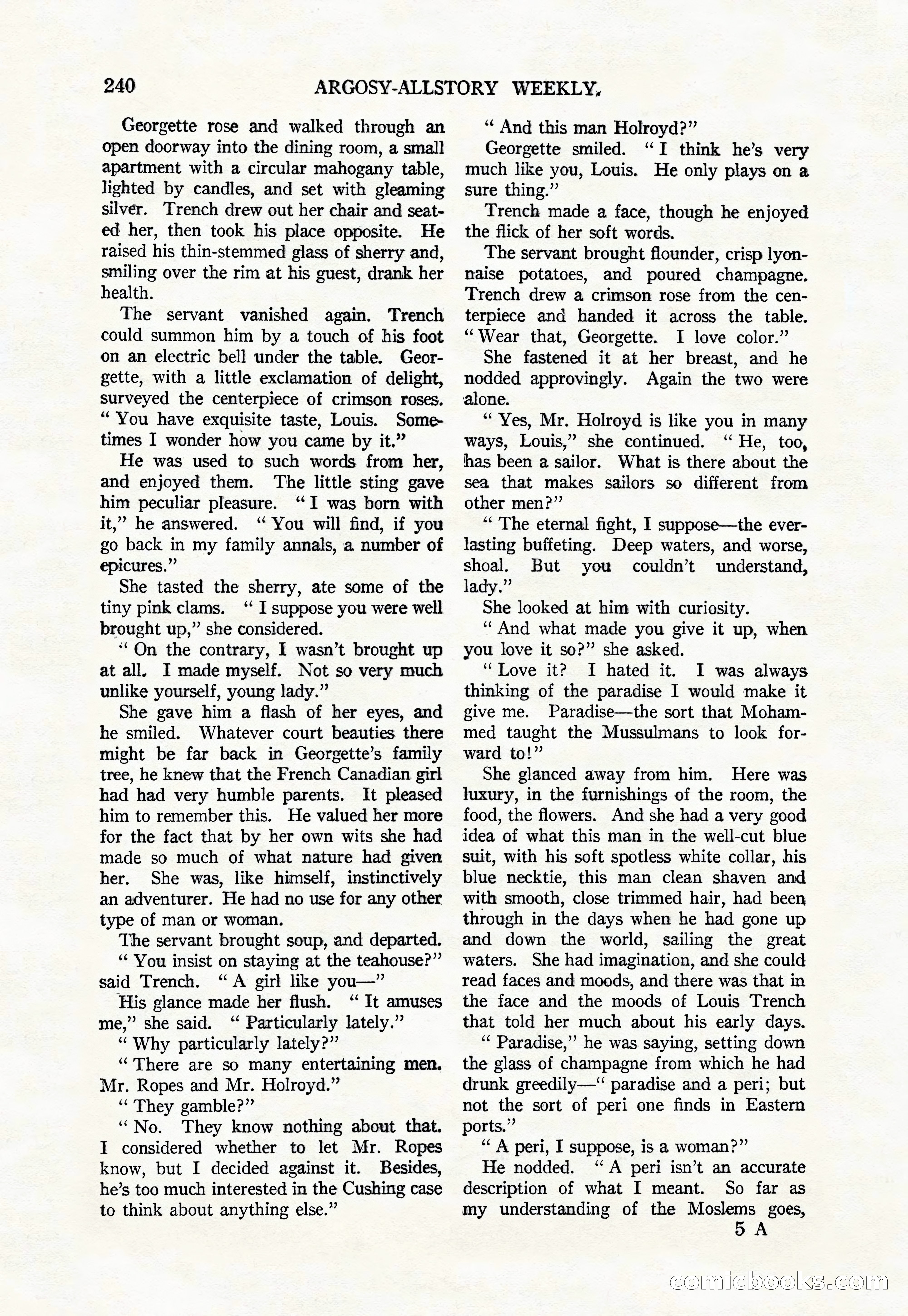
A restored page from Pulp Fiction, 1924. Page through the whole issue in the reader above.
📄 Transcribed text from this page (OCR, searchable)
Machine-transcribed from the original scan — historical spelling and the odd misread are preserved.
240 Georgette rose and walked through an open doorway into the dining room, a small apartment with a circular mahogany table, lighted by candles, and set with gleaming silver. Trench drew out her chair and seat- ed her, then took his place opposite. He raised his thin-stemmed glass of sherry and, smiling over the rim at his guest, drank her health. The servant vanished again. Trench could summon him by a touch of his foot on an electric bell under the table. Geor- gette, with a little exclamation of delight, surveyed the centerpiece of crimson roses. “You have exquisite taste, Louis. Some- times I wonder how you came by it.” He was used to such words from her, and enjoyed them. ‘The little sting gave him peculiar pleasure. ‘“ I was born with it,” he answered. ‘“‘ You will find, if you go back in my family annals, a number of epicures.” She tasted the sherry, ate some of the tiny pink clams. ‘‘ I suppose you were well brought up,” she considered. ‘*On the contrary, I wasn’t brought up at all, I made myself. Not so very much unlike yourself, young lady.”’ She gave him a flash of her eyes, and he smiled. Whatever court beauties there might be far back in Georgette’s family tree, he knew that the French Canadian girl had had very humble parents. It pleased him to remember this. He valued her more for the fact that by her own wits she had made so much of what nature had given her. She was, like himself, instinctively an adventurer. He had no use for any other type of man or woman. The servant brought soup, and departed. ‘“¢ You insist on staying at the teahouse?”’ said Trench. ‘A girl like you—” His glance made her flush. “ It amuses me,” she said. “ Particularly lately.” “ Why particularly lately?” “There are so many entertaining men. Mr. Ropes and Mr. Holroyd.” “ They gamble?” “No. They know nothing about that. I considered whether to let Mr. Ropes know, but I decided against it. Besides, he’s too much interested in the Cushing case to think about anything else.” ARGOSY-ALLSTORY WEEKLY, ‘‘ And this man Holroyd?” Georgette smiled. “I think he’s very much like you, Louis. He only plays on a sure thing.” Trench made a face, though he enjoyed the flick of her soft words. The servant brought flounder, crisp lyon- naise potatoes, and poured champagne. Trench drew a crimson rose from the cen- terpiece and handed it across the table. “Wear that, Georgette. I love color.” She fastened it at her breast, and he nodded approvingly. Again the two were alone. “Yes, Mr. Holroyd is like you in many ways, Louis,” she continued. ‘“ He, too, has been a sailor. What is there about the sea that makes sailors so different from other men?” “The eternal fight, I suppose—the ever- lasting buffeting. Deep waters, and worse, shoal. But you couldn’t understand, lady.” She looked at him with curiosity. “And what made you give it up, when you love it so?” she asked. “Love it? I hated it. I was always thinking of the paradise I would make it give me. Paradise—the sort that Moham- med taught the Mussulmans to look for- ward to!” She glanced away from him. Here was luxury, in the furnishings of the room, the food, the flowers. And she had a very good idea of what this man in the well-cut blue suit, with his soft spotless white collar, his blue necktie, this man clean shaven and with smooth, close trimmed hair, had been through in the days when he had gone up and down the world, sailing the great waters. She had imagination, and she could read faces and moods, and there was that in the face and the moods of Louis Trench that told her much about his early days. ‘* Paradise,” he was saying, setting down the glass of champagne from which he had drunk greedily—‘ paradise and a peri; but not the sort of peri one finds in Eastern ports.” ‘* A peri, I suppose, is a woman?” He nodded. ‘A peri isn’t an accurate description of what I meant. So far as my understanding of the Moslems goes, 5 A COMmICcloo ‘a SS CO) An