
Pulp Fiction, 1924 · page 139 of 172
Argosy All-Story Weekly, August 9, 1924 — page 139: what you’re looking at
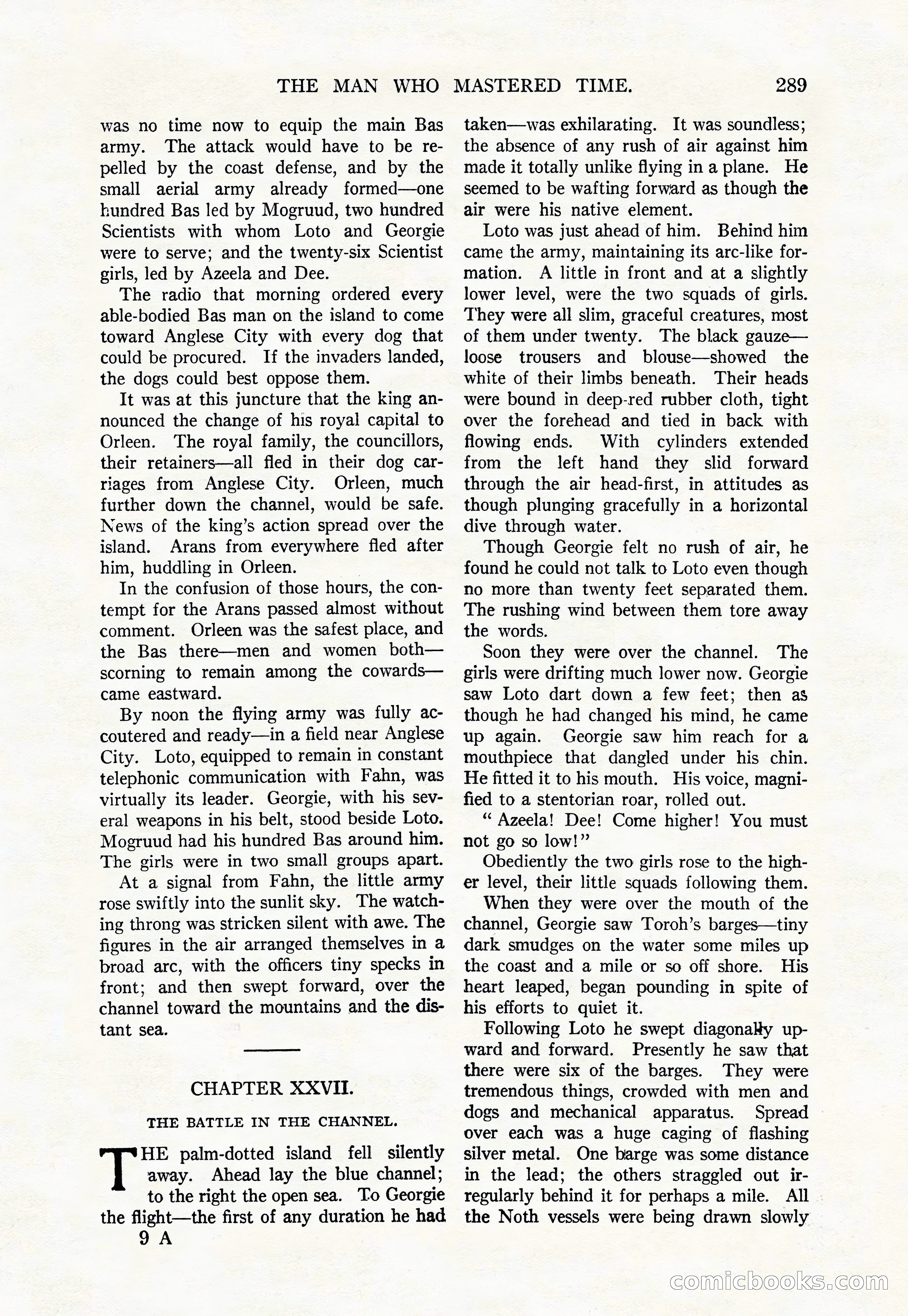
A restored page from Pulp Fiction, 1924. Page through the whole issue in the reader above.
📄 Transcribed text from this page (OCR, searchable)
Machine-transcribed from the original scan — historical spelling and the odd misread are preserved.
THE MAN WHO MASTERED TIME. was no time now to equip the main Bas army. The attack would have to be re- pelled by the coast defense, and by the small aerial army already formed—one hundred Bas led by Mogruud, two hundred Scientists with whom Loto and Georgie were to serve; and the twenty-six Scientist girls, led by Azeela and Dee. The radio that morning ordered every able-bodied Bas man on the island to come toward Anglese City with every dog that could be procured. If the invaders landed, the dogs could best oppose them. It was at this juncture that the king an- nounced the change of his royal capital to Orleen. The royal family, the councillors, their retainers—all fled in their dog car- riages from Anglese City. Orleen, much further down the channel, would be safe. News of the king’s action spread over the island. Arans from everywhere fled after him, huddling in Orleen. , In the confusion of those hours, the con- tempt for the Arans passed almost without comment. Orleen was the safest place, and the Bas there—men and women both— scorning to remain among the cowards— came eastward. By noon the flying army was fully ac- coutered and ready—in a field near Anglese City. Loto, equipped to remain in constant telephonic communication with Fahn, was virtually its leader. Georgie, with his sev- eral weapons in his belt, stood beside Loto. Mogruud had his hundred Bas around him. The girls were in two small groups apart. At a signal from Fahn, the little army rose swiftly into the sunlit sky. The watch- ing throng was stricken silent with awe. The figures in the air arranged themselves in a broad arc, with the officers tiny specks in front; and then swept forward, over the channel toward the mountains and the dis- tant sea. CHAPTER XXVII. THE BATTLE IN THE CHANNEL. HE palm-dotted island fell silently away. Ahead lay the blue channel; to the right the open sea. To Georgie the flight—the first of any duration he had 9A 289 taken—was exhilarating. It was soundless; the absence of any rush of air against him made it totally unlike flying ina plane. He seemed to be wafting forward as though the air were his native element. Loto was just ahead of him. Behind him came the army, maintaining its arc-like for- mation. A little in front and at a slightly lower level, were the two squads of girls. They were all slim, graceful creatures, most of them under twenty. The black gauze— loose trousers and blouse—showed the white of their limbs beneath. Their heads were bound in deep-red rubber cloth, tight over the forehead and tied in back with flowing ends. With cylinders extended from the left hand they slid forward through the air head-first, in attitudes as though plunging gracefully in a horizontal dive through water. Though Georgie felt no rush of air, he found he could not talk to Loto even though no more than twenty feet separated them. The rushing wind between them tore away the words. Soon they were over the channel. The girls were drifting much lower now. Georgie saw Loto dart down a few feet; then as though he had changed his mind, he came up again. Georgie saw him reach for a mouthpiece that dangled under his chin. He fitted it to his mouth. His voice, magni- fied to a stentorian roar, rolled out. “* Azeela! Dee! Come higher! You must not go so low!” Obediently the two girls rose to the high- er level, their little squads following them. When they were over the mouth of the channel, Georgie saw Toroh’s barges—tiny dark smudges on the water some miles up the coast and a mile or so off shore. His heart leaped, began pounding in spite of his efforts to quiet it. Following Loto he swept diagonaly up- ward and forward. Presently he saw that there were six of the barges. They were tremendous things, crowded with men and dogs and mechanical apparatus. Spread over each was a huge caging of flashing silver metal. One barge was some distance in the lead; the others straggled out ir- regularly behind it for perhaps a mile. All the Noth vessels were being drawn slowly GomilGbaoo @) SS GO) im