
Pulp Fiction, 1924 · page 138 of 172
Argosy All-Story Weekly, August 9, 1924 — page 138: what you’re looking at
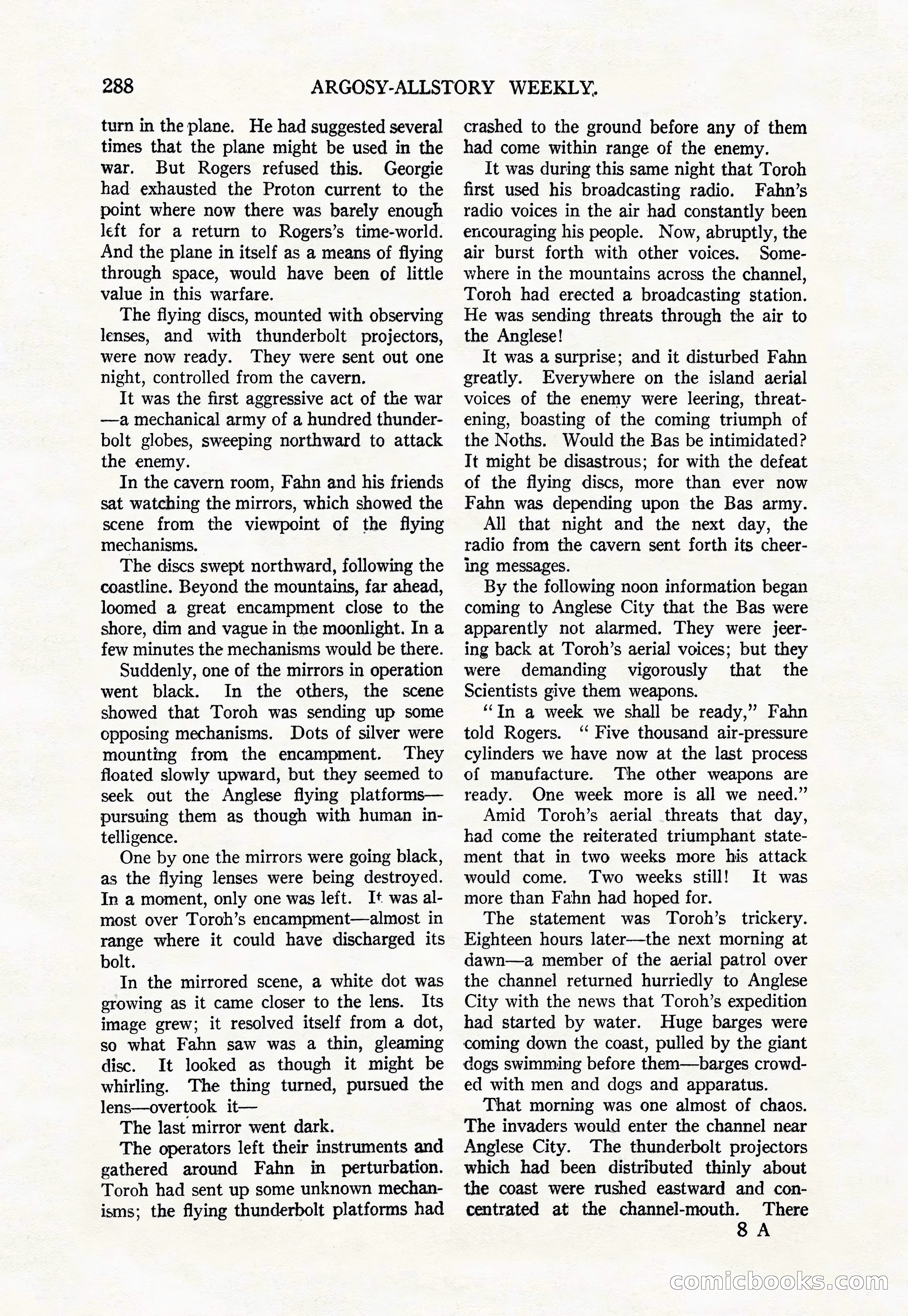
A restored page from Pulp Fiction, 1924. Page through the whole issue in the reader above.
📄 Transcribed text from this page (OCR, searchable)
Machine-transcribed from the original scan — historical spelling and the odd misread are preserved.
288 turn in the plane. He had suggested several times that the plane might be used in the war. But Rogers refused this. Georgie had exhausted the Proton current to the point where now there was barely enough left for a return to Rogers’s time-world. And the plane in itself as a means of flying through space, would have been of little value in this warfare. The flying discs, mounted with observing lenses, and with thunderbolt projectors, were now ready. ‘They were sent out one night, controlled from the cavern. It was the first aggressive act of the war —a mechanical army of a hundred thunder- bolt globes, sweeping northward to attack the enemy. In the cavern room, Fahn and his friends sat watching the mirrors, which showed the scene from the viewpoint of the flying mechanisms. The discs swept northward, following the coastline. Beyond the mountains, far ahead, loomed a great encampment close to the shore, dim and vague in the moonlight. In a few minutes the mechanisms would be there. Suddenly, one of the mirrors in operation went black. In the others, the scene showed that Toroh was sending up some opposing mechanisms. Dots of silver were mounting from the encampment. They floated slowly upward, but they seemed to seek out the Anglese flying platforms— pursuing them as though with human in- telligence. One by one the mirrors were going black, as the flying lenses were being destroyed. In a moment, only one was left. It was al- most over Toroh’s encampment—almost in range where it could have discharged its bolt. In the mirrored scene, a white dot was growing as it came closer to the lens. Its image grew; it resolved itself from a dot, so what Fahn saw was a thin, gleaming disc. It looked as though it might be whirling. The thing turned, pursued the lens—overtook it— The last mirror went dark. The operators left their instruments and gathered around Fahn in _ perturbation. Toroh had sent up some unknown mechan- isms; the flying thunderbolt platforms had ARGOSY-ALLSTORY WEEKLY, crashed to the ground before any of them had come within range of the enemy. It was during this same night that Toroh first used his broadcasting radio. Fahn’s radio voices in the air had constantly been encouraging his people. Now, abruptly, the air burst forth with other voices. Some- where in the mountains across the channel, Toroh had erected a broadcasting station. He was sending threats through the air to the Anglese! It was a surprise; and it disturbed Fahn greatly. Everywhere on the island aerial voices of the enemy were leering, threat- ening, boasting of the coming triumph of the Noths. Would the Bas be intimidated? It might be disastrous; for with the defeat of the flying discs, more than ever now Fahn was depending upon the Bas army. All that night and the next day, the radio from the cavern sent forth its cheer- ing messages. By the following noon information began coming to Anglese City that the Bas were apparently not alarmed. They were jeer- ing back at Toroh’s aerial voices; but they were demanding vigorously that the Scientists give them weapons. ‘““In a week we shall be ready,” Fahn told Rogers. ‘‘ Five thousand air-pressure cylinders we have now at the last process of manufacture. The other weapons are ready. One week more is all we need.” Amid Toroh’s aerial threats that day, had come the reiterated triumphant state- ment that in two weeks more his attack would come. Two weeks still! It was more than Fahn had hoped for. The statement was Toroh’s trickery. Eighteen hours later—the next morning at dawn—a member of the aerial patrol over the channel returned hurriedly to Anglese City with the news that Toroh’s expedition had started by water. Huge barges were coming down the coast, pulled by the giant dogs swimming before them—barges crowd- ed with men and dogs and apparatus. That morning was one almost of chaos. The invaders would enter the channel near Anglese City. The thunderbolt projectors which had been distributed thinly about the coast were rushed eastward and con- centrated at the channel-mouth. There 8 A GOMIIGIOO C(O)