
Pulp Fiction, 1924 · page 92 of 172
Argosy All-Story Weekly, May 17, 1924 — page 92: what you’re looking at
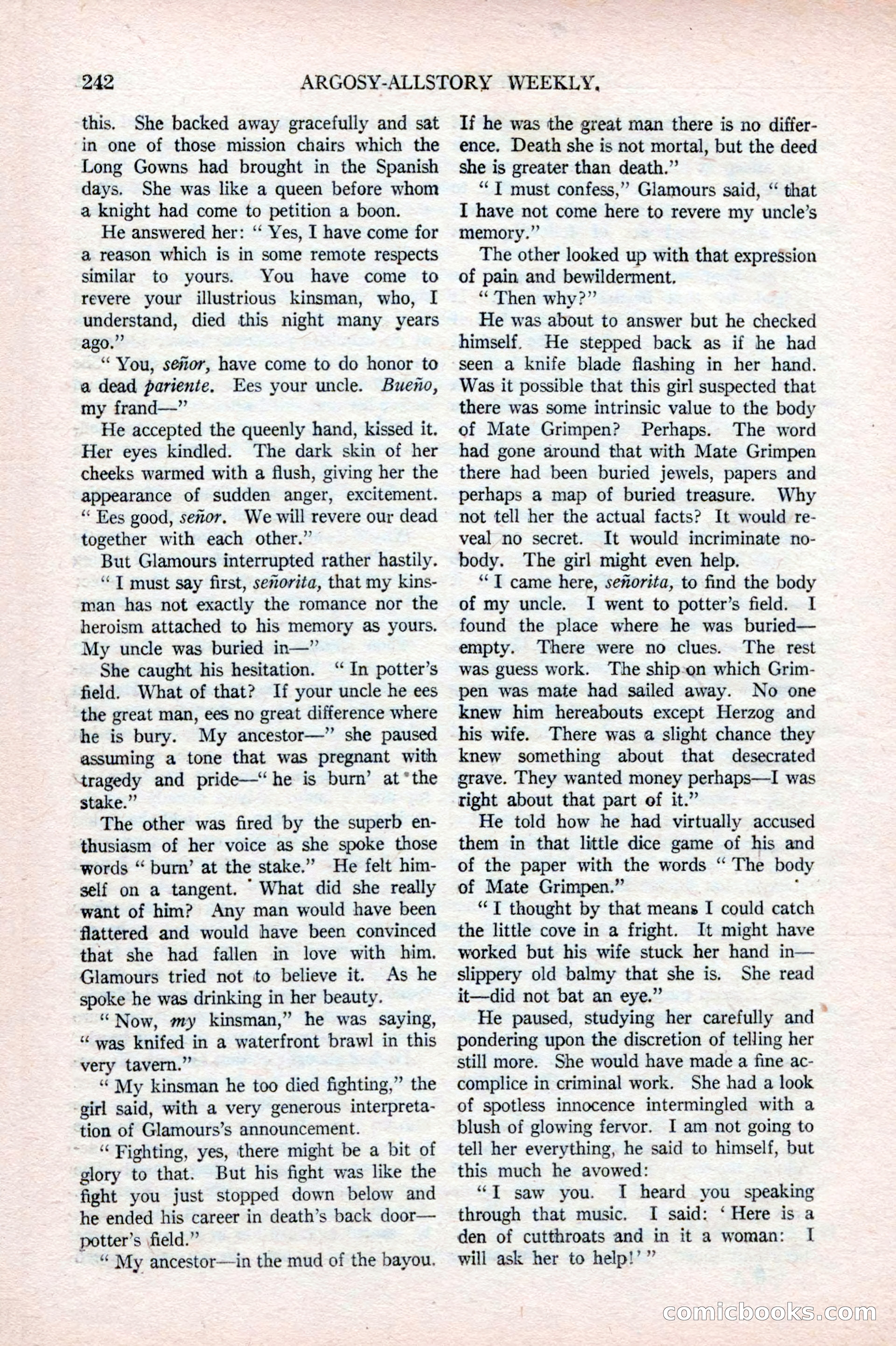
A restored page from Pulp Fiction, 1924. Page through the whole issue in the reader above.
📄 Transcribed text from this page (OCR, searchable)
Machine-transcribed from the original scan — historical spelling and the odd misread are preserved.
242 this. She backed away gracefully and sat in one of those mission chairs which the Long Gowns had brought in the Spanish days. She was like a queen before whom a knight had come to petition a boon. He answered her: ‘‘ Yes, I have come for a reason which is in some remote respects similar to yours. You have come to revere your illustrious kinsman, who, [I understand, died this night many years ago.” “You, sefior, have come to do honor to a dead pariente. Ees your uncle. Bueno, my frand—” He accepted the queenly hand, kissed it. Her eyes kindled. The dark skin of her cheeks warmed with a flush, giving her the appearance of sudden anger, excitement. “ Ees good, senor. We will revere our dead together with each other.” But Glamours interrupted rather hastily. ‘“T must say first, senorita, that my kins- man has not exactly the romance nor the heroism attached to his memory as yours. My uncle was buried in—”’ She caught his hesitation. “In potter’s field. What of that? If your uncle he ees the great man, ees no great difference where he is bury. My ancestor—” she paused assuming a tone that was pregnant with ‘tragedy and pride—“ he is burn’ at *the stake.” The other was fired by the superb en- thusiasm of her voice as she spoke those words “ burn’ at the stake.” He felt him- self on a tangent. What did she really want of him? Any man would have been flattered and would have been convinced that she had fallen in love with him. Glamours tried not to believe it. As he spoke he was drinking in her beauty. “Now, my kinsman,” he was saying, “ was knifed in a waterfront brawl in this very tavern.” “My kinsman he too died fighting,” the -girl said, with a very generous interpreta- tion of Glamours’s announcement. “ Fighting, yes, there might be a bit of glory to that. But his fight was like the fight you just stopped down below and he ended his career in death’s back door— potter’s field.” “ My ancestor—in the mud of the bayou. ARGOSY-ALLSTORY WEEKLY, If he was the great man there is no differ- ence. Death she is not mortal, but the deed she is greater than death.” ‘“*] must confess,” Glamours said, “ that I have not come here to revere my uncle’s memory.” The other looked up with that expression of pain and bewilderment. “Then why?” He was about to answer but he checked himself. He stepped back as if he had seen a knife blade flashing in her hand. Was it possible that this girl suspected that there was some intrinsic value to the body of Mate Grimpen? Perhaps. The word had gone around that with Mate Grimpen there had been buried jewels, papers and perhaps a map of buried treasure. Why not tell her the actual facts? It would re- veal no secret. It would incriminate no- body. The girl might even help. “IT came here, sevorita, to find the body of my uncle. I went to potter’s field. I found the place where he was buried— empty. There were no clues. The rest was guess work. The ship-on which Grim- pen was mate had sailed away. No one knew him hereabouts except Herzog and his wife. There was a slight chance they knew something about that desecrated grave. They wanted money perhaps—lI was right about that part of it.” He told how he had virtually accused them in that little dice game of his and of the paper with the words “ The body of Mate Grimpen.” : “T thought by that means I could catch the little cove in a fright. It might have worked but his wife stuck her hand in— slippery old balmy that she is. She read it—did not bat an eye.” He paused, studying her carefully and pondering upon the discretion of telling her still more. She would have made a fine ac- complice in criminal work. She had a look of spotless innocence intermingled with a blush of glowing fervor. I am not going to tell her everything, he said to himself, but this much he avowed: “T saw you. I heard you speaking through that music. I said: ‘ Here is a den of cutthroats and in it a woman: I will ask her to help!’ ” CoOmmicloool< (C@