
Pulp Fiction, 1924 · page 91 of 172
Argosy All-Story Weekly, May 17, 1924 — page 91: what you’re looking at
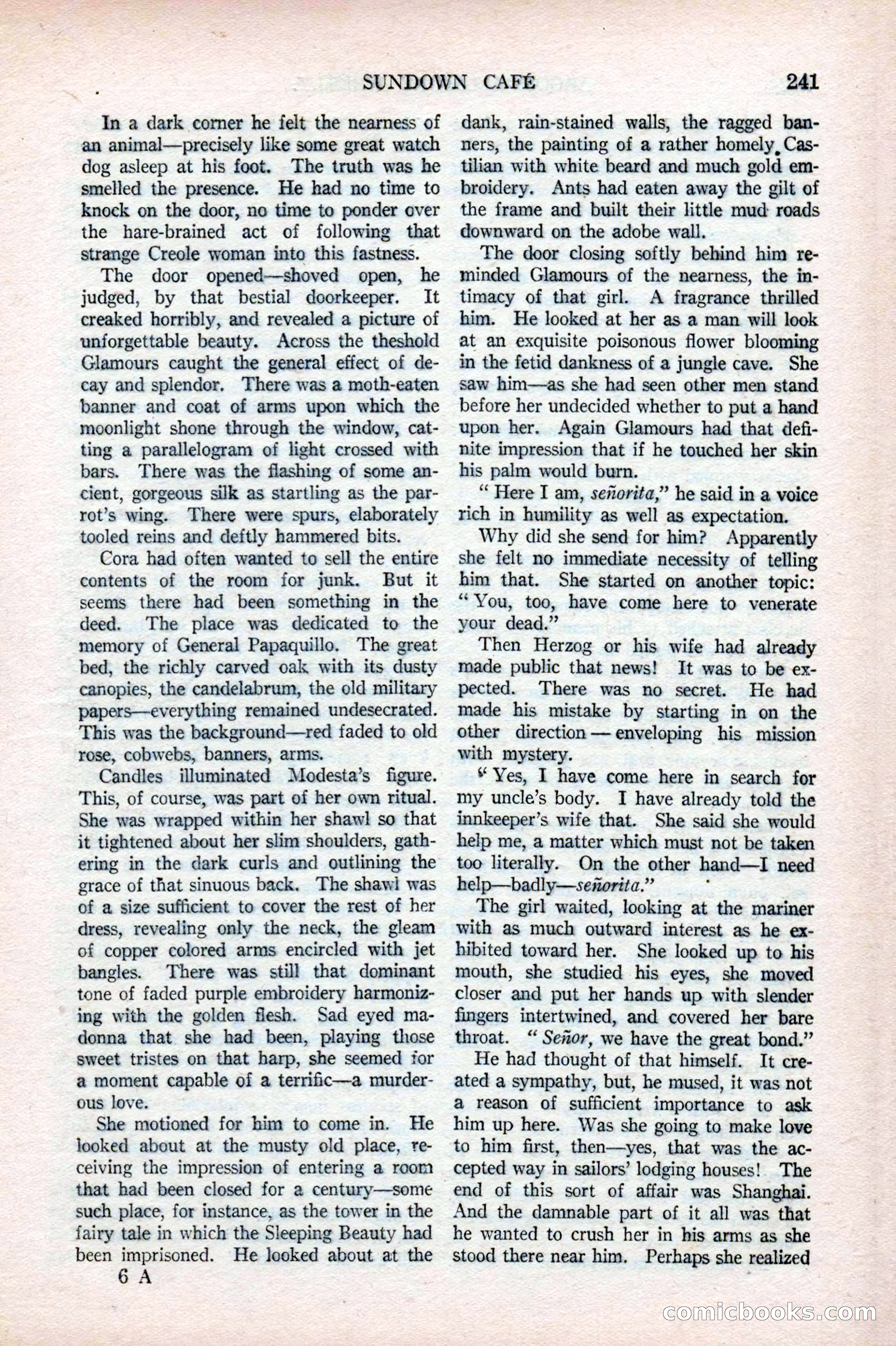
A restored page from Pulp Fiction, 1924. Page through the whole issue in the reader above.
📄 Transcribed text from this page (OCR, searchable)
Machine-transcribed from the original scan — historical spelling and the odd misread are preserved.
SUNDOWN CAFE In a dark corner he felt the nearness of an animal—precisely like some great watch dog asleep at his foot. The truth was he smelled the presence. He had no time to knock on the door, no time to ponder over the hare-brained act of following that strange Creole woman into this fastness. The door opened—shoved open, he judged, by that bestial doorkeeper. It creaked horribly, and revealed a picture of unforgettable beauty. Across the theshold Glamours caught the general effect of de- cay and splendor. There was a moth-eaten banner and coat of arms upon which the moonlight shone through the window, cat- ting a parallelogram of light crossed with bars. There was the flashing of some an- cient, gorgeous silk as startling as the par- rot’s wing. There were spurs, elaborately tooled reins and deftly hammered bits. Cora had often wanted to sell the entire contents of the room for junk. But it seems there had been something in the deed. The place was dedicated to the memory of General Papaquillo. The great bed, the richly carved oak with its dusty canopies, the candelabrum, the old military papers—everything remained undesecrated. This was the background—red faded to old rose, cobwebs, banners, arms. Candles illuminated Modesta’s figure. This, of course, was part of her own ritual. She was wrapped within her shawl so that it tightened about her slim shoulders, gath- ering in the dark curls and outlining the grace of that sinuous back. The shawl was of a size sufficient to cover the rest of her dress, revealing only the neck, the gleam of copper colored arms encircled with jet bangles. There was still that dominant tone of faded purple embroidery harmoniz- ing with the golden flesh. Sad eyed ma- donna that she had been, playing those sweet tristes on that harp, she seemed for a moment capable of a terrific—a murder- ous love. She motioned for him to come in. He looked about at the musty old place, re- ceiving the impression of entering a room that had been closed for a century—some such place, for instance, as the tower in the fairy tale in which the Sleeping Beauty had been imprisoned. He looked about at the 6A 241 dank, rain-stained walls, the ragged ban- ners, the painting of a rather homely, Cas- tilian with white beard and much gold em- broidery. Ants had eaten away the gilt of the frame and built their little mud roads downward on the adobe wall. The door closing softly behind him re- minded Glamours of the nearness, the in- timacy of that girl. A fragrance thrilled him. He looked at her as a man will look at an exquisite poisonous flower blooming in the fetid dankness of a jungle cave. She saw him—as she had seen other men stand before her undecided whether to put a hand upon her. Again Glamours had that defi- nite impression that if he touched her skin his palm would burn. “Here I am, sevorita,” he said in a voice rich in humility as well as expectation. Why did she send for him? Apparently she felt no immediate necessity of telling him that. She started on another topic: “You, too, have come here to venerate your dead.” Then Herzog or his wife had already made public that news! It was to be ex- pected. There was no secret. He had made his mistake by starting in on the other direction— enveloping his mission with mystery. “Yes, I have come here in search for my uncle’s body. I have already told the innkeeper’s wife that. She said she would help me, a matter which must not be taken too literally. On the other hand—I need help—badly—senorita,”’ : The girl waited, looking at the mariner with as much outward interest as he ex- hibited toward her. She looked up to his mouth, she studied his eyes, she moved closer and put her hands up with slender fingers intertwined, and covered her bare throat. “ Senor, we have the great bond.” He had thought of that himself. It cre- ated a sympathy, but, he mused, it was not a reason of sufficient importance to ask him up here. Was she going to make love to him first, then—yes, that was the ac- cepted way in sailors’ lodging houses! The end of this sort of affair was S l. And the damnable part of it all was that he wanted to crush her in his arms as she stood there near him. Perhaps she realized COMMICLMOookKks (C@