
Pulp Fiction, 1924 · page 152 of 186
Argosy All-Story Weekly, May 3, 1924 — page 152: what you’re looking at
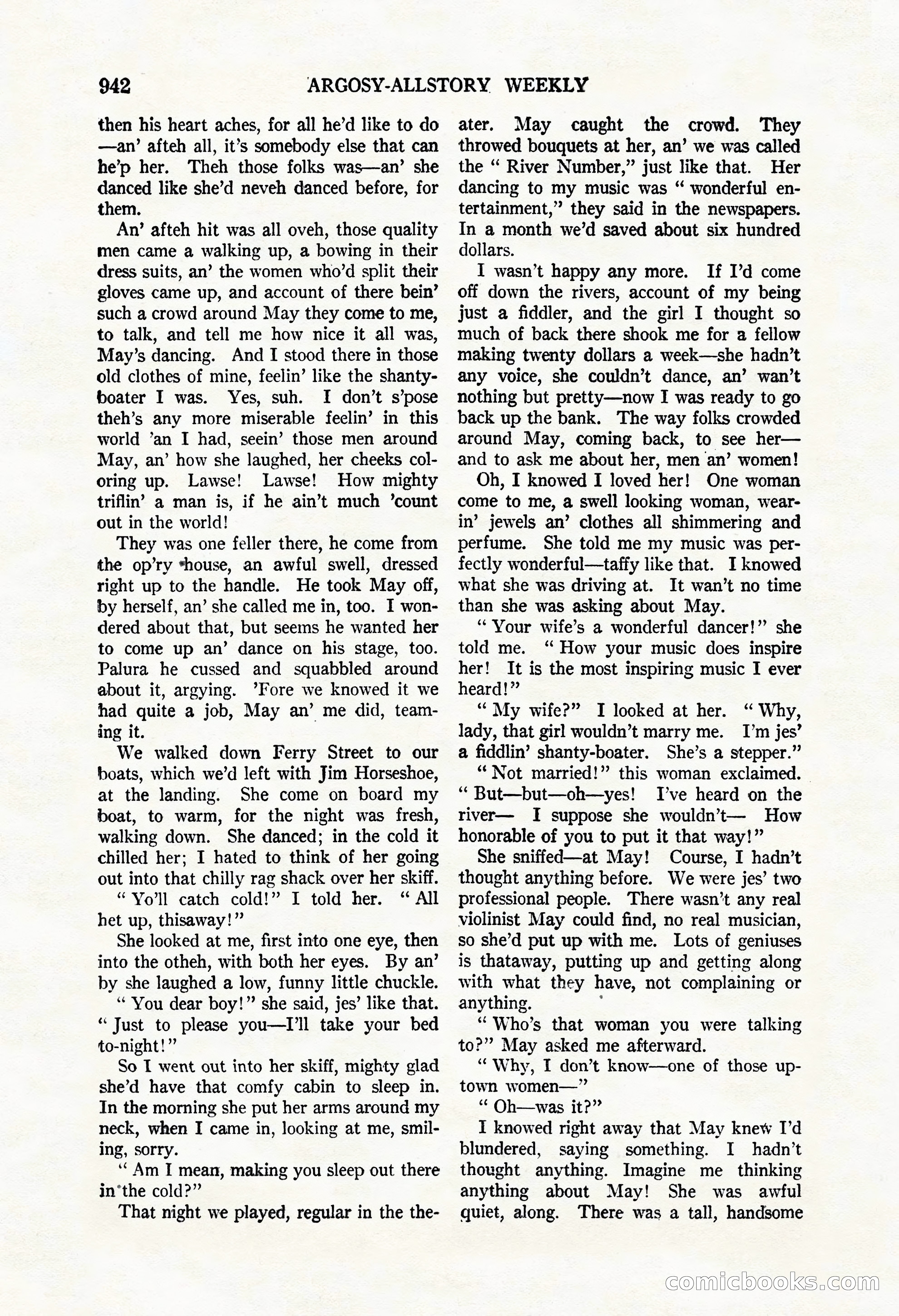
A restored page from Pulp Fiction, 1924. Page through the whole issue in the reader above.
📄 Transcribed text from this page (OCR, searchable)
Machine-transcribed from the original scan — historical spelling and the odd misread are preserved.
942 then his heart aches, for all he’d like to do —an’ afteh all, it’s somebody else that can he’p her. Theh those folks was—an’ she danced like she’d neveh danced before, for them. An’ afteh hit was all oveh, those quality men came a walking up, a bowing in their dress suits, an’ the women who'd split their gloves came up, and account of there bein’ such a crowd around May they come to me, to talk, and tell me how nice it all was, May’s dancing. And I stood there in those old clothes of mine, feelin’ like the shanty- boater I was. Yes, suh. I don’t s’pose theh’s any more miserable feelin’ in this world ’an I had, seein’ those men around May, an’ how she laughed, her cheeks col- oring up. Lawse! Lawse! How mighty triflin’ a man is, if he ain’t much ’count out in the world! They was one feller there, he come from the op’ry thouse, an awful swell, dressed right up to the handle. He took May off, by herself, an’ she called me in, too. I won- dered about that, but seems he wanted her to come up an’ dance on his stage, too. Palura he cussed and squabbled around about it, argying. ’Fore we knowed it we had quite a job, May an’ me did, team- ing it. We walked down Ferry Street to our boats, which we’d left with Jim Horseshoe, at the landing. She come on board my boat, to warm, for the night was fresh, walking down. She danced; in the cold it chilled her; I hated to think of her going out into that chilly rag shack over her skiff. “ Yo'll catch cold!” I told her. ‘“ All het up, thisaway!” She looked at me, first into one eye, then into the otheh, with both her eyes. By an’ by she laughed a low, funny little chuckle. “You dear boy!” she said, jes’ like that. “ Just to please you—I’ll take your bed to-night!” So I went out into her skiff, mighty glad she’d have that comfy cabin to sleep in. In the morning she put her arms around my neck, when I came in, looking at me, smil- ing, sorry. ‘“ Am I mean, making you sleep out there in‘the cold?” That night we played, regular in the the- ARGOSY-ALLSTORY WEEKLY ater. May caught the crowd. They throwed bouquets at her, an’ we was called the “ River Number,” just like that. Her dancing to my music was “ wonderful en- tertainment,” they said in the newspapers. In a month we’d saved about six hundred dollars. I wasn’t happy any more. If I’d come off down the rivers, account of my being just a fiddler, and the girl I thought so much of back there shook me for a fellow making twenty dollars a week—she hadn’t any voice, she couldn’t dance, an’ wan’t nothing but pretty—now I was ready to go back up the bank. The way folks crowded around May, coming back, to see her— and to ask me about her, men an’ women! Oh, I knowed I loved her! One woman come to me, a swell looking woman, wear- in’ jewels an’ clothes all shimmering and perfume. She told me my music was per- fectly wonderful—taffy like that. I knowed what she was driving at. It wan’t no time than she was asking about May. ‘Your wife’s a wonderful dancer!” she told me. ‘“ How your music does inspire her! It is the most inspiring music I ever heard!” “My wife?” I looked at her. lady, that girl wouldn’t marry me. a fiddlin’ shanty-boater. 6“ Why, I’m jes’ She’s a stepper.” “Not married!”’ this woman exclaimed. | ‘“* But—but—oh—yes! I’ve heard on the river— I suppose she wouldn’t— How honorable of you to put it that way!” She sniffed—at May! Course, I hadn’t thought anything before. We were jes’ two professional people. There wasn’t any real violinist May could find, no real musician, so she’d put up with me. Lots of geniuses is thataway, putting up and getting along with what they have, not complaining or anything. “Who’s that woman you were talking to?” May asked me afterward. “Why, I don’t know—one of those up- town women—” ‘“‘ Oh—was it?” I knowed right away that May knew I’d blundered, saying something. I hadn’t thought anything. Imagine me _ thinking anything about May! She was awful quiet, along. There was a tall, handsome comniiclooo! S (©