
Pulp Fiction, 1924 · page 151 of 186
Argosy All-Story Weekly, May 3, 1924 — page 151: what you’re looking at
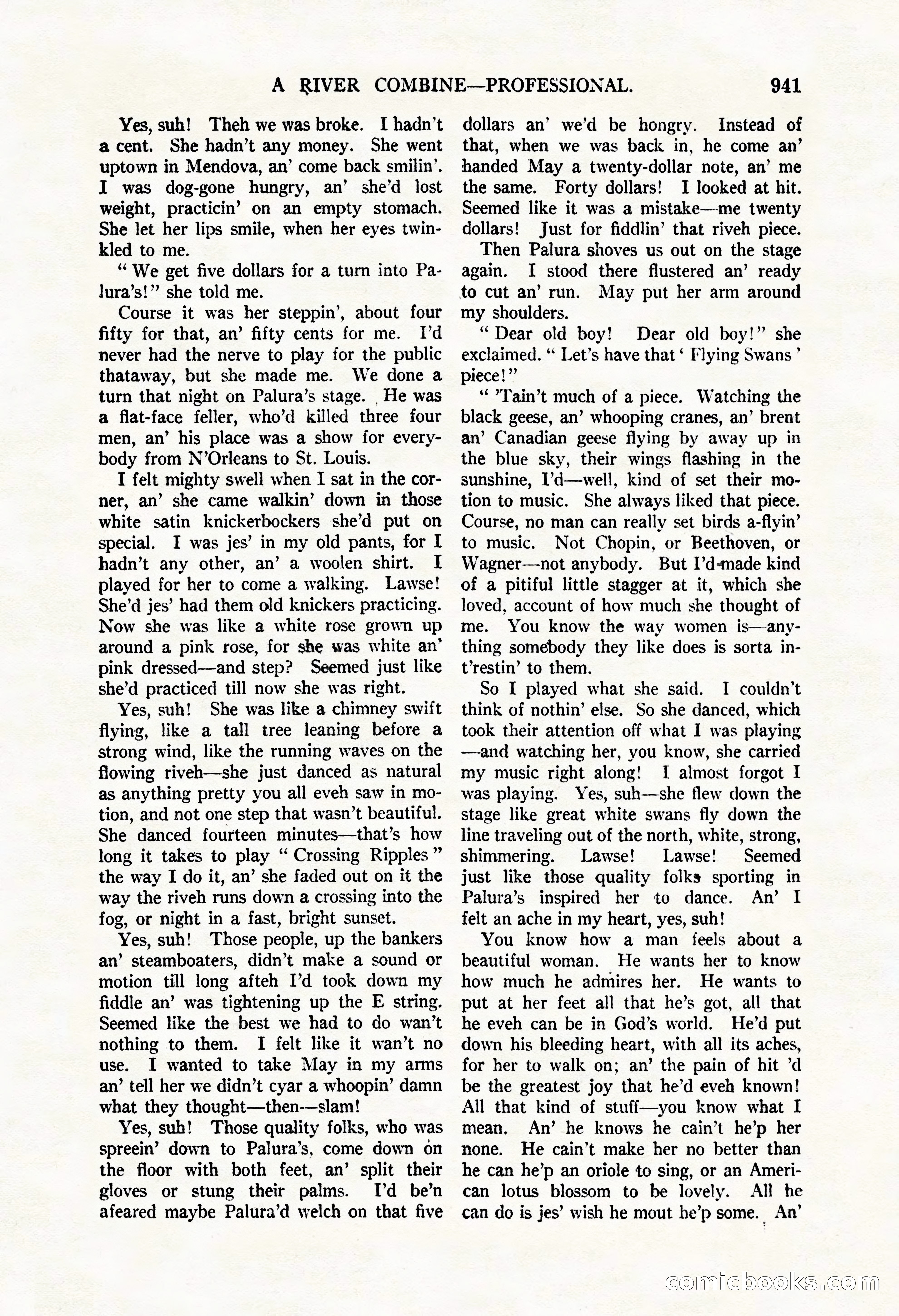
A restored page from Pulp Fiction, 1924. Page through the whole issue in the reader above.
📄 Transcribed text from this page (OCR, searchable)
Machine-transcribed from the original scan — historical spelling and the odd misread are preserved.
A RIVER COMBINE—PROFESSIONAL. Yes, suh! Theh we was broke. I hadn't a cent. She hadn’t any money. She went uptown in Mendova, an’ come back smilin’. I was dog-gone hungry, an’ she’d lost weight, practicin’ on an empty stomach. She let her lips smile, when her eyes twin- kled to me. ““'We get five dollars for a turn into Pa- lura’s!”’ she told me. Course it was her steppin’, about four fifty for that, an’ fifty cents for me. I'd never had the nerve to play for the public thataway, but she made me. We done a turn that night on Palura’s stage. He was a flat-face feller, who’d killed three four men, an’ his place was a show for every- body from N’Orleans to St. Louis. I felt mighty swell when I sat in the cor- ner, an’ she came walkin’ down in those white satin knickerbockers she’d put on special. I was jes’ in my old pants, for I hadn’t any other, an’ a woolen shirt. I played for her to come a walking. Lawse! She’d jes’ had them old knickers practicing. Now she was like a white rose grown up around a pink rose, for she was white an’ pink dressed—and step? Seemed just like she’d practiced till now she was right. Yes, suh! She was like a chimney swift flying, like a tall tree leaning before a strong wind, like the running waves on the flowing riveh—she just danced as natural as anything pretty you all eveh saw in mo- tion, and not one step that wasn’t beautiful. She danced fourteen minutes—that’s how long it takes to play “ Crossing Ripples” the way I do it, an’ she faded out on it the way the riveh runs down a crossing into the fog, or night in a fast, bright sunset. Yes, suh! Those people, up the bankers an’ steamboaters, didn’t make a sound or motion till long afteh I'd took down my fiddle an’ was tightening up the E string. Seemed like the best we had to do wan’t nothing to them. I felt like it wan’t no use. I wanted to take May in my arms an’ tell her we didn’t cyar a whoopin’ damn what they thought—then-—slam! Yes, suh! Those quality folks, who was spreein’ down to Palura’s, come down on the floor with both feet, an’ split their gloves or stung their palms. I'd be’n afeared maybe Palura’d welch on that five to cut an’ run. 941 dollars an’ we'd be hongry. Instead of that, when we was back in, he come an’ handed May a twenty-dollar note, an’ me the same. Forty dollars! I looked at hit. Seemed like it was a mistake—-me twenty dollars!’ Just for fiddlin’ that riveh piece. Then Palura shoves us out on the stage again. I stood there flustered an’ ready May put her arm around my shoulders. “Dear old boy! Dear old boy!” she exclaimed. “ Let’s have that ‘ Flying Swans ’ piece!” * *Tain’t much of a piece. Watching the black geese, an’ whooping cranes, an’ brent an’ Canadian geese flying by away up in the blue sky, their wings flashing in the sunshine, I’d—well, kind of set their mo- tion to music. She always liked that piece. Course, no man can really set birds a-flyin’ to music. Not Chopin, or Beethoven, or Wagner-——not anybody. But I’d-made kind of a pitiful little stagger at it, which she loved, account of how much she thought of me. You know the way women is—any- thing somebody they like does is sorta in- t’restin’ to them. So I played what she said. I couldn't think of nothin’ else. So she danced, which took their attention off what I was playing —and watching her, you know, she carried my music right along! I almost forgot I was playing. Yes, suh—she flew down the stage like great white swans fly down the line traveling out of the north, white, strong, shimmering. Lawse! Lawse! Seemed just like those quality folks sporting in Palura’s inspired her to dance. An’ I felt an ache in my heart, yes, suh! You know how a man feels about a beautiful woman. He wants her to know how much he admires her. He wants to put at her feet all that he’s got, all that he eveh can be in God’s world. He’d put down his bleeding heart, with all its aches, for her to walk on; an’ the pain of hit ’d be the greatest joy that he’d eveh known! All that kind of stuffi—you know what I mean. An’ he knows he cain’t he’p her none. He cain’t make her no better than he can he’p an oriole to sing, or an Ameri- can lotus blossom to be lovely. All he can do is jes’ wish he mout he’p some. An’ COMIC OOo! S (©