
Pulp Fiction, 1924 · page 17 of 166
Argosy All-Story Weekly, February 23, 1924 — page 17: what you’re looking at
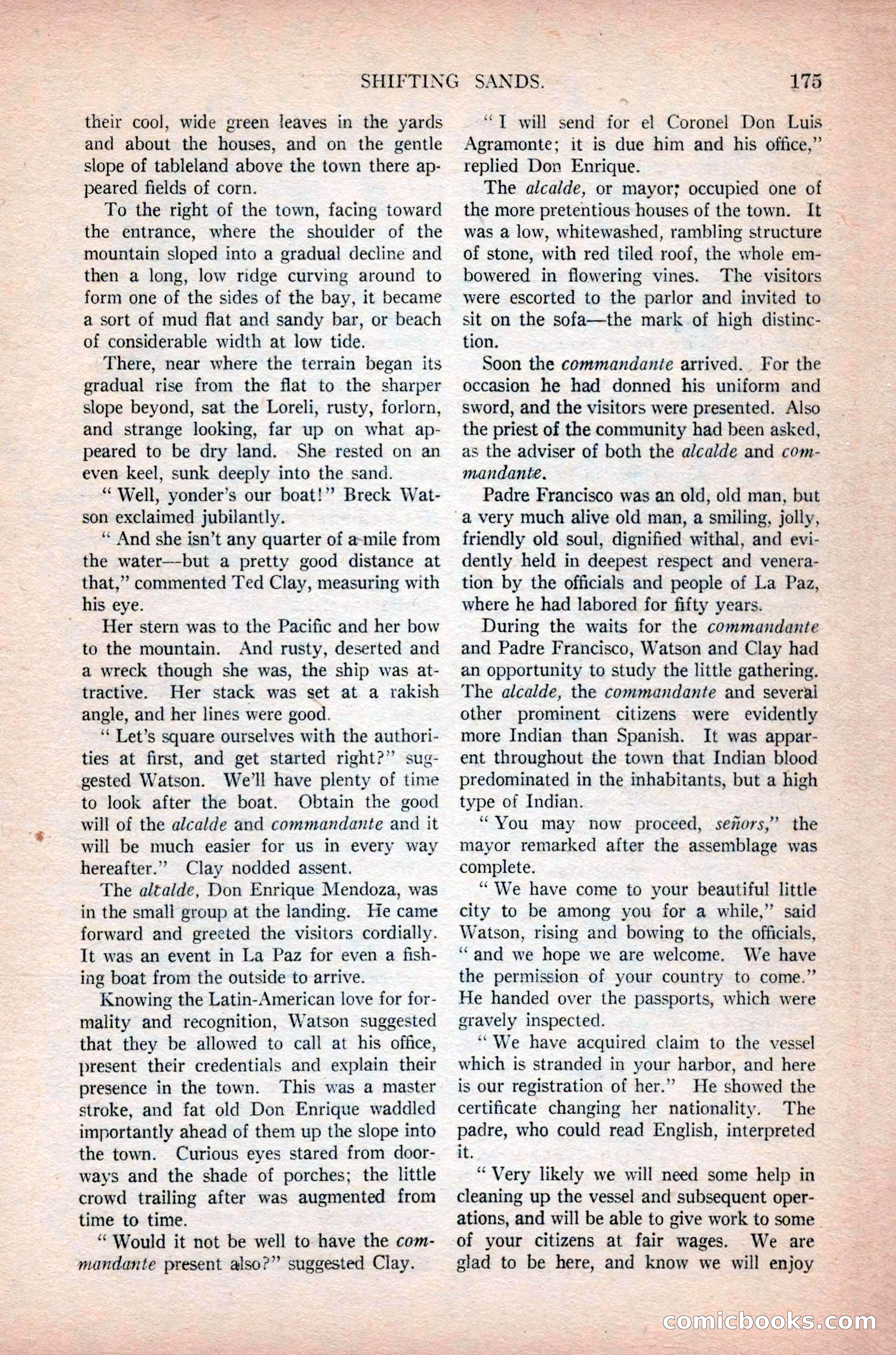
A restored page from Pulp Fiction, 1924. Page through the whole issue in the reader above.
📄 Transcribed text from this page (OCR, searchable)
Machine-transcribed from the original scan — historical spelling and the odd misread are preserved.
SHIFTING SANDS. their cool, wide green leaves in the yards and about the houses, and on the gentle slope of tableland above the town there ap- peared fields of corn. To the right of the town, facing toward the entrance, where the shoulder of the mountain sloped into a gradual decline and then a long, low ridge curving around to form one of the sides of the bay, it became a sort of mud flat and sandy bar, or beach of considerable width at low tide. There, near where the terrain began its gradual rise from the flat to the sharper slope beyond, sat the Loreli, rusty, forlorn, and strange looking, far up on what ap- peared to be dry land. She rested on an even keel, sunk deeply into the sand. “ Well, yonder’s our boat!” Breck Wat- son exclaimed jubilantly. ‘“ And she isn’t any quarter of a-mile from the water—but a pretty good distance at that,” commented Ted Clay, measuring with his eye. Her stern was to the Pacific and her bow to the mountain. And rusty, deserted and a wreck though she was, the ship was at- tractive. Her stack was set at a rakish angle, and her lines were good. ‘‘ Let’s square ourselves with the authori- ties at first, and get started right?” sug- gested Watson. We'll have plenty of time to look after the boat. Obtain the good will of the alcalde and commandante and it will be much easier for us in every way hereafter.” Clay nodded assent. The altalde, Don Enrique Mendoza, was in the small group at the landing. He came forward and greeted the visitors cordially. It was an event in La Paz for even a fish- ing boat from the outside to arrive. Knowing the Latin-American love for for- mality and recognition, Watson suggested that they be allowed to call at his office, present their credentials and explain their presence in the town. This was a master stroke, and fat old Don Enrique waddled importantly ahead of them up the slope into the town. Curious eyes stared from door- ways and the shade of porches; the little crowd trailing after was augmented from time to time. “Would it not be well to have the com- mandante present also?” suggested Clay. 175 ~. ‘““T will send for el Coronel Don Luis— Agramonte; it is due him and his office,” replied Don Enrique. The alcalde, or mayor; occupied one of the more pretentious houses of the town. It was a low, whitewashed, rambling structure of stone, with red tiled roof, the whole em- bowered in flowering vines. The visitors were escorted to the parlor and invited to sit on the sofa—the mark of high distinc- tion. Soon the commandante arrived. For the occasion he had donned his uniform and sword, and the visitors were presented. Also the priest of the community had been asked, as the adviser of both the alcalde and com- mandante. Padre Francisco was an old, old man, but a very much alive old man, a smiling, jolly, friendly old soul, dignified withal, and evi- dently held in deepest respect and venera- tion by the officials and people of La Paz, where he had labored for fifty years. During the waits for the commandante and Padre Francisco, Watson and Clay had an opportunity to study the little gathering. The alcalde, the commandante and several other prominent citizens were evidently more Indian than Spanish. It was appar- ent throughout the town that Indian blood predominated in the inhabitants, but a high type of Indian. “You may now proceed, sefors,” the mayor remarked after the assemblage was complete. “We have come to your beautiful little city to be among you for a while,” said Watson, rising and bowing to the officials, ‘“and we hope we are welcome. We have the permission of your country to come.” He handed over the passports, which were gravely inspected. “We have acquired claim to the vessel which is stranded in your harbor, and here is our registration of her.’”’ He showed the certificate changing her nationality. The padre, who could read English, interpreted it. “Very likely we will need some help in cleaning up the vessel and subsequent oper- ations, and will be able to give work to some of your citizens at fair wages. We are glad to be here, and know we will enjoy “S) GComichboo (E(0)