
Pulp Fiction, 1924 · page 16 of 166
Argosy All-Story Weekly, February 23, 1924 — page 16: what you’re looking at
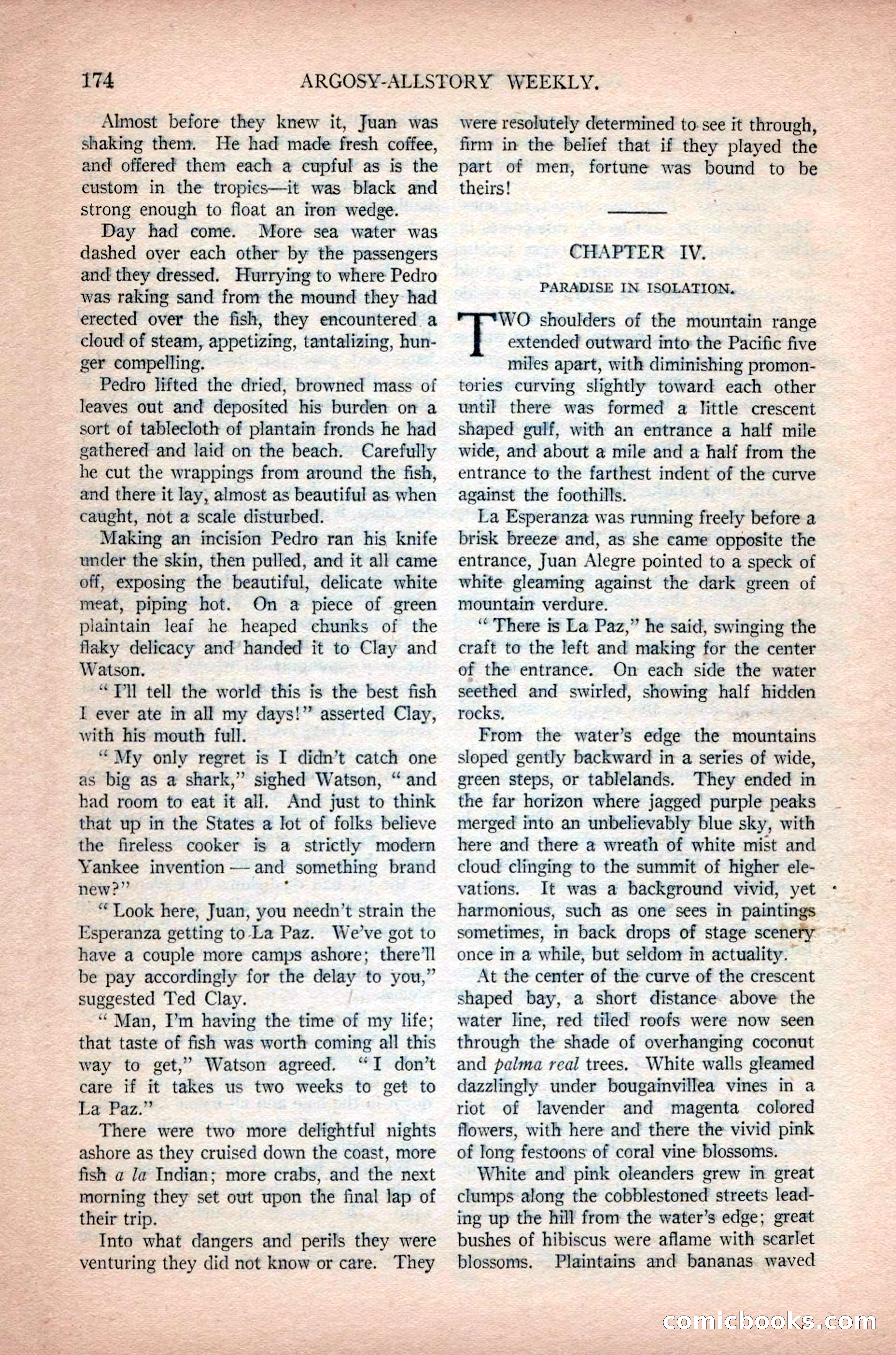
A restored page from Pulp Fiction, 1924. Page through the whole issue in the reader above.
📄 Transcribed text from this page (OCR, searchable)
Machine-transcribed from the original scan — historical spelling and the odd misread are preserved.
mine’ eps F< = — aa ae S —, a *¢ + « 174 Almost before they knew it, Juan was shaking them. He had made fresh coffee, and offered them each a cupful as is the eustom in the tropics—it was black and strong enough to float an iron wedge. Day had come. More sea water was dashed over each other by the passengers and they dressed. Hurrying to where Pedro was raking sand from the mound they had erected over the fish, they encountered a cloud of steam, appetizing, tantalizing, hun- - ger compelling. Pedro lifted the dried, browned mass of leaves out and deposited his burden on a sort of tablecloth of plantain fronds he had gathered and laid on the beach. Carefully he cut the wrappings from around the fish, and there it lay, almost as beautiful as when caught, not a scale disturbed. Making an incision Pedro ran his knife under the skin, then pulled, and it all came off, exposing the beautiful, delicate white meat, piping hot. On a piece of green plaintain leaf he heaped chunks of the flaky delicacy and handed it to Clay and Watson. “Tl tell the world this is the best fish I ever ate in all my days!” asserted Clay, with his mouth full. “My only regret is I didn’t catch one as big as a shark,” sighed Watson, “ and had room to eat it all. And just to think that up in the States a lot of folks believe the fireless cooker is a strictly modern Yankee invention — and something brand new?” : “Look here, Juan, you needn’t strain the Esperanza getting to-La Paz. We've got to have a couple more camps ashore; there’ll be pay accordingly for the delay to you,” suggested Ted Clay. “Man, I’m having the time of my life; that taste of fish was worth coming all this way to get,” Watson agreed. “I don’t care if it takes us two weeks to get to La-tez.” There were two more delightful nights ashore as they cruised down the coast, more fish a la Indian; more crabs, and the next morning they set out upon the final lap of their trip. Into what dangers and perils they were venturing they did not know or care. They ARGOSY-ALLSTORY WEEKLY. were resolutely determined to-see it through, firm in the belief that if they played the part of men, fortune was bound to be theirs! CHAPTER IV. PARADISE IN ISOLATION, WO shoulders of the mountain range extended outward into the Pacific five miles apart, with diminishing promon- tories curving slightly toward each other until there was formed a little crescent shaped gulf, with an entrance a half mile wide, and about a mile and a half from the entrance to the farthest indent of the curve against the foothills. La Esperanza was running freely before a brisk breeze and, as she came opposite the entrance, Juan Alegre pointed to a speck of white gleaming against the dark green of mountain verdure. ‘There is La Paz,” he said, swinging the craft to the left and making for the center of the entrance. On each side the water seethed and swirled, showing half hidden rocks, | From the water’s edge the mountains sloped gently backward in a series of wide, green steps, or tablelands. They ended in the far horizon where jagged purple peaks merged into an unbelievably blue sky, with here and there a wreath of white mist and cloud clinging to the summit of higher ele- vations. harmonious, such as one sees in paintings sometimes, in back drops of stage scenery once in a while, but seldom in actuality. — At the center of the curve of the crescent shaped bay, a short distance above the water line, red tiled roofs were now seen through the shade of overhanging coconut and palma real trees. White walls gleamed dazzlingly under bougainvillea vines in a riot of lavender and magenta colored flowers, with here and there the vivid pink of long festoons of coral vine blossoms. White and pink oleanders grew in great clumps along the cobblestoned streets lead- ing up the hill from the water’s edge; great bushes of hibiscus were aflame with scarlet blossoms. Plaintains and bananas waved CEOPMIC OO KS It was a background vivid, yet - (E@)