
Pulp Fiction, 1923 · page 47 of 196
Argosy All-Story Weekly, October 6, 1923 — page 47: what you’re looking at
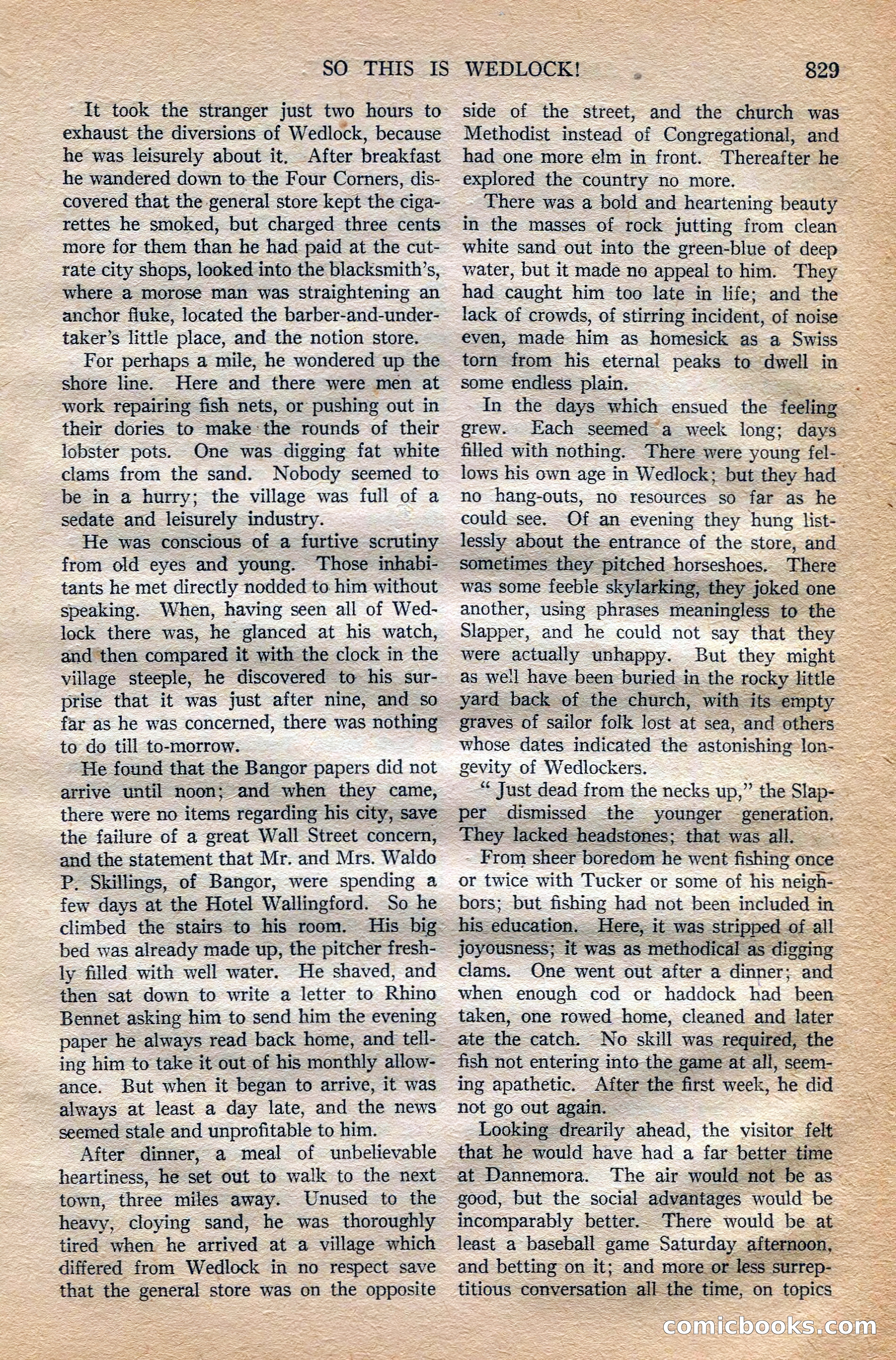
A restored page from Pulp Fiction, 1923. Page through the whole issue in the reader above.
📄 Transcribed text from this page (OCR, searchable)
Machine-transcribed from the original scan — historical spelling and the odd misread are preserved.
SO THIS IS At ook the stranger just two hours to exhaust the diversions of Wedlock, because he was leisurely about it, After breakfast ~ he wandered down to the Four Corners, dis- covered that the general store kept the ciga- rettes he smoked, but charged three cents more for them than he had paid at the cut- rate city shops, looked into the blacksmith’s, where a morose man was straightening an anchor fiuke, located the barber-and-under- taker’s little place, and the notion store. For perhaps a mile, he wondered up the shore line. Here and there were men at work repairing fish nets, or pushing out in their dories to make: the rounds of their lobster pots. One was digging fat white clams from the sand. Nobody seemed to be in a hurry; the village was full of a - sedate and leisurely industry. He was conscious of a furtive scrutiny from old eyes and young. Those inhabi- tants he met directly nodded to him without speaking. When, having seen all of Wed- lock there was, he glanced at his watch, and then compared it with the clock in the village steeple, he discovered to his sur- prise that it was just after nine, and so far as he was concerned, there was nothing to do till to-morrow. He found that the Bangor papers did not arrive until noon; and when they came, there were no items regarding his city, save the failure of a great Wall Street concern, and the statement that Mr. and Mrs. Waldo P. Skillings, of Bangor, were spending a few days at the Hotel Wallingford. So he climbed the stairs to his room. His hbig- bed was already made up, the pitcher fresh- ly filled with well water. He shaved, and then sat down to write a letter to Rhino Bennet asking him to send him the evening paper he always read back home, and tell-_ ing him to take it out of his monthly allow- ance. But when it began to arrive, it was always at least a day late, and the news seemed stale and unprofitable to him. After dinner, a meal of unbelievable heartiness, he set out to walk to the next town, fice miles away. Unused to the heavy cloying sand, he was thoroughly tired when he arrived at a village which _ differed from Wedlock in no respect save that the general store was on the opposite WEDLOCK! side of the street, and the church was Methodist instead of Congregational, and had one more e!lm in front. Thereafter he explored the country no more. There was a bold and heartening beauty mi the masses of rock jutting from clean white sand out into the green-blue of deep water, but it made ne appeal to him. They had caught him too late in life; and the lack of crowds, of stirring incident, of noise: even, made him as homesick as a Swiss torn from his eternal peaks to dwell: in some endless plain. In the days which ensued the fedling. grew. Each seemed a week long; days- filled with nothing. There were young fel- lows his own age in Wedlock; but they had no hang-outs, no resources so far as he — Of an evening they hung list-— could ‘see. lessly about the entrance of the store, and sometimes they pitched horseshoes. There was some feeble skylarking, they joked one another, using phrases meaningless to ie Slapper, and he could not say that they were actually unhappy. But they might — as weil have been buried in the rocky little - = es yard back of the church, with. its empty — graves of sailor folk lost at sea, and others whose dates indicated the astonishing Lu 5 gevity of Wedlockers. “€ Just dead from the necks up,” the Slap- per dismissed the younger So eee They lacked. headstones: that was all. : - From sheer boredom he went fishing once. oe = or twice with Tucker or some of his neigh- bors; but fishing had not been included in = his: education, _ Here, it was stripped of all — _joyousness: it was as methodical as digging — clams. One went out after a dinner; and — when enough cod or haddock had been — taken, one rowed home, cleaned and later _ ate the catch. No skill was required, the fish not entering into the game at all,seem- ing apathetic. After the first week, he did not go out again. Looking drearily ahead, the visitor tee that he would have had a far better time — at Dannemora. The air would not be as” good, but the social advantages would be = incomparably better.. There would be at least a baseball game Saturday aleeeoo SS and betting on it; and more or less surrep-— titious conversation ) all: the time, on topics == = ™a co m lek boo ‘Si 16 O mn =